Abandon all hope at the Your Party hustings
Of all the questions to ask Jeremy Corbyn at the beginning of a political hustings, “What is your vision for the future of Your Party in five years’ time?” is not the kindest. To a cynic, it could almost sound as if that question – from a Your Party member called Charlie, apparently – was chosen to remind the audience that in five years’ time, Corbyn will be 81 years old.
This week, Your Party has chosen its national and regional leaders from the groups that have been fighting for control of the project since it began. First they argued about whether they had in fact launched a party; then they disagreed over the name; then they fought over whether to let any members in; then they debated and eventually chose a name (the same name everyone else had been using to describe them for five months). For extra drama, Zarah Sultana’s faction boycotted their own inaugural conference. So now there are two parties, the Many (Corbyn supporters) and Grassroots Left (Sultana supporters), plus the “independents”, so maybe it’s three parties. None of the groups seem to like each other and all of them insist that Your Party is their party.
The elections – held, with classic Your Party timing, just in time to miss the Gorton and Denton by-election – are an attempt to turn this ongoing fight into a working political operation. And so Your Party has held a series of remote hustings, streamed on YouTube, for the positions on its central executive committee. If you want to know whose party Your Party is – or if you simply have a fetish for mind-numbing tedium – then these hustings are for you.
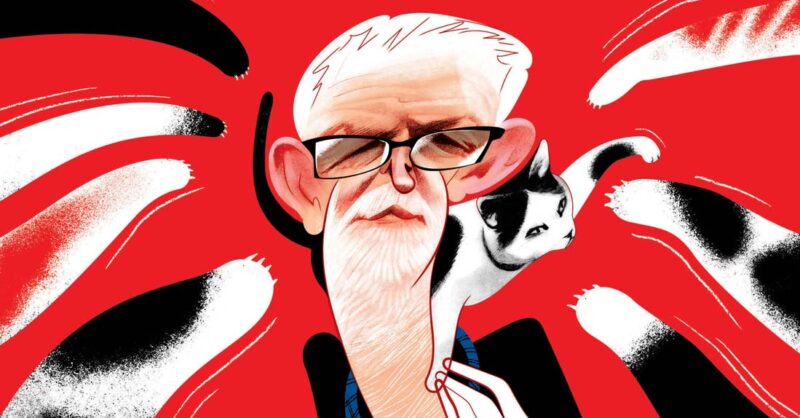
Corbyn had a secret weapon in the form of Keith Fernie, a councillor from Yorkshire so advanced in years he made the former Labour leader look positively middle-aged by contrast. Jezza also had a picture of El Gato, his late cat, in the background. Sultana had an ally in the 22-year-old councillor Grace Lewis, who made her appear more senior by contrast, and who underlined the professionalism of the proceedings by joining the meeting from her car. The candidates were asked when the infighting would end, and Sultana quickly flexed the magnanimity for which she has become known by denouncing a “toxic culture” of “leaks to right-wing journalists, witch hunts, expulsions and smears”.
Subscribe to the New Statesman today for only £1 a week.
Sultana defines her party as not only socialist but “anti-imperialist” and “anti-Zionist”. Your Party is not so much for things as against them. In the London hustings, a young woman declared her opposition to “the far right, the genocide in Palestine and the privatisation of the NHS”, which she said were “all part of the same struggle”. Joe, a former deputy headmaster in the south-west, said he was opposed to “a self-reproducing political party elite”, which sounds fair; the political elite should find someone else to reproduce with, as nature intended. A softly spoken teacher from Hull said he was against “the capitalists… with their tame media and journalists”.
“We want to win everyone to our side, except the far right,” declared one candidate, although it seems that in Your Party, the “far right” is a fairly broad church, encompassing Reform, the Conservatives, the Labour Party in its current form, the county of Surrey, Audi drivers and people who listen to The Archers. Labour is perhaps the most reviled of these groups; the phrase “Labour 2.0” was used repeatedly as the definition of everything Your Party does not want to be.
In the south-east, the hustings didn’t start well. The camera view moved to Ellen, who said nothing, only stared into her screen. “Ellen, can you hear us?” asked the chair. Ellen’s face had the look of someone who has muted a meeting in order to get the online grocery shop finished: bored but intent, eyes tracking across the screen from bagged salad to loo roll. In the north-west, there was another false start as the camera switched to a woman called Sue, sat in her spare room beside a tartan-covered ironing board. Sue squinted at the computer and simply shook her head. Back in the south-east another candidate, minimised in a little window, could be seen having a sneaky vape.
In London a candidate began speaking animatedly, his microphone muted. When this was pointed out, he unmuted and restarted his pitch: “Nuclear war is the most likely since the dawn of time,” he warned, but implied that it could be stopped by a united Your Party central executive committee. The same candidate would later forecast “impending global war”, but also its antidote: an electoral pact with the Green Party.
Every now and then, someone would talk about using “inclusive language”, but this did not mean saying things normal people could understand. It meant saying things like: “Solidarity must be intersectional to be effective.” There was talk of “class enemies” and “political education” and “anti-imperialist resistance” and “using the party as a vehicle to generate new forms of struggle”, which are the kind of things people used to say during China’s Cultural Revolution, but are also the kind of things you say if you’re 29 and still at university. The realisation that you’ve spent a third of your youth, and £90,000 in student debt, on an MPhil in digital humanities is followed naturally by the desire to immolate the power structures around you in the cleansing fire of permanent revolution.
It’s true that every candidate should get a fair hearing, but it’s also true that the British public has heard enough from the shabby, witless clown Piers Corbyn, Jeremy Corbyn’s brother and a candidate in the London hustings, who in 2021 (shortly after the murder of the MP David Amess) told his fellow nutjobs to “hammer to death” MPs and burn down their constituency offices. A conspiracy theorist who believes vaccines made by Bill Gates are used to control the population, Piers Corbyn has distributed leaflets that trivialised the Holocaust and yelled at environmental activists that they are “working for the devil”. Such are the privileges of democracy: Piers Corbyn gets to aim for office, and you get to decide exactly how unfit for office Piers Corbyn is.
As it turned out, the London delegates voted not to hear Piers Corbyn. A person with a shred of dignity would have said, “OK, perhaps I’ll try to inspire less revulsion,” but Piers Corbyn is not that person. “I HAVE BEEN BLOCKED,” he raged from the chat. Trapped with him in the sidebar of inanity was Raj Gill, who politely asked: “Please can someone send me link.” Commenters began a microcampaign to #FreeRajGill from his digital incarceration. A link was emailed and at last Raj, from his sofa, was able to take part.
Of all the candidates, one stood out as a new kind of politician. In the Yorkshire and Humber hustings, there was a woman who described her role as “a mum”. It was immediately clear that she hated public speaking. She looked at the camera as if it were a growling, salivating Dobermann. She was so opposed to political achievement that she ended her candidacy before the hustings had even finished, recommending voters choose two other candidates. What would the world be like if more of our politicians were like that? Introverts, visibly uncomfortable with attention, horrified at the idea of being elected. They’d hate power, and perhaps, for that reason, they’d use it responsibly.
[Further reading: The life and afterlife of Gordon Brown]
Content from our partners
Related