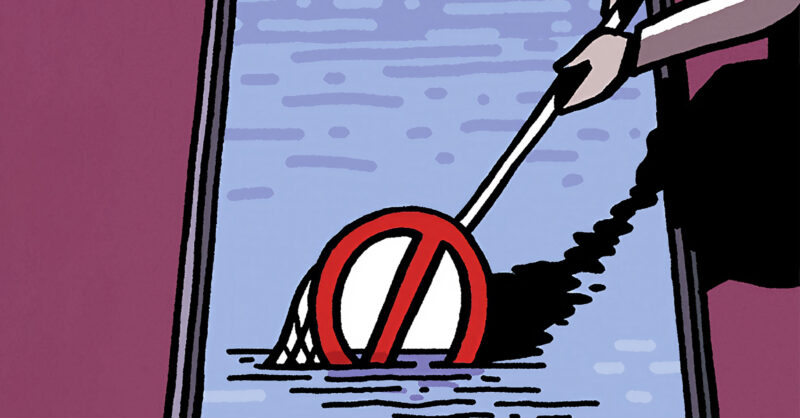
The OBR is throttling Britain’s economy
Politics, at its heart, is simple. It’s about choices, both those we make as politicians and those we ensure are available to us. Yet in modern Britain, the range of choices available to elected governments has been quietly but decisively narrowed – not by voters, but by the strictures we as politicians have designed.
Yes, I’m talking about the Office for Budget Responsibility (OBR) again. Because whilst Reform may have joined the Tories in abandoning their criticism of the body, just this week its monthly forecast for government revenue from November was out by £6bn. Given we are making fiscal decisions based on the five-year forecasts, we should be concerned that the prediction from just two months ago is out by billions of pounds.
Independent forecasting is, of course, a vital component of economic governance. It reassures markets and bondholders that fiscal plans are grounded in reality – something that matters acutely, given the fiscal inheritance this government faced when entering office. Catastrophically high debt, weak growth, and limited headroom have created a very jumpy bond market which does not have blind faith in Britain’s credibility or stability. Even small movements now provoke frenzied speculation and pressure for over-correction. This is simply, sadly, a fact of life for the UK at the moment.
So no one, least of all me, is suggesting that we abolish the OBR.
Subscribe to the New Statesman today for only £1 a week.
Because in this context, fiscal discipline matters – as does much-needed debt consolidation. But there are several ways to achieve it and the design of the OBR excessively and unnecessarily limits the choices available to governments in pursuit of those important aims. While it is sold to the public (and to those jumpy bond markets) as an independent and neutral arbiter of fact, the very design of the OBR in fact dictates a narrow, particular, and ideologically rooted perspective. It ties one of a Chancellor’s hands behind her back even before it has the chance to leak her Budget.
This is no surprise. The OBR was dreamt up by the Tories in opposition and placed on a statutory footing after the 2010 election. It was, explicitly, designed with the specific focus of reducing the size of the state. George Osborne then structured the OBR and its work to ensure that only reductions in public spending would be “scored” (that is to say, have their value registered as a genuine saving). This means that a Government which wishes to reduce public debt will be assessed as doing so by the OBR, thereby providing reassurance to voters and markets alike that there is no jiggery-pokery going on – and can only do so by making blunt cuts to services.
Limited account or credit is given to other means of reducing debt over time. Productivity growth is the most important way to manage sovereign debt, and yet there is little incentive to pursue supply-side reforms when even those that most economists agree on cannot meet the OBR’s burden of proof. Proper service reform, which tests and learns how best to meet the needs of the public in the most efficient way possible, takes years to pay off, well beyond the forecast period.
In practice, this has produced a system that finds it far easier to recognise reductions in public spending than to account for the long-term value of spending that prevents future costs. The bias born of ideology is now structural: cuts deliver immediate, legible savings within a five-year forecast window. Meanwhile investment which we know enhances human capital formation (like early years and skills training) or limits scarring (like public health and employment insurance) is just a cost because the returns are intrinsically long-term.
Programmes such as Sure Start were explicitly designed around this preventative logic: intervene early, reduce later costs, and improve lifetime outcomes. Yet under today’s fiscal framework, spending of this kind is structurally disadvantaged. Its benefits are diffuse, slow to materialise, and difficult to capture within short-term fiscal scoring, making it far harder to initiate or sustain – not because it is fiscally reckless, but because the framework cannot see its long-term value. With hindsight, the Institute of Fiscal Studies (IFS) have confirmed what we in Labour always knew: that Sure Start more than paid for itself in the long run.
The OBR did not challenge George Osborne to account for the lost future returns because it is built around a set of assumptions that render it the drunken man looking for his house keys under the streetlight – it’s not that the keys are likely to be there, it’s that that’s the only bit of the street he can see.
Because the OBR judges fiscal sustainability over a rolling five-year horizon – that mirrors the length of a Parliament – it is biased in favour of cuts to expenditure that produce immediate savings. Spending whose benefits accrue beyond that window is penalised. Cuts which lead to even greater pressures elsewhere are never re-evaluated. This is not neutral. It shapes what governments are willing – and able – to attempt to do. Neither is it transparent. The average maturity of UK debt is 14 years and markets who lend us money ought to have a better understanding of how short-sighted decisions could have lasting consequences for economic output.
And this myopia has clearly failed even on its own terms, with debt now three times higher than when the OBR was established.
We know that many of the challenges Britain faces cannot be addressed within a single electoral cycle. An ageing population, rising economic inactivity, regional inequality, and the long tail of post-pandemic worklessness all require sustained intervention over decades, not years. But the guardrails that have been imposed on our politics actively disincentivise and discourage our politicians from taking the steps they know are necessary to fix these things. We need to get British politics out of the straitjacket that George Osborne trussed us all into in 2010.
What is needed is an independent forecasting process that takes the whole economic cycle seriously, rather than compressing all judgement into a five-year window. This is not only consistent with fiscal credibility, but it enhances it. If a reformed OBR produced ten-year forecasts at each Budget, policymakers would be incentivised to prioritise meaningful reforms. This would not be just an excuse to borrow more, kicking the can of consolidation further down the road, but would help markets properly assess fiscal risk. Even within the current fiscal framework, Governments which looked to the horizon could expect to be rewarded today with a lower cost of borrowing. A long-term view will prioritise investment.
This is where the fiscal framework of the 2000s is instructive. Under Gordon Brown, fiscal rules distinguished between the current budget and borrowing for the long term, but crucially applied judgement over the economic cycle rather than year-by-year binary pass-fail assessments which result in constant chopping and changing of policy. That approach was not perfect, but it created the right incentives to pursue returns that were expected to materialise over time, to build resilience to shocks and to resist constant over-correction. It allowed for political choices to be made – in the long-term national interest. And it is why the IFS have this week proposed replacing the fiscal rules with a traffic light system, to reduce incentives to contort public policy in response to a single headroom figure.
Examples such as the New Deal for Young People or the Supporting People programme illustrate what becomes possible when governments are able to take a long‑term view of preventative spending. The New Deal for Young People, for example, aimed to increase labour‑market participation among 16–24‑year‑old Neets (“not in education, employment, or training”), and depended on sustained day‑to‑day investment in mentoring, employment assistance and skills support. Similarly, the Supporting People programme relied on intensive, ongoing support services whose gains, from reduced acute health use to lower criminal‑justice and emergency accommodation costs, emerged only over many years.
Under today’s framework, this kind of preventative spending is possible, but it is structurally harder to prioritise and defend. Because the benefits fall mostly outside a single Parliamentary term, but the costs appear immediately, such programmes are systematically deprioritised – not because they are less effective or less fiscally responsible, but because the five-year forecasts cannot adequately account for long‑term value.
The financial crisis exposed the limits of the old framework in the face of extreme shocks. It did not, however, prove that all discretion was misguided or that long-term judgement should be eliminated altogether. Since then, debt levels have risen sharply, and any credible fiscal framework must include a clear path to sustainable debt reduction. With debt now close to 100 per cent of GDP, pretending otherwise would be irresponsible.
For investors in UK gilts, what matters most is not whether governments invest, but whether they can demonstrate a stable, transparent path to debt sustainability – something a longer-term, cycle-aware forecasting is better equipped to provide.
But fiscal credibility cannot be the sole objective of economic governance. This Government was elected on a mandate to deliver change: to improve public services, rebuild local communities, and tackle long-standing economic weaknesses. Delivering on that mandate requires prioritising investment in policies whose payoffs are social as well as fiscal, and whose benefits may not be fully visible within a single forecast.
A system that consistently favours short-term certainty over long-term gain risks entrenching decline. Not because politicians lack ambition, but because institutions are designed to suppress it. Independent forecasting should inform political judgement, not replace it.
What is needed is not a rejection of fiscal rules or independent oversight, but a better balanced approach that maintains market confidence while recognising the value of long-term, preventative investment: that guards against excess without foreclosing ambition.
Keir Starmer promised to end managed decline and move beyond sticking-plaster politics. It’s time we looked honestly at our past – at what worked, what didn’t, and why – so that we can design institutions fit for the challenges Britain faces today. With both the Tories and Reform now clinging to the economic status quo, it is not just desirable that our politics claws back the capacity to make choices about how we run our economy, it is existentially necessary if we are to tackle the issues we face and restore trust in the capacity of democracy to change our country for the better.
[Further reading: Don’t abolish the OBR]
Content from our partners
Related