How Starmer can escape the digital doom loop
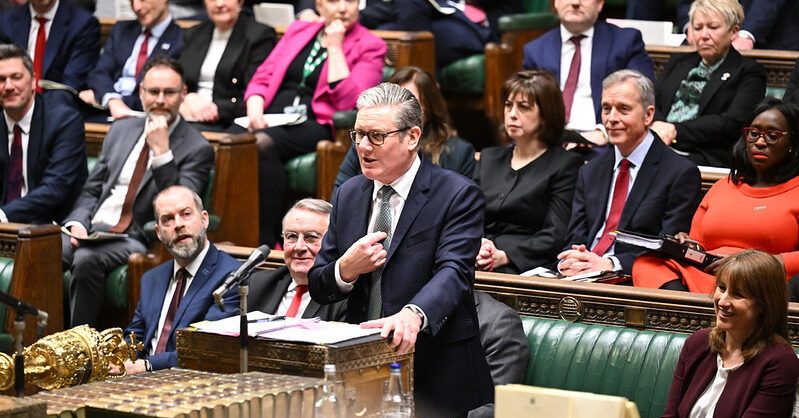
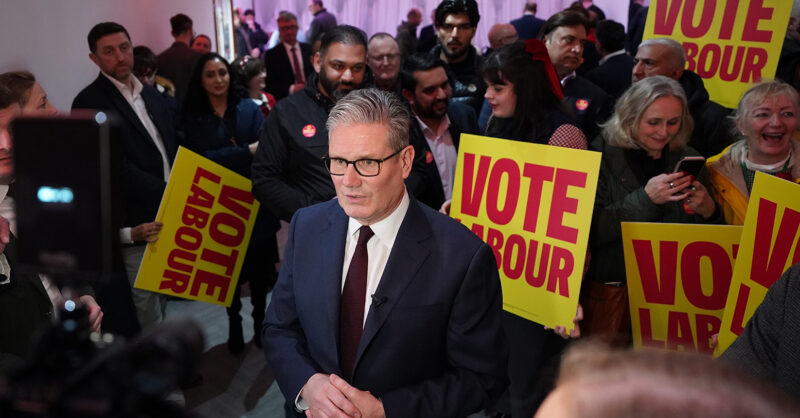
Keir Starmer has long seemed wary of taking on big tech. But now he has vowed on his Substack to bring in new powers “to crack down on the addictive elements of social media”, to “stop the auto-play, the never-ending scrolling”. The spur for this is the need to tackle the harm that rich, careless Californians stand accused of doing to British children, but what’s striking is Starmer’s focus not on the content of social media, but the design. He’s not alone.
The European Commission is currently investigating TikTok on similar grounds. In the United States, the big social media companies are facing their first jury trial over their designs’ alleged effects. Starmer appears ready to join this battle, insisting that if his crackdown “means a fight with the big social media companies, then bring it on”. He adds, almost plaintively, “We can make a difference on this. Politics can be a force for good.”
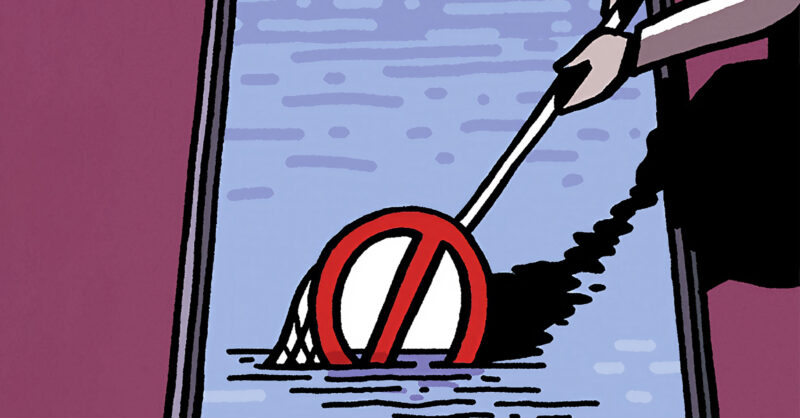
This cri de coeur points to why this is a fight worth having. In a new report for Demos, The Digital-Democratic Doom Loop, I argue that the design of social media has worsened the already-damaged relationship between citizen and government, eating away at the idea that the democratically-run state is anything other than a nuisance. Win this battle, and Starmer can both demonstrate that politics as a force for good, and start to address that longer-term corrosion.
But why did social media, which was meant to be fun – and still is, sometimes – end up making our politics worse? The answer lies in its origins in the enthusiasms of the 1990s, and what happened when all that collapsed.
Subscribe to the New Statesman today for only £1 a week.
Thirty years ago this month, on 8 February 1996, a plucky revolutionary channelled the spirit of Thomas Jefferson, and published a Declaration of the Independence of Cyberspace. Addressing his tract to the “Governments of the Industrial World”, John Perry Barlow denounced them for “the tyrannies you seek to impose on us”. Barlow was a lyricist for the discerning hippie’s favourite band, the Grateful Dead, and he appears to have thought he was facing down the hard-faced technocrats of the Cold War. He and his fellow cyberlibertarians, he vowed, would “spread ourselves across the Planet so that no one can arrest our thoughts”.
The cyberlibertarians were clearly keen to feel as if they were rebelling against the state. But Barlow published his Declaration at Davos, and the overlords of politics and finance milling about on their Swiss mountaintop were not plotting to arrest his thoughts. They thought in similar ways themselves, especially about the state. His Declaration was provoked by Congress passing a new Communications Decency Act – but its now-famous Section 230 absolved tech companies from liability for what users posted on their platforms. The Clinton administration was busy establishing the legal grounding for the internet, and its main concern was to protect the individual from the power of government, hoping that the web would spread democracy worldwide. (The idea that anyone might need protecting from the power of tech companies didn’t really figure.)
This was all very much on trend. Cyberlibertarians and neoliberal governments shared a belief that in the new world of globalisation, fusty old limits must be swept away like the Berlin Wall. In 1998, Peter Thiel launched PayPal, the “founding vision” of which, he later wrote, was “centered on the creation of a new world currency, free from all government control and dilution”. The following year, the Clinton administration demolished the wall separating retail and investment banking, built after the 1929 Wall Street Crash. Thus liberated, the financial system began to absorb ever greater complexity and risk in pursuit of maximum returns.
The dotcom bubble soon popped, but that didn’t stop things for long. From 2002, the early social networks – Friendster, MySpace, Facebook – began to appear. At first they were billed as a mix of a fun showing-off opportunity and a way to bring people together. But they also coaxed users to compete for status. “Friends” came to mean “strangers you connected with to boost your stats”. In 2006 Twitter appeared, armed with its reverse chronological feed; Facebook introduced its news feed. Infinite scroll removed a major limit on holding users’ attention.
Then on 29 June 2007, Apple launched its “magical” iPhone. But the following day, the New York Times was worrying about another magical invention: mortgage-backed securities for subprime mortgages and the “financial alchemy” they relied on. Here was another revolutionary device whose design overcame old limits: in this case, to package dogshit as solid gold.
The 2008 Crash brought a major disruptive new communications system smack into collision with prolonged economic turmoil. The banks’ limit-smashing launched ordinary people into years of economic pain. Silicon Valley’s limit-smashing created a powerful new way for them to channel their fury and frustration: the mobile social network.
On 9 February 2009, amid bailouts and foreclosures, Facebook introduced the “like” button. That November, as asset prices rose and wages didn’t, Twitter launched the retweet. As the two firms competed, today’s engagement-maxxing social media machine took shape. Facebook aped the retweet; Twitter aped the like, and added the “quote tweet”. Both companies algorithmified their users’ feeds. And with the help of autoplay, watching a video on your smartphone, then ten more, was suddenly as normal as breathing.
Like a jaunty zombie, all the pre-Crash Californian positivity about what social media was for was still at large. The leader of the team that built the one-click retweet thought it would empower under-represented voices. The like button was reportedly hailed as “radically democratic”. But voting is not just the instant expression of a personal preference. Unlike hitting “like”, it implies a relationship with the nation, and the state: an agreement to be part of an ongoing process in which we all participate together. It implies the acceptance of the result, and of the necessity of compromise.
The design of social media, however, is driven by the self-interested individual – its users, and its owners – chasing rewards they can count. It brings that old 1990s convergence of cyberlibertarians and neoliberals to fruition.
This isn’t just ideological: it’s how social media is built. Engineers and computer scientists learn to optimise systems by identifying a problem and remove all obstacles to solving it: a brutally simple logic which chimes with neoliberalism’s standard economic model. Both focus on the individual pursuing self-interested, measurable goals. Both consequently see the benefits of removing barriers and limits. Both cast business as a force that facilitates the individual’s pursuit of her goals by offering her what she wants and providing systems to obtain it: status, money or cheap consumer goods. Both cast the state and civil society as forces that get in the way of that, by imposing regulations, laws, taxes and the messy compromise of institutions. Both rank individuals’ status numerically, disregarding more intangible factors. And both set aside negative impacts of their approach as a necessary cost.
By 2009, it appeared that for some of social media’s pioneers, the distinction between individualist social media and democratic real-life society was part of the attraction. That April, Facebook’s first outside investor, Peter Thiel, wrote that such companies “create the space for new modes of dissent and new ways to form communities not bounded by historical nation-states”. He added that he no longer saw individual freedom and democracy as compatible.
After the Crash, anti-system grassroots movements like the Tea Party and Occupy appeared. In 2014, the political and media theorist Martin Gurri responded with a zeitgeist-catching book, The Revolt of the Public, which argued that the explosion of information and connection online had shattered the authority of the “elites”. He expressed concern that the revolt involved no constructive programme for change, leading to a stalemate that endangered democracy. He conjured the image of an online nihilist who “thinks his rulers are liars and cheats” and “fills the web with angry rants”.
But perhaps this had something to do with the medium through which that nihilistic anger was expressed. Social media risks undermining the whole idea of the democratically-run state, in more ways than one.
First, as their power has become concentrated in the extreme, the social media companies have challenged government more and more, asserting their founding hostility to state regulation from a position of huge strength. Efforts at regulation have been badly hampered by the pro-individual, anti-state thinking that shaped the way the Clinton administration laid the internet’s legal foundations. This all leaves democratically run states looking useless and outdated, unable to protect their citizens, so undermining their legitimacy.
Second, developing a constructive programme for politically led change starts from analysing how complex power structures cause problems. And that’s difficult in an information environment that’s constantly filling with smog. As the technologist Tobias Rose-Stockwell sets out in his book Outrage Machine, social media’s incentive structure discourages thoughtful analysis, partly by downgrading the importance of accurate information. The “algorithmic ordering of content soon flattened the hierarchy of credibility”, he writes, putting accurate, hard-won information on a level with rumour, trolling and conspiracism. It encourages emotional, impulsive responses, incentivising users to make and spread content which provokes anger, empathy, fear and hostility.
If your priority is individual freedom, this is fine. But if you’re bothered about maintaining the legitimacy of the democratically run state, not so much. That relies on trust, nuanced analysis, assessing accuracy, and a sense of national collectivity. Over the last decade, social media-driven behaviour of people not just on the right, but on the left and the centre, has made democratic compromise harder to sustain. As the biggest, most visible manifestation of power, the state already attracts more than its fair share of blame. It is very hard, in this information environment, to defend government’s complicated trade-offs, as Labour has been finding. Much easier just to attack the state as useless or treacherous.
And third, the more people express their anger at their post-Crash disempowerment through social media, the more it serves to reinforce the individualist, metrics-obsessed ideology from which social media springs. Which is the very ideology which led to the Crash and the public’s disempowerment in the first place.
Put all this together, and you have a digital-democratic doom loop.
This did not begin, of course, with social media. The last time a disruptive new communications technology collided with prolonged economic turmoil was the 1930s. Then as now, American grifters and demagogues spotted an opportunity, using radio to misdirect people’s rage at the Depression, goading them into a rage spiral rather than a constructive push for change.
The difference today is that social media means the audience can both express and spread the rage themselves, creating a faster, more involving, more escalatory loop, on a larger scale. And the amplification system created by the mainstream media’s willingness to report viral tweets offers political entrepreneurs like Donald Trump openings that his agitational ancestors could not have dreamed of.
Big tech didn’t build this system on purpose. It’s an expression of a worldview, not a conspiracy. The way Elon Musk appears to have been radicalised by his own algorithm attests to that. Nonetheless, Musk’s purchase and weaponisation of Twitter has had a particularly direct impact in Britain, through his attacks on the prime minister and other politicians and apparent calls for political violence. This brings social media’s latent, inherent hostility to democratic government, at both structural and ideological levels, to an apotheosis. The algorithm changes on Twitter, now X, exacerbated by the effective departure of many liberal and left-wing users, have normalised extreme right rhetoric, portraying the elected government as illegitimate and giving users – including many British politicians and journalists – a wildly skewed impression of British public opinion, further normalising extreme hostility to the democratically-run state. X is the digital-democratic doom loop in its fastest, most aggressive, most visible form.
So if Starmer is really willing to fight back, there is much to be done. Regulation alone cannot solve the problem. In response to rising American hostility, the EU is reportedly developing “legislation aimed at promoting tech sovereignty”. This creates impetus and opportunity to foster entirely new companies, and with them, stronger information supply chains. Doing this effectively requires jettisoning the approach to optimisation that shapes today’s social media, based on multivariate algorithms that encourage more thoughtful responses. In the years since Twitter and Facebook were built, advances in computational hardware have made this more possible.
So Europe should seek to emulate China’s successful construction of its own big tech companies – without, of course, emulating Beijing’s autocracy. We no longer live in the sunny 1990s when the internet’s rules were set. Today, the state must be the citizens’ active ally.
When Starmer has faced down Musk in the past, as he did (eventually) over AI-enabled generation of child sexual abuse material and non-consensual intimate imagery, he has made headway. As George Eaton has pointed out, that confrontation “was a reminder of the power that sovereign states can wield over Big Tech – if they choose to do so”. To paraphrase a great defender of democracy, this fight now looks like the worst option – except for all the others.
[Further reading: The Gorton and Denton by-election is anyone’s call]
Content from our partners
Related