Labour should be kind to the Greens
The government has been testing out a new line. I’m not convinced it’s a good one. In fact, I suspect it may be a very bad one indeed. It goes like this: the Green Party are basically as bad as Reform UK.
Early drafts of The Line have been circulating for some time. Last May, Loughborough MP Jeevun Sandher argued that years of economic insecurity had pushed voters to seek answers beyond the political mainstream. “Our political battle is no longer left vs right,” he wrote – in a sentence containing more dubious assumptions than the UK now has major parties – “but mainstream sensibles vs radical outsiders (in the form of Reform and the Greens).” It is far from clear that Labour, at this point in its history, still gets to style itself as the party of the “mainstream sensible”.
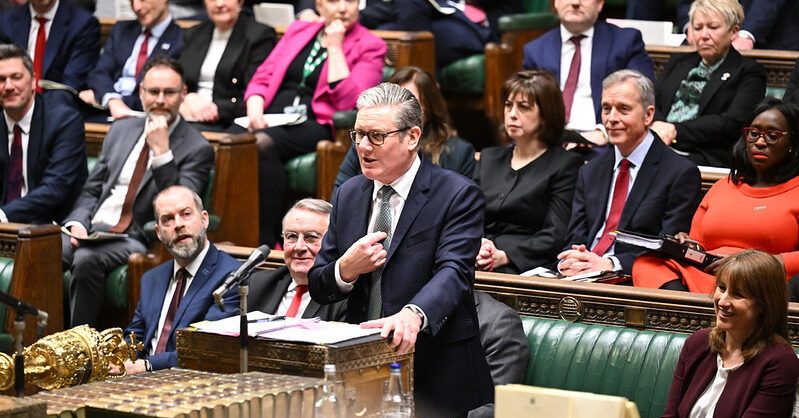
In his speech to the Munich Security Conference last week, Keir Starmer struck a similarly forceful note, warning of “the peddlers of easy answers… on the extremes of left and right”. “It’s striking that the different ends of the spectrum share so much,” the Prime Minister continued. “Soft on Russia, weak on Nato, if not outright opposed – and determined to sacrifice the relationship we need on the altar of their ideology.” He did not specify his targets. He didn’t need to. In the past, he has been far less coy.
I’m sure you can grasp exactly what Starmer is reaching for here. Nigel Farage’s oft-stated belief that Nato provoked Russia’s invasion of Ukraine finds its warped mirror in Zack Polanski’s opposition to the UK’s membership of the alliance, even if the two positions spring from radically different premises: the latter rooted in suspicion of strongmen, the former in a disconcerting admiration for them.
Subscribe to the New Statesman today for only £1 a week.
And there are other, more superficial similarities between the two. Both are charismatic communicators, capable of inspiring a fervent loyalty in their supporters in a way Starmer very obviously is not. Both have prospered as populists, feeding – as Sandher noted – on a broad, simmering dissatisfaction with the status quo.
And both trade in simplism, shrinking a knotted, complicated world into a comforting fable of heroes and villains – even if they disagree entirely on who the villains are. It is, of course, less morally grotesque to lay the country’s woes at the feet of the parasitical rich than at those who are inconveniently non-white or foreign. But moral gradations do not magically produce workable policy.
The idea, however, that the two forces are comparable is nonsensical – worse, offensive. Reform is unapologetically a party of the radical right, ideologically aligned with Donald Trump and Viktor Orbán. It promises mass deportations and flirts with reopening the settled status of legal residents. Its candidate in Gorton and Denton has declined to disown his habit of interrogating who, exactly, counts as British. Reform trades openly in resentment, nastiness and rage. Its poll lead is a genuinely alarming development.
By contrast, the Greens, broadly speaking, are a party of people who would like things to be kinder – and who quite like trees. I’ve had my quarrels with it: over hypocrisy, naivety, nimbyism, and the company it has occasionally kept in pursuit of votes. But it has not, at any point I can recall, come within a million miles of proposing mass deportations. You do not need to think much of Zack Polanski to recognise that equating him with Nigel Farage is absurd.
Even if the comparison were remotely fair, it would still be a strategic blunder for the government to push it. Disillusioned progressive voters have plenty of reasons to look elsewhere on the left: the Starmer government’s repeated failures to deliver, its habit of careening from one crisis to the next, and its willingness to make life harder for some groups in a bid to impress others. Telling those voters that they are morally equivalent to supporters of the deportationists addresses exactly none of these problems. Once again, it seems the Labour leadership’s instinct is not to give progressives what they want, but to chastise them for even wanting it.
The real reason the party is pushing this line, of course, is not that these two parties pose equal threats to Britain – but that they pose equal threats to Labour. Starmer would hardly be the first Prime Minister to conflate his country, his party, and his job, but make no mistake: this is electoral calculation masquerading as statesmanship.
[Further reading: The House of Lords’s cosplay democracy]
Content from our partners
Related