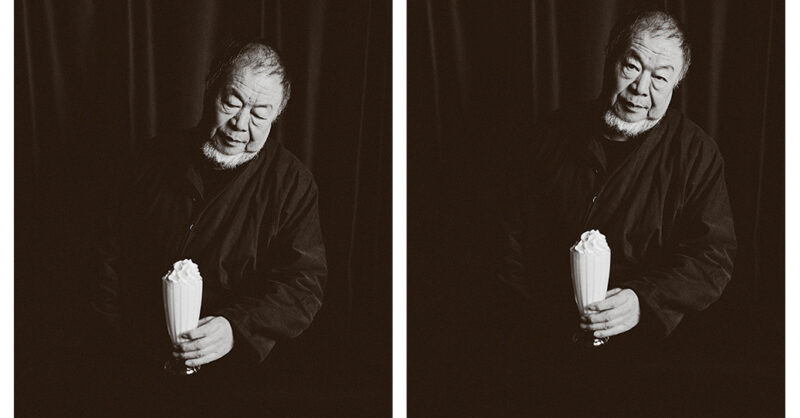
Ai Weiwei interview
The Chinese artist and activist Ai Weiwei’s major works include Sunflower Seeds – which filled Tate Modern’s cavernous Turbine Hall with millions of hand-made porcelain seed husks in 2010 – and the Bird’s Nest stadium (in collaboration with the architecture firm Herzog & de Meuron) for the 2008 Beijing Olympic Games. In 2011 Ai was arrested in Beijing for “economic crimes” and spent some five years under actual or virtual house arrest – which was likely to have been punishment for his criticism of the Chinese authorities. When his passport was returned in 2015, he moved to Berlin and resumed his career, working across media, from photography to found objects. Ai has had more than 150 one-man exhibitions around the world and is preparing for a show in Manchester. He has just written a book, On Censorship.
Michael Prodger: The last time we met was ten years ago. You were living in Berlin, and had been there just a few months. What have you been doing since then?
Ai Weiwei: I checked with my assistant to see how many times I have travelled. I have crossed borders, travelling from a state to another state, 350 times.
That works out at 35 times a year. You told me you get jet-lagged. You must be permanently frazzled.
Subscribe to the New Statesman today for only £1 a week.
It’s true. Jet-lag is normal. So I’ve started to appreciate it because someone is working [on an Ai Weiwei project] either in Beijing or in New York or in Europe. So 24 hours a day, I can be alert and answer their questions.
You moved to the UK in 2019, to Cambridge.
I stayed in Berlin for six years. Then I wanted my son to get an English education. So we moved to Cambridge.
And now you live in Portugal, but you don’t have a studio there. Why don’t you need a studio?
Most of my works have been done in hotels or airplanes. I don’t need a studio any more. I have a studio in Berlin and one in Beijing. I just give clear direction and make sure [my assistants] come up with the right quality. We are in very intense communication. But this is actually a one-person operation and I don’t want to lose any control, because otherwise it will give me no joy. I don’t have to do one more work or one extra work.
So you create work as and when you want to, but you don’t have a particular urge to be making something the whole time?
No. To make a work, I always have to have this mental precondition to say, “This is my last work,” or at the same time, “This is my first work.” So by doing that, I do have a liberty to re-establish something.
So if you were to put on an exhibition called “Ai Weiwei: The Last Work”, we shouldn’t believe it?
Actually, you shouldn’t believe anything I say.
You keep a studio in Beijing, but China was not a happy place for you. Your father, a poet and one-time friend of Mao, was exiled; you yourself were badly beaten by the police resulting in two brain clots; your studio was demolished; you were bugged and surveilled; you were accused – on trumped-up charges – of tax and currency irregularities; you had four years of virtual house imprisonment. But you still want to go back. Why not cut all ties?
Well, that means they had not beaten me badly enough. I survived. I survived very well and maybe I’m still seeking trouble.
We see plants being moved from here to there, they’re being pulled out from the ground. And you even have plants whose roots are living in the air, you don’t have to get those into the dirt. I think, fortunately, I have kept my sense of rooting in China. I don’t have a particular sense of patriotism or some kind of nostalgia. But I speak Chinese. I’m a typical Chinese man.
But you are not typical, are you? And you went back to China recently, for the first time in a decade. How was that?
I went back for 21 days after being apart from my mum for ten years. She’s 93 now. I brought my son, who is 17.
Your work and your name had basically been written out of the record in China. Had that changed? Are you a person again?
Yes, I have become a new person, or a guest of my homeland. You know, most people don’t know of me after ten years being “disappeared” from the public view. I start my new life there, like coming back from prison or exile. The youngsters, they certainly don’t know me.
Art mirrors life: Ai Weiwei’s S.A.C.R.E.D. (2013), which depicted scenes from his detention by Chinese authorities. Photo by Alex B. Huckle/Getty Images
Does your celebrity in the West hold any currency in China? The authorities are clearly aware of it.
Less than 0.01 per cent of people might know who I am. I would not be recognised except by the hotel people. Before I came out, I lived in the same hotel for a while, and they recognise me. They’re happy to see me back.
The works that got you into trouble with the Chinese authorities were ones in which you drew attention to corruption and censorship. For example, with the Sichuan earthquake in 2008, 5,335 students died when schools made of poor-quality concrete collapsed on them. You made a work using their backpacks. And you made another work, Straight, using salvaged rebar, the reinforcement bars that went into this low-grade concrete. So you were consciously and clearly attacking the state.
Not attacking the state.
What would you call it?
I wanted to try to make sure those students were remembered and I wanted to leave a permanent record, you know. These aren’t just numbers, but children who had names, birthdays. So I carefully recorded everything in film and in the art presentation.
But you knew what you were doing.
I believe what I did is good for not just those children – they lost their lives – but it is good for the government to be alarmed and to build more reliable constructions because there are a lot of children still in this kind of school.
Do you think it worked, alarming the government?
It is hard to answer, because you need another strong earthquake to find out.
When we last spoke, you said you believed that it was possible that art could change society. Do you still believe that?
I think that art certainly changed my life and I’m part of a society, so in that sense, art can really change society. But wider society… I don’t know. I don’t think people care that much. Not just about art but even the dramatic political conditions such as war or migration and all those much larger tragedies that happen every day.
I don’t think people are capable of handling those things emotionally… I think art in general has lost its original sense and is now detached from reality, and has become more decorative, offering some kind of entertaining comfort. So I think very few artists still would consider themselves connected to reality and social or political change.
Would you count yourself among the artists who still do care about those things?
I was. I was born this way only because my father was exiled. And that was a huge gift to me because the year I was born, he was exiled, he suffered his whole life. I think it is a gift because it made me understand about humanity, about politics, about the individual, strengths and freedom.
Your father was exiled to “Little Siberia”, the edge of the Gobi Desert. He was made to clean public lavatories. He was paraded in front of people. You grew up in extreme poverty, at one point living underground. This was not just exile to a comfortable villa somewhere on the fringes of society.
True. It’s very hard to describe these kinds of conditions, if you have to live in a dugout with no electricity, no water, no necessities. Yeah, it’s quite an extreme situation.
Were you angry with the state then?
I’m not angry, but I’m quite frustrated that truth or fact cannot be. The mistakes have been made, but I’m not really angry.
Your book is called On Censorship. Do you feel that China is censoring more now than when you left it ten years ago?
Compared to ten years ago, China has much more confidence. They have established their national position and are in a much stronger position. They’re less nervous, but they are still very careful with the ideological narrative. So they cannot allow any different opinions or ideas about their legitimacy. It simply cannot exist, which, you know, is understandable.
But censorship is a tactic for any powerful state trying to maintain control. It’s not good or bad; it is just the nature of power. Power can be political, such as a state, or financial, with big companies, or cultural, with museums, galleries and any kind of institution. They all have their own way of censoring.
You suggest that individuals self-censor, trying to keep hold of what they have.
They’re complicit. If you have a family, if you have a child, you borrow money from the bank, you have loans… Why risk it for some principle and hurt yourself and the people you love? You know, it’s just nonsense. Normally I would criticise whatever I like, but it is not a good habit. My father used to tell me that if you talk too much, trouble comes. That came from his experience. But I always want to see what trouble is like. So I keep talking, about China, about Germany, about the United States, but when [we] come to Britain, my son clearly tells me we don’t criticise, because he has to study here. I said I will not say anything that is not proper.
You have 20 people who work for you. Do you feel responsible for them?
When I was arrested, several of my colleagues were also arrested and sentenced to the same amount of time and they did nothing. They just took orders for me.
Does that pressure ever stop you?
In some way I have stopped, but maybe I will be little bit more wild than now. I’m making soft-tuned work with all good intentions – colourful and attractive, sometimes even sexy.
I think you’re pulling my leg here. Perhaps we could talk about the work you’re making for Manchester in the summer… A button factory there was closing down and you bought the stock and have turned the buttons into artworks.
Maybe a few hundred million buttons. Someone on Twitter said, “We have to close down our factory.” I said, “Oh, no, don’t do it.” They asked me: “Do you want them?” I said yes, because I didn’t want them to be wasted. When we lived in the Gobi Desert, if we lost one button, we couldn’t find another one to replace it. You couldn’t find a button in the desert and you cannot just make a button. So you had to tie your clothes with string.
For me, a button has to attach to a fabric – then it becomes a button. I waited many years until Manchester wanted to give me a show. I studied the history of Manchester and realised it was the first city of the Industrial Revolution. And Britain has invaded China three times: the first Opium War in the 1840s, the Second Opium War, and in 1900 when eight nations – the English, Germans, French, Italian, Japanese, Russian, American and Austro-Hungarians – invaded to force China to open up its markets. That covers 180 years of the history between the West and China. That history relates not just to the past 180 years, but also to my family and to global citizens today. So when Keir Starmer went to China, I think he made a good move because British people are very practical and quite rational. Britain should benefit from communication with this powerful state.
So when Mark Carney talks about China being a more reliable trading partner than the United States, he is right?
Absolutely. So far I think China maintains a very stable direction, building their own base, larger and stronger. They have no intention of invading another [country].
Taiwan?
I think China will never give up its claim, but if there’s foreign interference, or they make an announcement of being independent, definitely there will be war.
As you say, China is not a geographically expansionist nation, but if that were to reverse, would that be a valid subject for you to treat in your work?
I don’t know. I only can start working when something happens. I cannot predict what is going to happen, and hopefully nothing will happen. It’s not good for people in Taiwan and I don’t think it benefits China at all. China is very large already and it doesn’t really need that kind of expansion, but principally they still think they are unified.
Destruction is a theme in your art. One of your early works was dropping an antique vase and taking a series of photographs as it smashed. What if a future artist took some of your work and destroyed it for reasons of their own, how would you feel?
I don’t even care. I only care about the integrity of the idea rather than physical work. Once it’s finished I would rather forget about it, but the process of intensively trying to control it gave me joy. When I have an exhibition, I have pleasure when I think they recognise my effort, but I do not have pleasure in my work. It’s about the recognition of others because the art is about communication.
Does that mean you are always satisfied with the work you make, or never satisfied?
It’s more like exercise. You have to stop when you are very tired, but the next day you are fresh again, you start again. So as long as life goes on, you always come up with some ideas. Otherwise you will have nothing to do.
Your work is almost all on a very large scale. Do you ever create work that is personal, small-scale, intimate and hand-made by yourself?
At the beginning, I always made small work because I had no money. I had very limited materials and I cared about the touch of the work. And later I was always given difficult tasks – work for a federal jail, or the Royal Academy, or Manchester… so the architectural element started to challenge me: how to make work that can support this architecture. So a lot of my work is because I’ve been asked to do it, but if nobody asks me, I will never do even one more show.
I would feel happy to play card games or walk in the park or something. You know – fishing, probably. I still can learn something.
Are you really saying that if nobody invited you to make any more work, then you wouldn’t create another thing for the rest of your days?
Not another thing. I have three warehouses all packed with works. It’s very costly.
You’ve done enough?
More than enough.
This is an edited extract from the New Statesman’s new podcast “The Exchange”. Each episode is an extended interview with an important and influential figure. Upcoming guests include Amia Srinivasan, Masha Alyokhina and Eric Schlosser. It is available wherever you listen to podcasts
Further reading: The writer who fought the Mafia]
Content from our partners
Related