Josh Babarinde: Lib Dems need to fight “for the soul of our country”
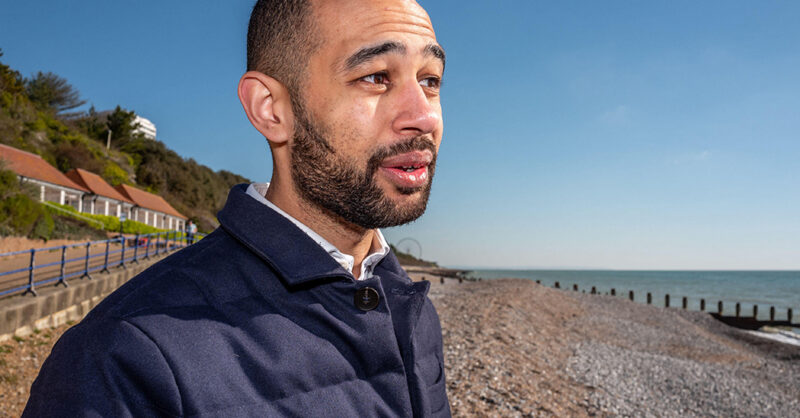
“Being an MP is basically like being a political entrepreneur,” Josh Babarinde remarks as he leads me on a tour around his hometown of Eastbourne. “No one tells you the rulebook.”
The 32-year-old Liberal Democrat MP has been writing his own rulebook since winning the East Sussex consistency off his Tory predecessor (and former teacher) 18 months ago. His biggest legislative achievement in parliament so far is working with the government to secure a change in how perpetrators of domestic abuse are categorised and tracked through the criminal justice system in order to better protect victims. To this professional success, he has recently added a more personal one: proposing to his boyfriend Connor in the House of Commons.
We are wandering around Eastbourne’s market stalls and seaside shop fronts on a winter afternoon, whose temperatures have not dissuaded Babarinde from wearing the lively green suit that has become an iconic sight in Westminster. He recounts his efforts to ensure the perfect proposal – requesting permission from the Speaker (“He said yes first!”), enlisting colleagues to take photos at the pivotal moment, and ensuring the whole thing remained a surprise for Connor. This was tricky, he says, because the day before he’d been elected president of the Liberal Democrats.
“People were coming up to me saying ‘congratulations!’, and I’m thinking, argh! Is that because you know what I’m about to do, or is it because you’re saying congrats about the presidency?”
New year, new read. Save 40% off an annual subscription this January.
It is the latter triumph that has brought me here – to discuss what Babarinde’s term as president, which began at the start of January, heralds for the Lib Dems and their efforts in 2026. But it is the former that has captured the hearts of the people of Eastbourne. As the afternoon progresses our conversation is interrupted dozens of times by passers-by. Some want to raise a constituency matter with their MP, but the majority just want to wish Babarinde congratulations on his engagement. He tells me he’s been inundated with offers from locals to choregraph his and Connor’s first dance or bake their wedding cake.
“People have got their stereotypes about the kind of town that Eastbourne might be,” he says, alluding to the reality that this is not the kind of leafy commuter-belt Blue Wall stronghold the Lib Dems are known for targeting, but a Brexit-voting coastal constituency with high levels of deprivation that on paper might not be top of the list of progressive hotspots. “But I have not experienced any negative feeling. People are delighted.” Later, he describes his hometown as being imbued with a kind of “hopeful nostalgia”.
Babarinde is all about busting stereotypes, not just about Eastbourne but about who the Lib Dems are. For one thing, he’s the party’s first black MP to be elected. (Chuka Umunna and Sam Gyimah both defected to the Lib Dems from other parties but were not then re-elected.) And he has views about the sorts of places his party should be targeting.
The job of Lib Dem president (a role sometimes seen as a step towards party leadership – both Charles Kennedy and Tim Farron held the position) involves chairing the board and setting the party’s strategy. That strategy, its new president insists, needs to be broad.
“Lots of folks talk about the Liberal Democrats as the party of middle England, and we certainly did well in middle England, but I think we have a duty to really look further as well.” His job, he says, is to “make sure that we are being as open and ambitious as possible about having a footprint and taking that fight to all parts of the country, particularly to those beyond where we’re traditionally most comfortable as a party”. In other words, it’s not just about affluent Home County seats with good schools and branches of Gail’s Bakery.
Unlike Labour and the Tories, where psychodrama and leadership speculation have bubbled beyond the parties’ internal discussions to become a national pastime, the Liberal Democrats generally manage to project a united and contented outward front. Ed Davey may elicit grumbles over the lack of impact the Lib Dems have managed with their 72 MPs, but the party’s success across the country in focusing on local issues, particularly its by-election victories, have kept frustrations at bay. Nonetheless, ask Lib Dems to muse about who might be in line as Davey’s eventual successor, and Babarinde’s name is top of the list. The “rising star” moniker can be a curse in politics, but it’s one that’s been attached to him since he entered parliament, having previously served on Eastbourne Borough Council.
Babarinde joined the party as a teenager, inspired by a Lib Dem beer mat he spotted at a freshers’ fair. (He claims not to remember exactly what was on said beer mat, though he insists he still has it somewhere.) His background before politics was as a youth worker and social entrepreneur in gang outreach: he founded Cracked It, a phone-repair service staffed by ex-offenders and at-risk young people.
The experience has given him some amusing anecdotes, such as setting up a pop-up repair stall in the US embassy in London during the first presidency of Donald Trump, where his team included “one guy who had a conviction for wielding an axe”. On another occasion, they were fixing phones in the headquarters of the Ministry of Justice. “When you’re conducting a battery repair, you’ve got to be really careful, because if you accidentally pierce the battery and expose the lithium in there to the elements, it’s like that science experience at school,” he explains, conjuring up the image of lithium burning bright red in a Bunsen burner. “Basically, that happened at the Ministry of Justice. Black smoke started streaming out.” Anxious to avoid a mass evacuation of the MoJ, he picked up “this phone that was on fire with my bare hands” and ran out of the building.
Minor burns aside, Cracked It provided Babarinde with two opportunities that would prove key to his political career. First, it brought him into contact with James Timpson, the businessman and prison reform campaigner, who offered his advice on getting the social enterprise started. Years later, when Timpson was ennobled and appointed to Keir Starmer’s frontbench just after the election, Babarinde found he had an ally in government on criminal justice reform. Less than a year later, as the Lib Dems’ justice spokesperson, he got his domestic abuse measure through with cross-party support. The issue was particularly important to him: as an MP, he has spoken publicly about his experience as a child watching his mother’s ex-partner abuse her and being a victim himself.
The second thing working in youth outreach gave him was a different approach to politics.
“It often involved going into abandoned stairwells at stupid o’clock at night, approaching groups of young people, trying to get them to do our employability programme,” he recalls. “The response, as you might imagine, wasn’t great. But we went back again and again and again.” He refers to this as “relentless intervention”: the idea of repeatedly returning to someone until they are eventually ready to engage, whether that takes weeks, months or years.
This is, he says, a tactic that helped the Lib Dems win big in the last election including in Eastbourne. And it’s what the party needs to do if it is to make further gains beyond its stereotypical heartlands – ensuring its presence is felt not just in areas where the Lib Dem message is likely to be well-received, but in the more marginalised, left-behind places that feel let down by establishment politics and tempted by the allure of Nigel Farage.
It might seem odd to view the Lib Dems as rivals to Reform, but core to the party’s 2026 strategy is presenting itself as the main alternative for voters who do not want Farage, wherever they may be. This was the theme of Ed Davey’s conference speech in September which railed against Farage and Trump, and is a message the Lib Dem leader reiterates each week at PMQs. But the fightback against populism, Babarinde warns, must go further.
“Reform are obviously the key populist threat, but the Conservatives are a pound-shop populist party, and Labour – ‘Island of Strangers’ Labour – is all too often fuelling rather than fighting that division,” he says. It’s far more pointed criticism of the government than Davey usually puts forward. But Babarinde has grown frustrated with Labour’s hesitancy in calling out what he sees as Reform’s “reckless” attempt to undo decades of progress on racism and xenophobia. “I think there are too many cases where the government, I think, instinctively knows that a lot of this stuff is wrong, but they’re too concerned with upsetting some folks who – well I don’t know who they’re concerned with upsetting. But they’re treading on eggshells to make sure they don’t offend people by taking the right moral position, and therefore leaving the rest of us to fight these battles on our own.”
He continues: “We cannot rely on anyone else in my view to credibly fight that threat… We’re the ones who can take [Reform] on where the two traditional parties are failing.”
By now the winter light is fading over the Eastbourne sea – the sunniest place in the UK, as Babarinde repeatedly reminds me. We’ve walked the length of the pier accompanied by vocal seagulls, past the town hall where Babarinde had his school graduation and returned over a decade later for the constituency election count, and down winding alleys where shops and cafes boast awnings decorated with the same brightly patterned fabric. The textile was designed by a local artist to represent the area and celebrate its rich multicultural history. It gave Babarinde an idea, he says. This year, Eastbournians will get to consult on a similar project to design an official flag for the town, incorporating the symbols that mean something to them.
This is the Lib Dem answer to the dark nationalism that swept across the country over the summer, with the St George’s Cross popping up in public spaces, sparking a fierce debate about patriotism, racism and who owns our nation’s flags.
“If people want to celebrate where they live, they can do so in whatever way they think is appropriate,” Babarinde says. But the Eastbourne flag “will unite our town rather than divide our community”.
It’s a sentiment he expressed in the Commons when parliament returned in September, arguing “those who attempt to divide our communities in the name of our flag are no patriots of Churchill’s England, no patriots of today’s England and no patriots of our great country”. The day after that intervention, he tells me, “I had someone come to my office who had hurled racist and xenophobic stuff through the intercom, who then proceeded to urinate at my office door.” We walk past the constituency office in question. “This rhetoric” – the kind employed by Farage and his MPs – “it emboldens people.”
As the Lib Dems gear up for 2026, this is how they are framing the conversation. Brexit is back on the agenda, with a renewed debate about the customs union as a way to spur economic growth and tackle the cost of living crisis. Electoral reform is high up on the list too, as the electorate fractures across too many parties for first-past-the-post to be able to cope with. Both are subjects on which the Lib Dems have campaigned vigorously, and even won parliamentary votes with the help of Labour rebels.
But if neither of those subjects can be relied upon to capture the public’s imagination, there is another option: presenting the party as the alternative to the narrative of division and nationalism seized upon by Reform. As flags pop up on roundabouts across the country like mushrooms sprouting over a lawn, the visible manifestation of a deeper decay, the Lib Dems, with their 72 MPs and message of “hopeful nostalgia”, want to be the antidote.
And the party’s new president has no doubt about his role in that mission. When I ask him what he sees as his main priority in the job, Babarinde doesn’t hesitate: “to gee-up our party to fight for the soul of our country”.
[Further reading: Only Reform voters can save Labour]
Content from our partners
Related