Clare Short: “There’s no place for people like me” in Starmer’s Labour
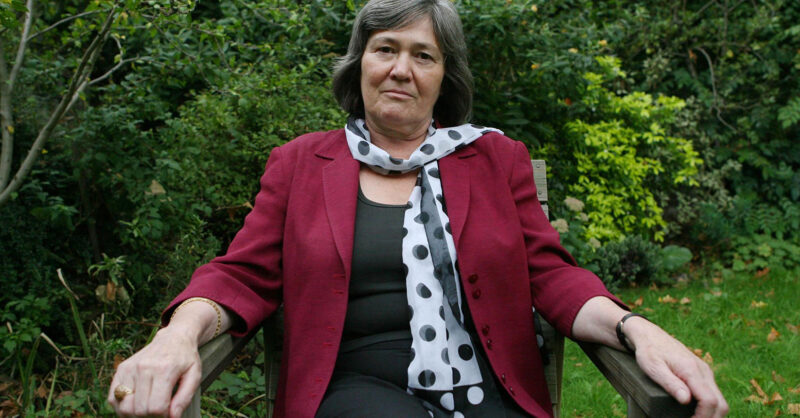
Clare Short thinks there would be “no place” for her in Keir Starmer’s cabinet. In fact, Tony Blair’s former International Development secretary doesn’t even think she’d be allowed to sit on Starmer’s backbenches. Short, 79, famously resigned from Blair’s cabinet over her opposition to the Iraq War in May 2003. She had already attempted to resign that March after calling Blair “reckless” on BBC Radio 4. But though her relationship with Blair was torturous, she believes the Labour Party now is “less tolerant” than it was during his 13-year leadership.
“It used to be that if you’re a frontbencher or a minister, you have to toe the line,” she told me when we met in August last year. Short was friendly and inquisitive, with a turquoise scarf and neatly cropped grey hair. We sat opposite one another in wing-backed armchairs on the top floor of a private members club close to Trafalgar Square (the owners gave Short a lifetime membership owing to her stance on Iraq). “But backbenchers could speak truthfully.” When we spoke, the party had just removed the whip from six backbenchers for what one Labour insider described as “persistent knobheaddery”. Short pointed out that things would have been very different under Blair.
“You’d get told off by the whips, it means you’re not going to get promoted and so on,” she said. “Jeremy Corbyn was there all those years, all through the Blair years.” Short said she thinks the “way Corbyn was treated was disgraceful” and though she has never been a “far-left person” she thinks there is “no place for people like me anymore”.
Short believes the narrowing of Labour’s historic “broad church” is why the government is running into so many problems. “Labour’s coalition is breaking up. A lot of the moral and intellectual people are disgruntled. And those on lower incomes, they’re dissatisfied. Labour doesn’t seem to be their party anymore.”
New year, new read. Save 40% off an annual subscription this January.
Short was the MP for Birmingham Ladywood for 27 years – from 1983 to 2010. It is the constituency now held by Shabana Mahmood, the Home Secretary, who has held it since Short stepped down. At the 2024 general election, Mahmood was re-elected with a severely decreased majority of 3,421 (she had won with a 28,582 majority in 2019). She was challenged by the Independent Akhmed Yakoob, who stood on a pro-Gaza platform, in a similar style to several other seats across Birmingham. Short was not surprised by this. “We’re a disgrace on Gaza,” she told me. “I think it’s worse than Iraq,” she said, “because Iraq was one big vote, one big demonstration… it wasn’t going on and on like Gaza is.” (When we spoke in August, a ceasefire deal had yet to be agreed between Israel and Hamas).
Neither is she impressed by Starmer’s relationship with the US President Donald Trump. At an event hosted by the centre-left think-tank Compass last year, Short warned Starmer against becoming a “lap-dog” of the US. Her warnings have not changed following Trump’s recent invasion of Venezuela and capture of its president, Nicolás Maduro. She told the New Statesman, “article 2 of the UN charter prohibits the use of force against the territorial integrity or political independence of any state. The only excuse is self defence. This principle has, of course, been breached many times, but this instance is so unashamed that it may mark an endpoint.” She added: “The future is increasingly dangerous and the UK irrelevant.”
Short was born in Birmingham in 1946, the second of seven children. When she was ten, the Suez Crisis gripped British politics. In the playground at her school in Birmingham, her classmates would chant “we’ll throw Nasser in the Suez canal”. But a pre-teen Short would rebuke them. “I had to get them all together and say ‘no, no, no this isn’t right. It’s their land. It’s their canal. They’re allowed,’” Short said.
She gained her social conscience from her parents. Short’s father, Frank – a teacher from Crosmaglen in County Armagh – was “agitated about Suez”. He had been the first National Secretary of the Anti-Partition League, an organisation which campaigned for a united Ireland. (Frank’s brother, Charles, emigrated to Canada, making his son, the actor Martin Short – of Only Murders in the Building – Short’s first cousin.) Her mother, Joan, was a descendant of Irish emigrants who had fled during the potato famine of the 1840s. “My mum was a very devout liberation-theology type Catholic,” Short said, “she was very generous, very concerned with people in need and helping people out.”
The Shorts ensured their seven children were well informed of global injustices. This awareness has stayed with Short. It was consequential for her career. After leaving school, she attended Leeds University where she studied political science and from there took the entry exams required for the civil service, passed, and took up a position in the Home Office. She was elected to parliament in 1983 where she quickly made a name for herself after claiming the then Conservative Employment Minister, Alan Clark, was drunk at the dispatch box. In his diaries, Clark writes of Short, “a new Labour member whom I had never seen before, called Clare Short, dark haired and serious with a lovely Brummie accent”. (In the same passage, Clark admitted he was, in fact, drunk.)
As International Development Secretary during Blair’s first six years in office, Short rose to further prominence. Her resignation in May 2003 was a flashpoint ahead of the Iraq War. But her initial failed attempt opened her up to criticism from the left (“it didn’t cover me in glory”, she said). In his 2001-2007 diaries the late Tony Benn and former president of the Stop the War Coalition wrote he had “no time” for Short, though he added he thought her resignation speech was “effective”. And it certainly didn’t win her favour with those around Blair. In the same diaries, Benn writes that after bumping into Alastair Campbell, one of Blair’s closest aides, at an event in London, Campbell told him he “hated Clare Short”. But her eventual departure from the cabinet was praised by those who opposed the war; and she is seen by some as the moral conscience of Blair’s first cabinet.
Explaining the reasoning behind her resignation, Short told me that in the run up to the war, Blair had become “ambiguous in cabinet discussions”. She told me: “everyone was on tenterhooks about whether maybe we could persuade him not to”. It was always in her mind – fuelled by her social conscience – that she couldn’t stand by if Blair took the UK into a war. “I delayed my resignation because Blair had me in and said he couldn’t promise that there would be an international peacekeeping force with the UN etc,” Short said, “and of course, whether he meant it, or he couldn’t do that anyway, it wasn’t going to happen.” The experience of resigning was very lonely for Short. But it’s clear she wouldn’t have changed things. “For me, I was clear that I couldn’t defend it, but if there was any way of giving Iraq a better future, I would have backed it.”
[Further reading: Starmer has failed to stand up for his own principles]
Content from our partners
Related