Deals, dukes, and dirt: Inside the largest land sale for 30 years
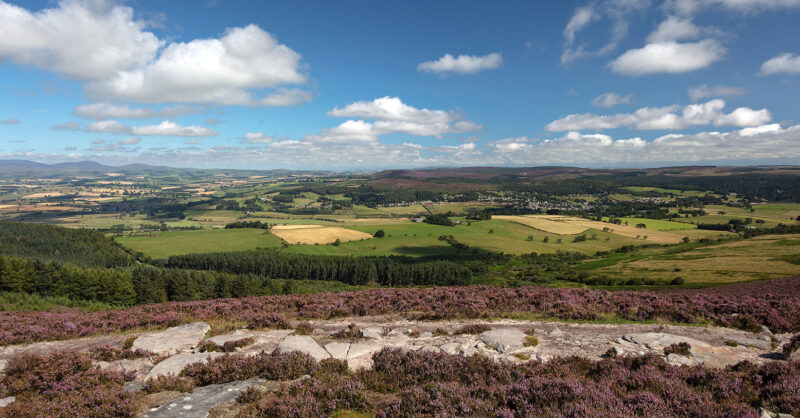
A few minutes after sunrise in late November, the Rothbury estate is blanketed in snow. You can see it all from the Simonside Hills, defined by the coast to the east and the Scottish Border’s Cheviot Hills to the north. Towards the edge of the hill is a Bronze Age fort; its concentric ridges of stone and boggy grass resemble the prehistoric “cup and ring” rock carvings famous in the area. Snaking through the valley, the River Coquet heads for the North Sea. It passes through the village of Rothbury, the bustling social and commercial centre for farms miles around. At times, the rumbling of artillery can be made out from the nearby army ranges. Not this morning. Skylarks chirrup in the bracken on the moor. A wren hops from a branch of frozen heather. A weasel darts into a hole.
All this, or a great deal of it anyway, will soon be someone else’s. The sale of the Rothbury Estate will be England’s largest land sale for 30 years. The change has united vastly distant worlds, from David Attenborough to Brian May, from hedge funds to one of England’s oldest noble families, from global climate interests to local farming concerns. And all is not smooth. The ensuing disputes have spawned bitter, and guerilla, disputes, with rumours that locals who argue for the wrong side have found dog mess posted through their letterboxes. Seven hundred years of history are being overturned, and the post-feudal upheaval has thrown up all the anachronism and turbulence of modern England.
Northumberland, so my family jokes, had its heyday in the 900s, when it was the independent Kingdom of Northumbria. It is a dramatic arena in Northumbrian chronicler Saint Bede’s accounts of Viking pillaging and divine interventions. But history settled down after the Norman conquest. The Percy family, one of England’s oldest noble families, famous in Shakespeare for Hotspur, moved in 700 years ago – and are still the largest landowners. Henry Percy bought his first Northumberland barony in 1310. His descendants fell from royal favour two centuries later for backing the Pilgrimage of Grace rebellion against Henry VIII in 1536, but were reinstated by Queen Mary in 1553 after their replacement John Dudley, the first Duke of Northumberland, engineered the disastrous nine-day reign of Lady Jane Grey. The Percys have held the duchy ever since.
Now, though, the winds of change are blowing once more. In 2023, a patch of Percy land roughly the size of Athens (9,500 acres) was listed for sale. Land agent Knight Frank described “a once-in-a-lifetime chance to acquire England’s largest land sale in 30 years”. It is not the Duke’s patch, but the portion gifted, as the tradition goes, to the family’s second son, Lord Max. The Eton-educated investment analyst decided to sell after concluding that it was too difficult to manage the estate from his home in the south of England, where he lives with his wife, Princess Nora of Oettingen-Spielberg. Some three quarters of the land is farmed, and much of the rest forms part of Northumberland National Park, the least populated national park in England, home, as its website claims, to “England’s cleanest rivers, clearest air, the darkest skies”.
New year, new read. Save 40% off an annual subscription this January.
A buyer was found. The conservation charity Northumberland Wildlife Trust (NWT) took up the opportunity and in 2024, it concluded negotiations to buy the estate. The final price has not been disclosed, but NWT’s fundraising target is £30m. Lord Max has agreed to give them until September 2026 to raise the money. So far, they’re £20m short.
Rothbury, the village that serves as the hub of the estate, is in many respects a rural idyll. It is home to a thriving pipe band, a basketry group, and a WI – whose Christmas wreath-making workshop is raising money for the NWT campaign. At the same time, it is joked that the cannabis farms, which seem to pop up whenever local shops are forced to close after falling victim to a tough post-Covid economy, are the area’s most profitable businesses. The hotel shut down, so the rumour goes, because a “knocking shop” was found to be operating on its upper floors, a fact apparently borne out by local forensics – the discovery of a “frilly thong” by the village litter-picking society.
The village is home to 4,000 people and has four pubs. When rare scuffles occur, they’re often blamed on “incomers”. Clearly, things have changed since 1888, when WW Tomlinson’s Comprehensive Guide to the County of Northumberland reported that “the people of Rothbury among former times were the most wild and uncivilised in the country… Very little regard had the good folk for laws and their love of venison frequently got them into trouble.”
For all this old-world charm, however, it’s striking how feudal local land law remains. In Northumberland, ducal rights can extend even to domestic freeholders, with homeowners required to pay thousands of pounds to obtain permission for renovations. Crucially, many farming tenancies are under ten years. The tenuousness of life so unnerved every farmer I interview that each request total anonymity. Many decline to speak at all.
It is perhaps unsurprising that local feeling towards the Percy family seems tepid. I ask one farmer what he thinks of the current Duke. A bewildered smile crinkles his eyes. “Eeh, I can’t remember his name.” He says he knew Hugh Percy, the Duke’s father, a fox-hunter and a “countryman”. He’d fought in the war and “mixed with ordinary people”. One retired farmer recalls: “On his way home [from the city] he’d call in… at one of his tenant’s farms. Then there’d be a panic – did they have anything for him to drink?” Few villagers I speak to relish the idea of sharing a bottle with Hugh’s son.
But local farmers are nervous about the prospect of the ownership of the estate changing hands. The fear is that the Northumberland Wildlife Trust will be hostile to farming, and seek to repurpose the estate as natural conservation land. Indeed, the NWT is open about the fact that it hopes to slowly diversify grazing on the land by reducing sheep numbers and introducing cattle. But because the sale hasn’t officially been completed, practical conversations about next steps remain murky, and rumours have proliferated. Colourful predictions envisage farmers evicted altogether and the land left to become a wild “jungle” with newly introduced lynxes and wolves. One woman sums it up: “Farmers are terrified they’re going to be stopped from farming.”
Local anxiety is worsened by an awareness that the Northumberland Trust’s work is largely controlled by the national organisation, the Wildlife Trust – if orders from on high change, there’s not much the local branch can do. The Wildlife Trust’s head office is in Victoria, central London – worlds away from the meagre transport services and dark skies of Northumberland. Locals are used to being let down by London policymakers. Despite half a century of campaigning, there remain houses further up the valley that are yet to be connected to mains electricity. Despite decades of government promises, parts of the A1 remain single carriageway.
One vocal critic of NWT is the county councillor, Steven Bridgett. A local man, whose occupation and place of residence are not widely known, Bridgett’s views are well-documented online. Commenting on NWT’s plans to use the estate as a “nature corridor” between the coast and the Scottish border, he took particular issue with a local climate group (estimated membership: 70) that expressed support. Recalling the late political giant, Tony Benn, he wrote: “What power have you got? Where did you get it from? In whose interests do you exercise it? To whom are you accountable? And how do we get rid of you.” Bridgett has also suggested a Telegraph report on the land sale was a “paid for” piece, believing it to be biased towards NWT. Bridgett declined my request for an on-the-record interview.
“[Some of his followers] treat him like a sort of prophet,” says pub landlord Debbie Noble. “They think, ‘He’s a councillor so he can’t be wrong.’” Despite Bridgett’s ubiquity, Noble is the only person I can find who is willing to go on the record about his behaviour.
Lord Max has made clear he does not wish to provide statements about the sale. I have a very natural conversation with a spokesperson at Northumberland Estates, only later to be sent an email with approved quotes: “The sale and transition of the Rothbury Estate to the Wildlife Trusts has been carefully and responsibly managed, with confidence that they are well placed to safeguard the estate’s long-term interests. Throughout, we have focused on providing clear, accurate information amid wider speculation.”
Non-disclosure agreements prevent the company from telling me who, or even how many, considered buying the land. It was rumoured that the multinational investment company, BlackRock, investigated the site for carbon offsetting. Locals I spoke to did not think it would be BlackRock, but had assumed the land would be bought for carbon offsetting. “It certainly wasn’t being marketed as farmland,” one man tells me. The listing made “no mention of livestock or production potential”. A report published by the Scottish Land Commission found that between 2017 and 2022, 40 per cent of UK farmland sold was acquired by investors and amenity buyers, much of it for carbon offsetting. The practice is widely considered to inflate land prices, push out farming communities, and leave cherished old landscapes to be shaped by corporate accounting spreadsheets.
One cat sprang excitedly out of the bag when Queen’s Brian May took a helicopter tour round the estate. May’s opposition to badger culling and track record for decommissioning farmland would not have boded well for Northumberland farmers. This doesn’t seem to have bothered Councillor Bridgett, who vowed to “get a concert out of him!” if the sale went ahead.
There is a sense of inevitability around the sale. Throughout the country, land is increasingly managed along large-scale commercial lines. “The problem is,” one farmer says, “men like [the old duke] Hugh went away to university and studied classics or the like. The newer lot did land management – they learned to treat the land as a business.” Pre-sale plans under Lord Max had included two large commercial conifer forests for Scottish Forestry, which farmers also opposed.
The Northumberland Wildlife Trust presents a more optimistic vision. On the moor, I meet Duncan Hutt, conservation officer for the trust. He zips up the snowy road to the Simonside car park in his VW. A caramel spaniel hops out beside him. It has a strong pair of lungs. Hutt takes a moment to kit up. “It’s a four-layer job today,” he says.
We head round the other side of the hill, at times wading through drifts. I hope he doesn’t notice I’m walking in his footprints. “All this,” Hutt tells me, gesturing to the hills around us, “belongs to the trust already… the fundraising is going on the second half where most of the farmland is.” He tells me he’s worked in conservation for 25 years. “It’s been so long,” he says. “Northumberland is where my heart is.”
He leads me to a copse of willows. “This is doing what it should anyway.” He talks about reducing, not eliminating, sheep numbers, and introducing cattle to vary grazing patterns. He stresses that changes will be slow. “We’re cataloguing species right now,” he tells me. “If you don’t know what you’ve got, you might end up doing as much harm as good.” He reveals, with a broad smile, that the project has allowed him to record the area’s first frog orchid since 1903.
Conservation will not only concern wildlife. “Access is a big priority for us,” he says. Nearly half the estate is part of the Northumberland National Park, and is crisscrossed by footpaths, but the trust already has plans for another, turning a disused railway into a cycling and walking route.
Beneath the snow, the hillside is clothed in heather. Before the Duke handed over the land to his son, this patch was used for shoots. Heather was burned to encourage new growth and prevent wildfires. Even so, they happened – 2020 saw Simonside smoulder for several days. Talk of ending controlled burning has caused anxiety among locals. However, Hutt says, “that way of managing the land has only been around for about 35 years. It’ll need to be carefully handled, but we’ll be able to get back to a system that’s much more low maintenance.”
Earlier in the year, David Attenborough spoke on behalf of the NWT’s campaign, warning the public: “Time is running out to save the historic Rothbury Estate.” Some locals took issue with his terminology. “That was a marketing boob,” one man says. “[Locals] thought: ‘We’ve been looking after this land for decades.’ Most farmers aren’t Clarksons. There’s a quiet majority who want to be close to nature, to work alongside it.”
An older farmer reflects, “On the whole, I think we’re better off with the Wildlife Trust. People like Duncan [Hutt] will be taking a lot more interest in the estate than Lord Max.” Still, there is a sense that the tacit contract between farmers and owners has been broken. The retired man tells me: “Traditionally, when you wanted to sell a farm, a landlord would give his tenant first refusal. Most of the owner-farmers round here’ve inherited their land from older generations who were given that opportunity.” Today, that bond has been broken. You won’t get many family farmers raising £30m.
Local farmers have been on the land for as long as the Percys have owned it. They’ve weathered all manner of storms – from Border Reivers of the 14th century to the 2001 foot and mouth disease outbreak. A freedom of information request made in 2019 showed half of British land was owned by 1 per cent of the population, with 30 per cent held by “the aristocracy and gentry” in vast estates. But this has changed as rural land ownership has grown less and less profitable. In 2018, Richard Montagu Douglas Scott, the 10th Duke of Buccleuch, sold off 9,000 acres of his land in Dumfries and Galloway to Rogibus, a UK land investment company which operated in conjunction with Belport Ltd, another investment firm. Last year in Dorset, Sir Philip Williams listed his 2,047 acre estate along with his historic nine-bedroom house “Bridehead”, after his family had lived there for seven generations. Incidentally, it too was valued at £30 million. It sold quickly to the same “faceless” investment company Belport Ltd, which has since closed public access to local beauty sites and historic walking paths. After one tenant did not have his tenancy renewed, residents in the estate’s 32 properties live in fear of being priced out or having their houses sold from under them.
Farmers all across Europe have been courting attention in recent years, with images of combine harvesters tearing down motorways becoming a regular feature in national and international news coverage. British farmers have embraced this new political voice, finding a leader in TV personality Jeremy Clarkson, whose Amazon series about his “Diddly Squat” farm has, many feel, given the harsh realities of modern farming a new place on the national agenda. Earlier this year, he joined protests against changes to inheritance taxes on family farms. Leading a protest in front of Whitehall, Clarkson described the Labour policies as “a knee in the nuts and a light hammer blow to the back of the head”. 2024 was the first election in history Rothbury Estate helped vote in a Labour MP. It looks possible it will be the last.
The NWT has sought to engage with the Rothbury community by setting up stalls at fetes and hosting meetings in village halls. Locals feel these efforts have shown an awareness few modern landowners possess: that land is an emotional thing as well as acreage. But the prevailing emotion is powerlessness. Local farmers are far removed from power, which is increasingly remote and faceless. They are reduced to hoping that whichever powerful actor becomes their new master will be benevolent, and to donating their money towards this hope. One local remarked: “[NWT] are asking the public to pay the Duke of Northumberland[‘s family]. It’s a hard sell, really.”
The Percy family motto is “Esperaunce en Dieu”. That translates to “Hope in God”. As the Percys withdraw, and the contemporary English confusion is admitted, it is hard to see that the people of the Rothbury Estate have much else.
[See also: Kentish berserk]
Content from our partners
Related