Viktor Orbán’s moment of truth
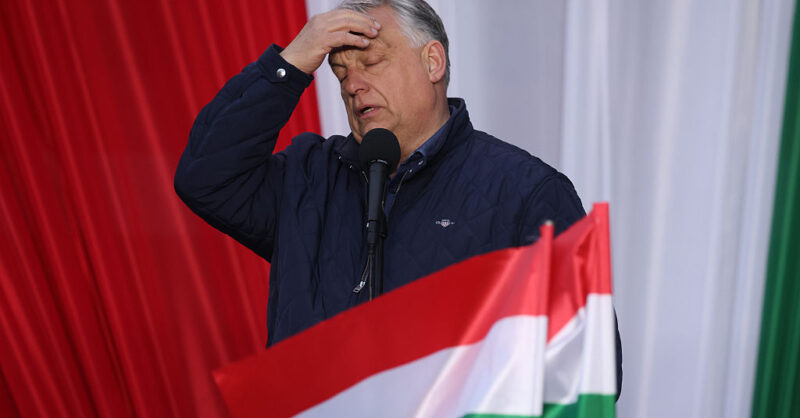
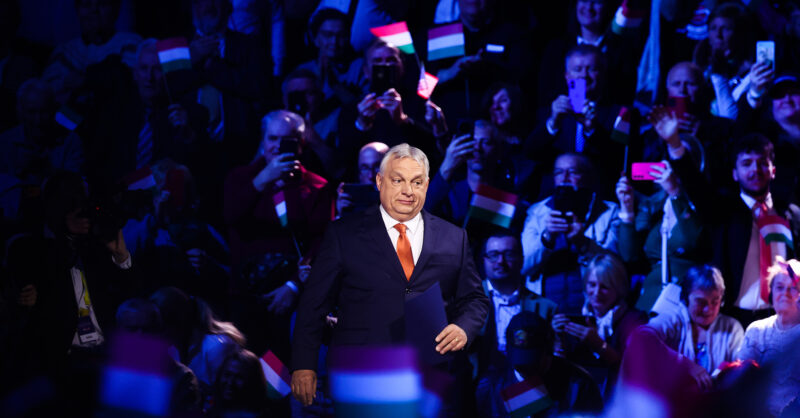
On Tuesday, 7 April, US Vice President J.D. Vance held a rally in Budapest’s MTK Stadium in support of Hungarian prime minister Viktor Orbán. The visit, part of Orbán’s campaign ahead of the 12 April general election, underlined the prime minister’s international stature – but also the central gamble of his campaign: that global politics still resonates with Hungarian voters.
This election may ultimately hinge on whether that bet still holds. After years of combining domestic dominance with international prominence, Orbán now faces an electorate increasingly shaped by economic stagnation and declining public services – raising the question of whether his geopolitically focused politics can still deliver electoral success.
Orbán is facing his most serious challenger since coming to power 16 years ago. After securing a constitutional majority, he and his Fidesz party rewrote election rules, reshaped the judiciary, consolidated control over much of the media, and cultivated a network of loyal oligarchs, including his childhood friend Lőrinc Mészáros and his son-in-law István Tiborcz. Because of this uneven playing field, Hungarian elections are often described as “free but not fair”. Yet Orbán has also enjoyed genuine popular support, retaining a two-thirds parliamentary majority in three consecutive elections.
In the past decade, his electoral success and hardline anti-immigration stance have made him a prominent figure on the international right. Admirers across Europe – from Matteo Salvini to Marine Le Pen and Geert Wilders – have presented Orbánism as a model for Western governance.
Subscribe to the New Statesman today and save 75%
His influence extends to the United States, where Republicans often praise his Christian messaging and family policies. Donald Trump namechecked him during his 2024 debate with Joe Biden. Institutional ties have also deepened: Budapest hosts an annual edition of the Conservative Political Action Conference (CPAC), and Fidesz-aligned figures have built extensive links with US conservative networks. Vance’s visit represents the culmination of these efforts.
During his speech, Vance accused the European Union of interfering in Hungary’s election and praised Orbán’s positions on energy and the war in Ukraine, calling him a “more important and constructive partner for peace than almost anyone anywhere else in the world”. He framed Orbán as a defender of Western civilisation: “There have been too few people willing to stand up for the values of Western civilisation. Viktor Orbán is the rare exception,” he said.
Such rhetoric reinforces Orbán’s core campaign message: that he alone can shield Hungary from a dangerous and chaotic world. The government has repeatedly claimed that Ukraine is working to unseat him and draw Hungary into war. “What’s at stake at this election is our ability to keep Hungary out of the war,” Orbán told supporters at a rally in Székesfehérvár. “The Americans are now on the side of peace. But Europe still wants to continue the war – and if we don’t pay attention, it will drag us into it too.”
Among attendees, this message clearly resonates. Gábor, a supporter at the rally, said the war was a decisive issue. He argued that Péter Magyar’s openness to Ukraine’s EU accession could ultimately drag the bloc – and Hungary – into conflict. Another attendee said she backed Orbán because she wanted peace for future generations. “I want my grandchildren to live in peace, and that’s why I don’t want to send any weapons to Ukraine,” she said.
Yet Orbán’s campaign focus on geopolitics exposes a vulnerability. Hungary’s economy has stagnated in recent years, with investment falling and headline inflation peaking at around 25 per cent in early 2023. The European Union is withholding roughly €17 billion (£14.8 billion) in funds over rule-of-law concerns – resources that previously underpinned rising living standards. As economic pressures mount, voters appear increasingly focused on domestic conditions rather than international positioning.
This shift is fuelling the rise of Orbán’s challenger, Péter Magyar. On the same day as Vance’s visit, Magyar held seven rallies outside Budapest, drawing large crowds even in small towns. His party, Tisza, now leads in several independent polls, with some suggesting it could even approach a constitutional majority. A former Fidesz insider, Magyar rose rapidly after a 2024 scandal that forced the resignation of President Katalin Novák. Since then, he has consolidated support across the political spectrum, positioning himself not as a liberal reformer but as a pragmatic critic of state decline. His campaign avoids abstract debates about democracy, instead focusing on healthcare, education, infrastructure, and corruption. At rallies, that message appears to resonate strongly. In Dévaványa, a town of 7,000, Magyar filled the main square on a weekday afternoon – an unprecedented turnout for an opposition figure in recent years. Asked why voters are responding differently this time, a local organiser offered a blunt explanation: “Because they are much poorer now.”
Magyar’s speeches frequently draw sharp contrasts between everyday hardship and elite wealth. “In ten years, Lőrinc Mészáros… has become richer than the British monarchy did in 400 years,” he told one crowd – a claim that overstates the comparison, though Mészáros’s wealth has indeed surged dramatically. He couples such rhetoric with vivid, emotional appeals, highlighting failing infrastructure and poverty.
At a rally in Aszód, these themes were echoed by attendees. One elderly woman said she was backing Tisza because “the government did not spend EU funds on pensioners or on our hospitals, but gave them to its oligarchs instead. That money should have been spent on us.” A man in his forties, who had previously voted for Fidesz, said he was now considering switching sides because “there has been a lot of theft” and pointed to the deteriorating condition of hospitals and roads. Others shared similar frustrations. A teacher described “economic rot” and said public services had declined to the point where families increasingly rely on private healthcare. Another attendee recounted how her grandmother died waiting for surgery, highlighting the human cost of systemic strain.
Unlike Orbán, Magyar frames the European Union not in civilisational terms but as a source of tangible benefits. At his rallies, he speaks of unlocking frozen funds to revive the economy and repair public services – offering a materially grounded alternative to Orbán’s geopolitical narrative. This election, then, is not just a contest between two politicians, but between two visions of politics itself: one centred on global conflict and national sovereignty, the other on economic recovery and everyday governance. Orbán has long relied on external threats to mobilise support, but that strategy depends on voters feeling they have something to lose. As living standards stagnate, that calculation may be changing.
Even so, Orbán retains structural advantages, and any transition of power would be far from straightforward. Magyar’s coalition is ideologically diverse and bound primarily by opposition to the current government. Meeting expectations – particularly rapid economic improvement – would be a formidable challenge. Whether Orbán’s internationally focused politics can still secure domestic legitimacy is now the central question. For years, his model has appeared durable. This election will test its limits.
[Further reading: If Viktor Orbán loses, global Orbánism is over]
Content from our partners
Related