An English life in Vladimir Putin’s twilight zone
An Orthodox church, a long curved sword, a candle; a fish, a ladder, a red arrow, a red spoon, and a saw blade crowd the canvas around a confused man in a top hat, his mouth open. This is a 1914 Kazimir Malevich work titled An Englishman in Moscow. Reading The Descent, a new book by the Times’s long-time Russia correspondent Marc Bennetts, it is hard not to see him in the painting.
An Englishman in Moscow (1914), Credit: Stedelijk Museum Amsterdam.
Subtitled “Witnessing Russia’s Spiral into Madness Under Putin”, Bennetts’s book begins with a familiar story of a hopeful and somewhat disorganised young Briton moving to a foreign country and going (almost) native. Unfortunately for the author, he travelled to Russia instead of Tenerife or Thailand— and so he was forced to pack up and leave abruptly after the full-scale invasion of Ukraine in 2022.
Bennetts looks back at his 25 years in the country that he got to know very well indeed — much better than Vladimir Putin, he claims — and amusing and horrifying anecdotes collected along the way. He studied Russian by chatting with homeless Afghan War veterans in St Petersburg, learnt to drive a nuclear waste truck in Voronezh, interviewed a psychic who claimed to have Kremlin officials among her clients, escaped from drunken fishermen in the Arctic, ate blueberry muffins with religious hardliners known as TheOrthodox Taliban, drunk excessively with Spartak Moscow hooligans and tried to decipher the neurotic impulses of a nationalist party boss.
But stories of exotic encounters serve a purpose: to try and answer a series of questions that now keep the author up at night back in Britain. Why has Russia “allowed itself to be ruled by the same former KGB officer, a man of unremarkable intellectual ability” for over 25 years? And “how and why did Russia slide so quickly into violent nationalism?” Of course one answer presents itself immediately. Those who dared to challenge the regime could face professional ruin, torture, forced disappearance, arrest on trumped-up charges and imprisonment. But even those silently opposed to the regime appear to have always been a minority.
Subscribe to the New Statesman today and save 75%
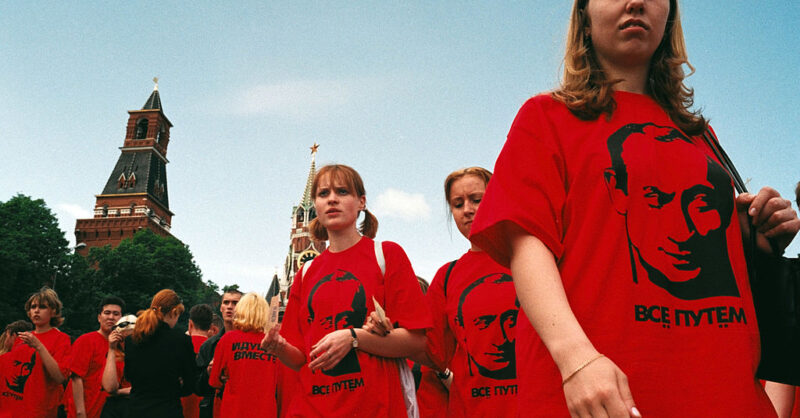
Does that make Putin supporters a majority? Not really, says the author, pointing to a near-total absence of organic pro-government or, since 2022, pro-war rallies. To have decent turnout, both federal and local governments had to either force public sector employees to attend a rally — or to pay random people to do so instead. Bennetts tells a fascinating story of a 2018 pro-Putin gathering in Tyumen, Western Siberia. It was organised by local opposition activists curious to see how many people would take part with no bribes offered or pressure exerted. In a city of over 800,000 people, only seven men showed up.
Where does that leave the rest of the country, then, if both pro-government and opposition-minded citizens are in the minority? The majority simply do not care, says Bennetts: “The overwhelming sense I got from travelling across Russia was one of apathy. Most people were utterly convinced that nothing depended upon them, a conviction the Kremlin did its very best to encourage.”
This all-consuming apathy later developed into cynicism and nihilism. Again, why? One gets the idea that it was the consequence of the deep poverty that millions were plunged into after the Soviet Union’s collapse. The author’s first work contact in Russia in 1997 was a woman with “a scarf wrapped around the lower half of her face.” He later found that “she had been embarrassed about a foreigner seeing her blackened, crumbling teeth.” And while life in big cities gradually got better — and in Moscow some had it very good for the last two decades — for much of Russia, very little has changed. But however minor improvements in daily life were, rule by Putin was apparently worth it. The author sums this logic up as: “What were a few stolen votes compared to a guarantee of warmth and electricity?”
None of this is to justify or absolve the Russians’ actions, or lack thereof. Early on, Bennetts confesses early that he has nothing but hatred for active pro-regime agitation and for silent acquiescence alike, especially after having reported from Kyiv and other places since the full-scale war began. Bennetts has covered towns devastated by Russian air strikes and interviewed Ukrainians tortured under Russian occupation. Or, for that matter, having reported on similar torture used against opposition inside Russia when it was still safe enough for him to make a home there.
In 2026, moral indignation about the Russians’ perceived indifference to the suffering of others is not exactly an original idea. But Bennetts did not just judge from afar — he debated those he disagreed with, from his own Russian mother-in-law and neighbours to football hooligans and nationalist firebrands. His recollections of these arguments are perhaps the most compelling part of the book. The narrator is vulnerable, often emotional and sometimes naive, anything but a detached observer. Take, for example, a visit to a neighbour from his apartment block who turned out to be hooked on state TV and its lies. “I thought that she might listen to me if I told her the truth,” Bennetts writes. But listen she did not: “My neighbour’s eyes flashed with sudden fury and her voice seemed to drop a tone. <…> It was as if she was possessed by a demon.”
No less amusing are his repeated attempts to awaken the consciousness of top Russian propagandists. As a Russian “I wanted to look into her eyes, although not for too long, and gauge for myself if she genuinely believed the things she was saying or if she was saying them merely to further her rise up the bloody rungs of Russia’s political ladder”, Bennetts writes of one encounter. Unlike the neighbour, the loyalist MP in question found his arguments intellectually stimulating and wanted to keep talking. When finally Bennetts presented her with evidence of lawlessness tolerated from the very top, she texted back in despair, “What do you want from me?”
The reader is tempted to contemplate scenes of an Englishman roaming the streets of Moscow arguing with people from all walks of life. For a change, I found myself mildly scandalised by this image, after nodding along to every page. He describes Russia exactly as millions of Russians in their 30s know it, myself included, without banging on about its profound differences from the West — or pretending it is a regular European country. But the thought of debating politics with perfect strangers, let alone with propagandists, is bewildering to a Russian. In a fractured and polarised society, there is rarely any interest in a discussion with anyone outside of what is called “people of our circle,” a euphemism for social class and education background. It takes an outsider with no set allegiance and a certain naivety about the place to strike a conversation.
And whatever little Bennetts shares of his post-Moscow life is equally amusing: a Bristolian who comes back to England after 25 years, observing Russian superstitions and mixing Russian nu (a filler like “um” or “well”) into his speech. Perhaps contrary to the author’s design, his idiosyncrasies make him the most interesting character of the book. He is also the only recurring character of the book. Others are a well-known cast of heroes and villains whose stories would be familiar to international audiences with even the vaguest interest in Russia. Alexey Navalny, Boris Nemtsov, Pussy Riot and others represent one side and Putin, the FSB and nationalist ideologues the other. These mini-profiles sprinkled with exactly the quotes one expects from each figure provide little new material for understanding either side.
Much more intriguing are mentions of Russians with stranger life trajectories, like a lesbian rock band playing secret gigs across Moscow, or of a teacher in Siberia who organises his colleagues to protest woeful salaries but remains a firm believer in Putin’s benevolence. Another bizarre personage is Jeff Monson, a retired UFC star from Minnesota who moved to Russia to sit on a city council in the Moscow region and work for state propaganda. He tells Bennetts he does not like to be called a “useful idiot” and then proceeds to behave exactly like one.
These minor characters rarely get more than a couple of paragraphs. One exception is a profile of Dani Akel, a Russian-Syrian young man raised between Moscow and Aleppo. He studied philosophy in Russia but was expelled after a conviction for attending opposition rallies. In 2022, he travelled to Ukraine and eventually joined a unit of Russians fighting with Ukraine’s armed forces against their own country. The author met him while reporting from Ukraine and they stayed in touch until Akel’s death on the battlefield, at the age of 25. Bennetts later brought a photo of Akel’s favourite place in Moscow, Tsvetnoy Boulevard, to the man’s grave in Kyiv. It is a powerful and complex story, not in the least because even some of the leading Putin critics have misgivings about Russian units fighting on Ukraine’s side.
There is also a bigger question looming over this and other recent books from foreign correspondents. What is their role in an age where social media is flooded with footage of drone strikes, violent crimes and mass protests for the millions of sleep-deprived news junkies to “monitor.” If Evelyn Waugh was to write Scoop in the 2020s, William Boot would not need to leave his dear Boot Magna Hall armed with a collapsible canoe and cleft sticks.
Equally, a different kind of a foreign correspondent, one with a taste for strong opinions about the place, is also at risk. Everybody on the internet has a hot take, and there are thousands of regional experts with PhDs offering instant analysis. In other words, it will be difficult for a new Robert D. Kaplan or Tom Friedman to emerge from the traditional wellsprings of print newspapers, magazines and serious non-fiction publishing.
But there is also a different approach to the role, one that is based on a deep personal connection to the place. Instead of exclusively reporting news from a foreign country or offering grand theories about it, it is built around both personal introspection and what is called strategic empathy, an attempt to understand the other’s perspective without falling head over heels in love with it. It usually involves spending a long time in one country, city or even neighbourhood, rather than bureau-hopping.
Ultimately, Western readers would only care about a distant nation if the correspondent reporting from it feels its suffering as her own suffering, “which is in a sense what love is,” wrote a longtime Istanbul hand Suzy Hansen in Notes on a Foreign Country: An American Abroad in a Post-American World.
Bennetts’s book passes this test. He moved to St Petersburg in 1997 with “only a handful of words in Russian”. In 2022, he was departing Moscow with his Russian wife and their daughter, and by that time he was dreaming in the language. “It is a strange and rare experience to lose yourself so completely in a foreign culture, especially one that had been so inaccessible for so many years,” he muses. Moscow has now closed once more, at least for those like Bennetts who have an argument with the Kremlin.
[Further reading: How Russia became a franchise of the Wagner Group]
Content from our partners
Related