Inside Birmingham’s eternal bin strike
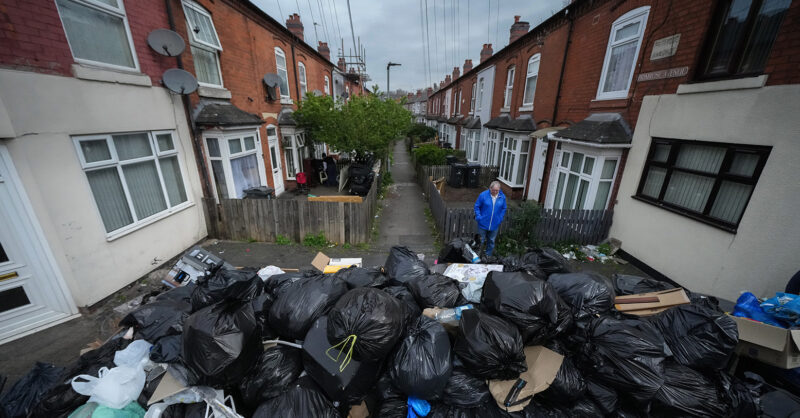
Last year, Birmingham was overflowing with rubbish. Sacks of waste piled high, the overflowing contents spilling onto the humid streets. Rats, reported to be “the size of cats” roamed the streets. Local Conservative members dressed up as rats in response to the council’s lack of action. The New York Times declared the city Britain’s “garbage” capital.
So much of political discussion can feel aloof from the everyday worries of voters: bin collections, potholes, and planning, operating on a treadmill of never-ending “permacrisis”. Yet the values and aspirations Britain is arguing over – a fair wage, a decent life, and civil debate – can be found in these local disputes. Oil price shocks affect everyone. But voters are most motivated by the specificities of their lives. Birmingham is one once-mighty industrial city which is continuing to prove that all politics is ultimately local.
The dispute began over the council’s decision in early January 2025 to abolish the waste recycling and collection officer role – a senior position on each bin crew that Unite, the union representing the refuse workers, claims is vital for the safety of its workers. The union estimated that scrapping the role would lead to around 150 workers losing up to £8,000 a year each. (The council disputed that figure initially, saying the maximum loss would be just over £6,000 and would only affect 17 workers, with pay protected for six months.)
As a response to the abolishment of the position, around 350 bin workers planned 12 walkouts across four months last January. Two months later, that became an indefinite all-out strike. And the union’s demands widened too: Unite wants guaranteed long-term pay for bin lorry drivers, warning that under the council’s job re-evaluation process, bin lorry drivers, classified as a Grade 4 job, were in line to be dropped to a Grade 3, which would mean a pay cut of £6,000-£8,000. Some drivers were reported to be at risk of compulsory redundancy.
Subscribe to the New Statesman today and save 75%
Tensions at the Redfern Road Depot, in Tyseley, east Birmingham, erupted last July after strikers breached a High Court injunction, issued in May, by blocking bin lorries from being deployed and workers “slow walking” next to lorries as they began their rounds. This week, the High Court ordered Unite to pay £435,000 – £265,000 in fines to the government and £170,000 in costs to Birmingham City Council – because of those breaches. Unite says there was a “genuine misunderstanding” as it believed the injunction only applied to protests in the immediate vicinity of the depots.
I visited Redfern Road Depot in early March, on the anniversary of the strike. Protesters were waving red flags that read “I support the Brum bin strikers” alongside a smiling Oscar the Grouch, his fist punching the air in solidarity. Two men were working together to inflate a giant rat, to cheers from the strikers. I didn’t see any rats, or even uncollected bin bags, in the clean city centre. The mess had all been pushed to the edges of the city. In lay-bys, I saw mattresses, old shopping trolleys, a hollowed-out pineapple.
The workers on the picket line were furious with the council. Wendy Yarnold had worked as a refuse collector for nearly ten years. She rented a three-bedroom home from the council – the same council she was on strike against. “My rent is going up from £600 to £650,” she said. “That’s before bills and food. I can’t afford groceries. And now with the rent increase I’m at risk of losing my home.”
Striking workers receive £70 a day from the Unite strike fund, leaving many struggling to stay afloat. I asked Yarnold why she didn’t find other work in the meantime, and she laughed. “What jobs are there out there? I apply for five jobs a day on Indeed. I hear nothing back.” Christmas was exceptionally hard. She had to tell her three sons she couldn’t host them. “My back feels against the wall.”
Kate joined the strike in December 2025. She worked as agency staff for a recruitment firm – Job and Talent – hired by Birmingham City Council to replace striking bin workers. Unite has accused the council of trying to “break” by doubling spending on agency staff since the start of the strike. Workers had voted in favour of joining Unite’s original strike, Unite said, after their “performances” were publicly ranked in a league table that was posted on their staffroom wall at Smithfield depot. The union also claimed managers had threatened agency workers with being blacklisted and banned from jobs if they refused to cross picket lines.
According to Kate, she lost her job with the agency when “they said through a text my service was no longer required”. She has heard that the reason was because she had posed for a photo with the striking full-timers. “Apparently, I got out and posed for a photo with them. I was dancing with them. That’s not true. What’s more worrying is the agency trying to make sure you’re not having breaks.”
When asked about this by the New Statesman, Job and Talent referred back to a previously published statement. The company said it had “no record or documentation” relating to Kate’s case, and that it did not terminate assignments on the basis of union membership or industrial action. Decisions about assignments, it said, were based on “operational requirements and worker performance”. It added that it took the welfare and working conditions of its workers “very seriously, including ensuring appropriate breaks”. Kate lives with her dad, who had also been a refuse collector before he retired. “I want to move out and buy a house,” she said. “But I can’t. What about those strikers with no family support?”
“I think I’m going to have to sell my car,” said a man called Dave, who was wearing a Birmingham City Football Club beanie. “I’ve got a Honda Civic. It’s nothing mad, just a normal car. Running it – fuel, insurance, everything – it’s hard when you can’t maintain it. I’m just about keeping the roof over my head. I never expected this in my working life. I have sleepless nights about all of this.” All of the strikers were determined to fight on against the council. In particular, many strikers mentioned David Carpenter, a refuse worker at neighbouring Coventry City Council, who died from injuries in 2023 after being lifted in a bin lorry while out on collections. Over a scratchy sound system, one union rep told the crowd: “I don’t give a shit what colour your rosette is… There is an easy resolution. It starts with [the council] walking through the door.”
Yet with only six weeks to go until the local elections, a capitulation from the Labour-run council seems unlikely. That might be the point. The strikers’ political capital has been drained, and Unite’s patience with Labour appears to be running out too. The union announced on the anniversary of the bin strike that it would cut membership fees to the party by 40 per cent, a move that could cost Labour as much as £580,000. The calculation seems to be that squeezing Labour centrally is Unite’s only remaining lever: if the party feels financial pain, it may finally pressure the council to settle.
Many of the strikers were particularly angry about the mismanagement of the council, which approved its first balanced budget to increase council tax by the standard 4.99 per cent. This is after a much steeper bump of 17.5 per cent over the previous two financial years. The council has been beset with financial problems, such as a projected £760m equal pay liability bill and a botched IT system rollout that has cost the council up to £100m. Strikers believe all of this wasted money by the council could have been better used to resolve real issues: pay and conditions with their own workers.
They were particularly angry with Councillor Majid Mahmood, the cabinet member for environment and transport. Local media reported that Mahmood had been filmed removing posters supporting striking Birmingham bin workers. He claimed he did it because “residents complain” about the placards. On a previous bin strike, in 2019, he was photographed in support of the workers. At the time he said he “firmly believed [they] have been discriminated against”. Now, he says it is “immensely frustrating” the strike has not been resolved. “Come back to work, I want you to be part of this new, improved service,” he said in a statement.
One councillor said this was not good enough. Sam Forsyth, a former Labour and now independent councillor who represents Quinton, in south-west Birmingham, said it was “absolutely ridiculous” the council could not get around the negotiating table with the strikers. It is not clear how many Labour councillors are pro-strike – the council’s press office has asked councillors not to approach the media about the strikes. Thirty-five MPs – including Tahir Ali, who represents Birmingham Hall Green and Moseley – have called on the Keir Starmer to take action to end it.
Birmingham Labour faces what may be the fight of its life in the May local elections. Already the national party was so alarmed by the regional group’s dysfunction that it has deselected a dozen councillors. Polling in the region suggests Labour will remain the largest party, but no longer command a majority. Once again, it’s impossible not to read that collapse in the national context. Voters, no matter the rosette colour, are fractured and angry. They are furious here in the West Midlands over the bin crisis, and nationwide, at the failure to salve the cost-of-living crisis which came into view after 2022, but which arguably began in 2008.In the constituency of Birmingham Yardley, a focus group of eight previous Labour voters found themselves fractured between Reform and the Greens. It is easy to dismiss them as gunning for populism on either side of the political spectrum, but with global instability gnawing on their minds, and still recovering from the fever of Brexit and the pandemic, it’s hard not to sympathise with them when they say: “We’re not having to live, but having to survive in a way.”
For Dave, he will be back on the picket line tomorrow, and the day after that. “I just want this to be over,” he says. “I want to go back to work. I want to provide for my family.” He pauses. “But not like this.”
Some names have been changed
[Further reading: How Covid fear shaped the meningitis response]
Content from our partners
Related