Inside the court of Iran’s opposition leader
On a spring morning in April 2023, Reza Pahlavi stood before the Western Wall in Jerusalem, one of Judaism’s holiest sites. Accompanied by his wife, Yasmine Pahlavi, he spoke about the possibility of restoring what he described as the “historic friendship between the Iranian and Israeli peoples.” The image was striking: the son of Iran’s last shah standing at a sacred site in a country that the Islamic Republic has treated as its most implacable enemy for more than four decades.
Within hours, photographs of the visit circulated widely across international media and Persian-language outlets. For Pahlavi’s supporters, the symbolism was powerful – a reminder of the close ties that once existed between Iran and Israel before the 1979 revolution. For his critics, however, the scene raised questions about political strategy, and the broader implications of such a gesture at a time when Iran and Israel were locked in an intense conflict.
Pahlavi’s trip took place at the invitation of Gila Gamliel, Israel’s minister of intelligence. Gamliel described it as a symbolic effort at “building bridges and collaborations between the two peoples” of Iran and Israel, whose official diplomatic relations ended after the Iranian Revolution. During the visit, Pahlavi met Israeli officials, including prime minister Benjamin Netanyahu, visited the Yad Vashem Holocaust memorial and participated in public events emphasising the prospect of future relations between a post-Islamic Republic Iran and Israel.
The highly publicised trip marked more than a diplomatic gesture. It symbolised a moment in a broader transformation of Pahlavi’s public role, a shift in which the exiled crown prince was increasingly presented not only as a historical figure but as a potential political player in Iran’s future.
Subscribe to the New Statesman today and save 75%
This notion of Pahlavi as a political actor contrasts sharply with earlier perceptions of his ambitions. For years after leaving Tehran following the 1979 revolution, Pahlavi appeared cautious about assuming a leading role in opposition politics. Journalists who profiled him in the early 2000s often described a man who spoke more about family life than about the prospect of returning to power.
Appearing on Patrick Bet-David’s podcast, PBD, in November 2023, Pahlavi reflected on his life in exile and acknowledged the extent to which his personal and social world had become disconnected from Iran. “Honestly,” he said, “my life has been here in the United States for the past four years. My children live here, my friends are here, and almost everyone I know is here. So if I were to go back, it would almost be unfair to them. What exactly would I be going back to?”
In more recent speeches, however – such as one delivered at a gathering in Munich – Pahlavi has presented himself in a markedly different light, telling audiences that he stands ready to return to Iran and help guide the country through a political transition.
This shift is best understood in the broader political and social context of Pahlavi’s re-emergence.
For many years, a significant segment of Iranian society placed its hopes in reformist politicians operating within the framework of the Islamic Republic. Beginning in the late 1990s, the reform movement promised gradual political liberalisation, greater civil freedoms and the possibility of change through electoral politics. Much of the Iranian diaspora – including Reza Pahlavi and his supporters – remained sceptical of this approach, instead advocating for more fundamental change, and often called for regime change.
By the late 2010s, however, those expectations had faded. Many political activists increasingly argued that the reformist project had reached a dead end. The growing disillusionment was captured in a chant heard during nationwide anti-regime protests in 2017 and 2018: “Reformists, hardliners – the game is over.”
The slogan reflected a widespread sentiment that meaningful political change could no longer emerge from within the existing political structure. As public frustration in Iran intensified during the 2017-2018 protests, attention began to shift toward figures and ideas outside the framework of the Islamic Republic.
At the same time, sociologists both inside and outside Iran – including Hamidreza Jalaeipour and Reza Zia‑Ebrahimi – have pointed to another parallel trend: the revival of cultural and historical nationalism among younger generations of Iranians. Since the establishment of the Islamic Republic in 1979, the state has largely framed national identity through the lens of a political version of Twelver Shia (Jaʿfari) revolutionary ideology, while expressions of pre-revolutionary nationalism have often been repressed.
Yet over the past decade, public displays invoking Iran’s ancient past have increasingly appeared during protests and gatherings. Demonstrators have repeatedly chanted slogans such as “Neither Gaza nor Lebanon, my life for Iran,” emphasising national priorities over regional allegiances designed to constrain Israel. Another example is the annual Cyrus the Great Day gatherings at his tomb in Pasargadae on 29 October. Despite restrictions, crowds assemble to express cultural pride and historical identity predating the Islamic Republic. In 2016, thousands gathered at the tomb and several organisers were arrested by the government.
The combination of these developments – disillusionment with reformist politics and the revival of nationalist symbolism – has created a political and cultural environment in which figures associated with Iran’s pre-revolutionary past can regain relevance and political influence. In this context, Reza Pahlavi’s name has begun to surface. In a manner unthinkable in 1979, the Pahlavi family was once again becoming part of discussions around Iran’s future.
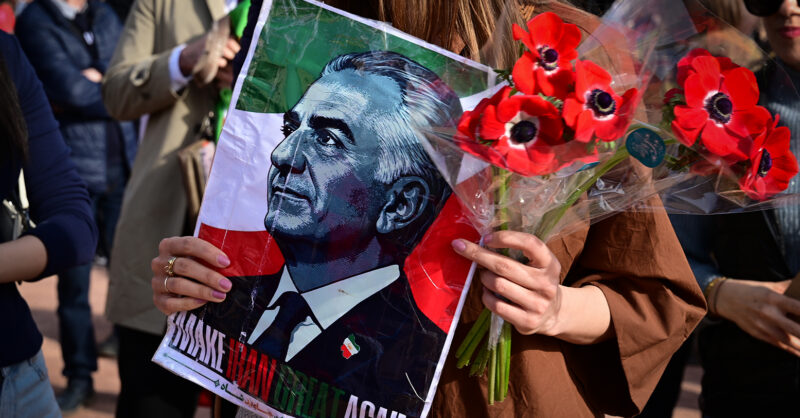
The resurgence of attention around Pahlavi became particularly visible during the wave of protests that followed the death of Mahsa Amini in September 2022. The demonstrations, widely known by the slogan “Woman, Life, Freedom,” represented one of the most sustained challenges to the Islamic Republic in its history.
At the height of the protests, a group of prominent Iranian opposition figures gathered at Georgetown University in Washington, DC, on 10 February 2023. The meeting brought together activists, intellectuals and political figures from diverse ideological backgrounds who sought to present the appearance of a unified opposition front advocating democratic change in Iran.
Pahlavi joined the gathering and spoke on the panel alongside Masih Alinejad, Iranian journalist and activist; Nazanin Boniadi, human rights advocate and actress and Hamed Esmaeilion, spokesperson for families of victims of the 2020 Ukrainian plane crash. He emphasised the need for unity among the opposition. His presence signalled an effort to position himself within this emerging coalition. Participants described the meeting as the first step towards cooperation between groups that had historically been divided by ideological differences and political rivalries.
Yet the unity projected at Georgetown proved fragile. Disagreements soon emerged over questions of leadership, decision-making and political strategy. Within months, tensions within the coalition became increasingly visible, and the alliance began to unravel. Several members, including Alinejad and Esmaeilion, blamed Reza Pahlavi for the breakdown, arguing that he sought to position himself as the group’s leader and attempted to impose decisions on the coalition. As these internal disputes broke out in public, Reza Pahlavi’s official visit to Israel was announced.
While debates about leadership continued among opposition activists, another dynamic was unfolding in parallel – one that took place largely in the digital sphere.
In October 2025, an investigation by the Israeli newspaper Haaretz, drawing on research from the Citizen Lab at the University of Toronto, reported on what it described as a large-scale Persian-language online influence campaign. According to the investigation, networks of coordinated social media accounts, AI-generated videos and digital avatars were used to circulate content promoting the restoration of Iran’s monarchy and amplifying Reza Pahlavi’s public profile.
Researchers suggested that the network worked to distribute speeches, hashtags, and imagery associated with Pahlavi across Persian-language digital spaces, portraying him as a central political figure in a potential post-Islamic Republic Iran. At the same time, investigative reporting from organisations such as Mediapart has drawn attention to the role of lobbying networks in Europe that promote closer political ties with Israel and Reza Pahlavi’s campaign. The European Leadership Network (ELNET), an organisation that describes its mission as strengthening relations between Europe and Israel, has in its articles and events aimed at European audiences highlighted Reza Pahlavi as a potential leader who could guide Iran toward democratic change.
Supporters of Pahlavi argue that the renewed attention surrounding him reflects a genuine shift in Iranian public sentiment. Justin Forsyth, a political adviser and communication strategist who previously worked with former British prime ministers Tony Blair and Gordon Brown, and who now advises Pahlavi, describes Pahlavi’s political project as a long-standing mission centred on democratic transition.
“His mission has always been to serve the people of Iran and to establish a secular and democratic government,” Forsyth tells me. “What has changed is timing. The people of Iran have made their choice. More than 43,000 people did not die for the nuclear deal; they died for freedom and democracy” – a reference to the demonstrations of 8 and 9 January this year, when hundreds of thousands of Iranians took to the streets following a call to protest made by Pahlavi. They were met with a violent crackdown by the authorities, reportedly resulting in the deaths of thousands.
According to Forsyth, Pahlavi occupies a unique position capable of bridging divisions within the opposition. “He is the only person who can unite the democratic opposition while also providing a reliable national pathway for the armed forces and security institutions to separate from the regime,” he says. “Tens of thousands within the armed forces – including members of the regular army, the Revolutionary Guard, police, and intelligence agencies – have contacted him through secure channels.”
Forsyth emphasises that Pahlavi has repeatedly stated that he does not seek to restore monarchy through personal ambition. Instead, he presents his role as transitional: helping create conditions for a democratic process in which Iranians themselves would determine the future constitutional structure of the state.
Not everyone who has worked with Pahlavi in the past shares this optimistic assessment. Some former associates have expressed doubts about his leadership style and political strategy.
Ramin Parham, an Iranian writer who once served as an adviser and speechwriter to Pahlavi, argues the crown prince lacks the charisma necessary to lead the kind of movement he’s aspiring to: a Khomeini-like political force. In his view, Pahlavi has never demonstrated a willingness to return to Iran or assume the risks associated with leading a political struggle in the midst of revolutionary upheaval. He points to the January demonstrations, when Pahlavi issued a call for people to take to the streets and claimed that members of the armed forces in the regime had been in contact with him, with signs of possible defections. He argues that such deceptive statements created unrealistic expectations and illusions among emotion-driven teens who made up the bulk of casualties in the subsequent and expected bloody crackdown. The government’s brutal response began on 8 January, combined with an internet blackout.
The following day, Parham says, he sent a message to Pahlavi “through a trusted intermediary”, advising him to refrain from issuing a second such call, warning that further bloodshed would follow and could rightly be blamed on Pahlavi’s “moral responsibility”. His warning was “expectedly” ignored, he says.
Parham maintains that this episode makes Pahlavi unfit to be a leader. Citing Henry Kissinger, he adds that effective leadership requires “a combination of the farsighted pragmatism of the statesman and the visionary boldness of the prophet,” qualities that have not been demonstrated by Pahlavi during the severe and multi-layered crises Iran has faced in recent years.
Parham describes the crown prince as someone heavily influenced by court sycophants and flatterers, “bowing to their knees in front of His Imperial Majesty!” “Have you ever seen someone bow down to the waist before another human and kiss his shoes?” he asks me. “This is exactly the kind of behaviour you see around Pahlavi.” What Pahlavi wants, he says, is “the benefits of his last name without the responsibilities that come with it”. It is behaviour “typical of a spoiled child”.
According to Parham, the circle surrounding Pahlavi resembles French reports of the court of Versailles: a “factory of lackeys and yes-sayers”.
Similar concerns have been voiced by Marty Youssefiani, another former adviser who is now involved in organising opposition initiatives, including a project known as the Transition Group, which aims to bring together different opposition actors to discuss potential frameworks for political change in Iran. Pahlavi and members of his current circle have strongly opposed the initiative, arguing that its objectives conflict with what they see as the need for a unified leadership centred around the Crown Prince .
Amir Etemadi and Saeed Ghasseminejad, the two main current advisers to Pahlavi, have drawn particular criticism. Some members of Pahlavi’s former circle jokingly refer to the pair – both former student activists in Iran – as “Mirza Ghassemi”, combining their names in a sarcastic nod to the well-known Iranian dish.
Yusefiani tells me the pair have been widely criticised within parts of the diaspora opposition for allegedly limiting access to Pahlavi, creating a highly centralised and insular environment. Youssefiani also believes that Pahlavi’s standing among Americans has been undermined, citing repeated comments by President Donald Trump in which he suggested that Pahlavi is not the US’ choice for leader following the fall of the Iranian regime.
Yet Pahlavi’s supporters argue that his political significance cannot be understood solely through the dynamics of diaspora politics. They point instead to broader intellectual and cultural debates unfolding among Iranians themselves.
Chahla Chafiq is an Iranian writer who was involved in left-wing activism against the Shah’s government during her student years before 1979. She was recently seen alongside Dariush Ashouri, a highly respected Iranian intellectual, in a meeting with Pahlavi – a moment that sparked controversy among Iranian political activists, particularly within intellectual and left-wing circles opposed to him.
Chafiq has studied the writings and cultural expressions of younger generations of Iranians, and believes they have a deep desire for personal freedom. She tells me that after the disappointment of the reform movement, new political ideas began to emerge in the streets – ideas that combine demands for democracy with a renewed emphasis on being Iranian, rather than an Islamic framework.
She points to Majidreza Rahnavard, a protester executed during the recent demonstrations. Rahnavard reportedly had a tattoo of the Iranian lion-and-sun emblem, and requested that the Qur’an not be recited at his grave. These gestures have resonated deeply with many Iranians, particularly during the recent funerals of protesters killed in January, and which Chafiq interprets as symbolic expressions of attachment to a distinctly Iranian national identity. In her view, Pahlavi has attempted to respond to these cultural currents by presenting a political project that goes beyond nostalgia for the Peacock Throne. Like Forsyth, she notes that he has proposed plans for a democratic political structure in which Iranians themselves would determine the country’s future.
While Pahlavi remains highly visible in meetings, speeches and media appearances, his public presence often appears symbolic rather than operational, offering little evidence of engagement with the hard realities of power: internal rivalries, wartime decision-making and the complex logistics of governing a state in transition.
Meanwhile, signs from within his own circle suggest persistent instability. His recent dismissal of close adviser Hamed Sheibani Rad – followed by Rad’s public criticism of what he described as a “court-like” inner circle – exposed internal dysfunction. Such episodes cast doubt on Pahlavi’s ability to maintain cohesion even among close allies, let alone across a diverse political landscape.
Against this backdrop, Pahlavi has sought to focus on forward planning. His recent announcement of a “committee for drafting the framework for transitional justice” – chaired by Nobel laureate Shirin Ebadi and composed of cross-generational Iranian experts – signals an attempt to anchor his vision in legal and institutional terms. The initiative, part of the Iran Prosperity Project, proposes mechanisms such as a special court for crimes against humanity and a “truth commission”, addressing decades of unresolved injustice. Yet while this represents one of the more concrete elements of his platform, its political traction remains uncertain.
His supporters argue Pahlavi is, at present, the only widely recognised figure capable of guiding Iran toward a democratic transition. Yet that transition is still far off. At present, Iranians fear both Israeli bombs and the echo of Basij militias marching through the streets, chanting religious slogans as they move to suppress and kill unarmed civilians. Within this climate of fear and urgency, a new political imagination is taking shape. It remains to be seen what role Pahlavi will play.
[Further reading: How ready is Britain for fuel shortages?]
Content from our partners
Related