I have avoided going to the dentist for as long possible
I write these words under a doom; a doom of dentistry. You might remember that last week I mentioned the tooth that had split. Ten days on, it is still, incredibly, hanging on in there. How it is managing this I have no idea. I mean, it doesn’t even have gravity on its side. But there it is, flapping away like… like… I give up. Language fails me.
One good thing has come of this: I have an NHS dentist. I had mentioned the tooth to my friend S— and she said, “Run, don’t walk, to the M— Dental Practice round the corner from you. They’re taking NHS patients. I’ve been going there for years and they’re lovely.” She even commended its “ramshackle” aesthetic, which I had thought not the most desirable adjective to choose when describing a dentist’s.
As it happens, the M— Dental Practice is the closest non-private building to the Hove-l that I know of; it is even closer than Waitrose. And as such, I walk past it every day, and were it not for the sign outside, you’d think it was occupied by the kind of people Channel 4 used to make documentaries about. The last dentist’s I ever attended somewhat regularly was also NHS but it was in Wimpole Street and, let me tell you, Wimpole Street looks down on Harley Street as its shabby, disreputable uncle. My fang wrangler there was the excellent Mr Weiss. (Like posh surgeons, none of this “Doctor” business, but I think that changed.) With his white curls and moustache, he looked a little like a cross between Harpo and Groucho Marx, and, like them, he had a cunning wit. Unlike the good Bros M, Mr Weiss expended on (a) the state of my teeth and (b) whoever the health secretary was. Each gave him plenty of material to work with.
But I was as fond of him, or so I thought, as one could be of a dentist, even though his manner of treatment was not of the kind that displaces one’s fears and makes one look forward to the next six-monthly check-up. My father also went there, and of him, Mr Weiss would say “it was all I could do to keep him in the chair” – and my father was no coward. I think I averaged five years between visits. This was despite the opulence of the waiting room – its table scattered with the poshest magazines you can imagine – and the fanciness of the high-tech equipment.
Subscribe to the New Statesman today and save 75%
The M— Dental Practice is not like that. It does have a table in the waiting room, but the publications on offer are either an old copy of Metro, or the latest edition of the Dentist, and another one called something like Aesthetics, which is not about the beauty of art but about making your teeth look nice – as far as I could see. I put both magazines back down on the table with a shudder and read a book on my phone. I had also noticed the box of baklava beside the receptionist; a brave snack, I thought, for such an establishment.
I asked myself: can poetry save me? I can think of only two poems mentioning teeth in any meaningful way, and one of them is Pam Ayres’s self-explanatory “Oh, I Wish I’d Looked After Me Teeth”, and the other, separated from Ayres’s work both by millennia and by sentiment: “Thy teeth are like a flock of sheep that are even shorn, which came up from the washing,” and I don’t even want to think about what kind of animal my teeth look like. If they were sheep, they’d be put on a bonfire and the farm they were on would be sent into quarantine for a year. Oh, there’s another poem, the riddle in The Hobbit (and, I think, the Exeter Riddle Book): “Thirty white horses on a red hill,” etc. I’m pretty sure I have fewer than that. (“But we has only six!” answers Gollum.)
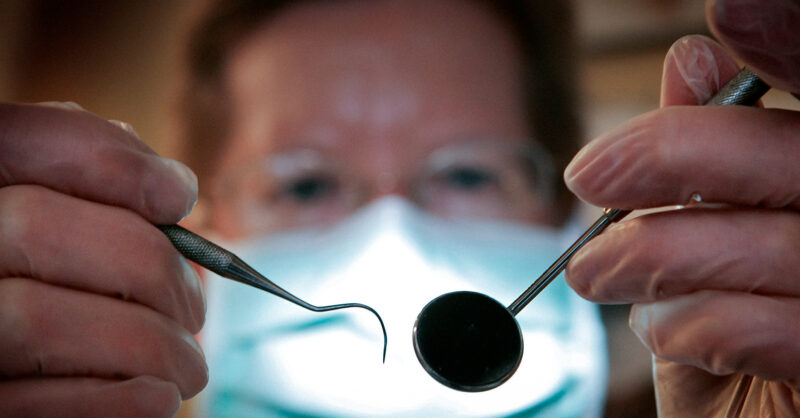
But my dentist… oh, my new dentist. As unlike Mr Weiss as possible – a young woman with an accent from the subcontinent, a neat bob of black hair, a bearing as kind and gentle as his was brusque and no-nonsense; black, sympathetic eyes, and a ready smile full of mercy. And Solomon would have gone nuts about her teeth. He’d have crumpled up his first draft full of sheep and aimed for something better. No one has handled me with such tenderness since I dropped from the womb. She almost certainly sees in me a terrified old man, and in this she is bang on the money.
She did a couple of X-rays (the surgery and the equipment are not as fancy as Wimpole Street was in 2010, the last time I checked) and showed me where all the cavities were. The tooth behind the split one was also carious, and had to go too.
“But it doesn’t hurt,” I said. “It also works. Can we keep it?” I added, as if I were asking about a tattered family heirloom that might contain moths. “Look, if it starts hurting, I’ll come running back here.” She accepted this.
Anyway, in slightly under four hours I will be back in her chair, having been told to eat beforehand, as the anaesthetic works better that way. I might struggle down to my local caff, Belchers, for sausage, egg and chips, but I fear that I will have little appetite.
[Further reading: Len Deighton was a revolutionary]
Content from our partners
Related
This article appears in the 18 Mar 2026 issue of the New Statesman, The new world war