In the moment, at night, with Keith Jarrett
Listen to a Keith Jarrett live show and you will regularly hear, buzzing almost out of earshot like a honey bee, Jarrett’s voice, as he double-tracks his own prettiest bits of piano playing, and lets out small cries in a way that is apparently quite beyond his control. The pianist Glenn Gould did the same thing – his recording engineers hated it.
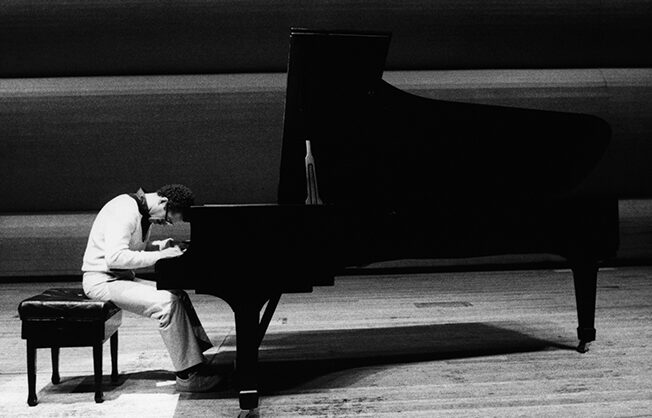
For Jarrett, for whom the set was often entirely improvised, it was a spontaneous expression of feeling about the music created in that moment. While it was OK for him to make noise, woe betide you if you did. He has stopped performances because of audience members coughing, down the years. (Who has not experienced the random epidemic of “dry throat” that spreads through a concert hall during a show’s subtlest movements?) He also has extremely specific piano needs, favouring a 10ft, half-ton Bösendorfer Imperial for a while – though not every venue could provide one.
In perhaps the most famous story in jazz history, Jarrett was given a dud six-footer with no damper pedal at the Cologne Opera House in 1975 – for a concert he was due to play at 11.30pm, after a 500-mile car journey and no dinner, with a really sore back. Incredibly, he did not walk off stage, and the live recording of that fully improvised show became the highest-selling solo jazz album of all time. The Köln Concert is talked about, these days, as a kind of fairy-tale moment, as Jarrett’s unreal talent overcame the many obstacles before him, the “magic” being inside, rather than in the machine he thought he needed (you can hear him thumping the broken pedal like a bass drum). But legends aside, this was an absolute worst-nightmare scenario for a musician of his ability, the jazz equivalent of a total tech fail at a Ted Talk. It is not surprising that he spent his life trying to distance himself from the recording, or that it didn’t stop him being fussy about pianos. It must have been destabilising, for Köln to become as successful as it was – though I miss the live album as a genre, that true symbol of improvisation, of a fleeting beauty that will never be recreated.
Jarrett is 80 now, and unable to play concerts following a series of strokes in the last few years. In the Barbican’s forthcoming programme of events celebrating his life, which starts on 30 March, two classical pianists, Thomas Enhco and Maki Namekawa, will present their own version of Köln – a funny thought, because Köln only happened once.
Subscribe to the New Statesman today and save 75%
The main reason for Jarrett’s popularity in the 1970s, and beyond, is his accessibility. As someone once pointed out, “Sometimes he’s an anarchist, and sometimes he’s not.” Jarrett may improvise, but he keeps his metre steady, and he doesn’t go wild. What appeals to me most is his attraction to – and lack of snobbery towards – that which is musically gorgeous, in the true sense of the word. There are many delicious components to his playing. His “modal” chords, for instance – ghostly chords that hover around the edges of more obvious ones – and your musical expectations – like an aura. Then there’s his technique of delicately spilling clusters of notes with his fingers for a sound that is inherently emotional – a kind of musical deliquescence. There is often a deep, kinetic left hand, thumping away like a motor. There are tonal resolutions that make you narrow your eyes, like having a good scratch (listen to his 1978 album My Song).
The combination of technical ability and “accessible” beauty is not that common in top musicians: you so often find one without the other. As well as his extraordinary tenderness, Jarrett is marked out by his ability to move between many different genres in one piece, from snatches of Bach to gospel. He was a product of his age – the age of jazz fusion – in which his contemporary Chick Corea might dress up in a sombrero and do a “Spanish” album on the piano, just because he was going through a flamenco phase. Jarrett did not like the term “jazz” player: he once called it “universal folk music”.
But talk about it too much, and you ruin it. To watch him being interviewed, back in the day, is to be reminded that jazz musicians and journalists will forever speak different languages. What a drag it must be, to have to spend your life talking about this thing only you can do, to an interviewer who can’t do it, for an audience who also can’t do it… “How much of what you played just now did you KNOW you were going to play when you sat down?” asked a presenter in a 1970s interview – which wasn’t a bad question at all. “None of it,” Jarrett replies, looking at him with dark eyes. “I knew I had ten minutes. I am a pawn in this process. If I had an overview as to what improvisation was, I’m afraid I would turn into an improvisationocologist.”
You can almost hear a fear about cracking the formula. Jarrett wanted to be within the music, not explaining what he was doing from the outside. True, sustained improvisation is technically impossible, he would point out, because a musician cannot remain in the moment forever. You sit down at the piano, try to get back in, and sometimes, you don’t make it at all…
Keith Jarrett was born in Allentown, Pennsylvania in 1945, one of five sons raised by a single mother of Slovenian descent. By seven, he was playing classical concerts, but at home he was changing notes in pieces by Mozart when he came up with something he liked better. He went by the jazz route usual at that time: Berklee College of Music in Boston, then quartets in Greenwich Village.
By the late 1990s he was suffering from chronic fatigue syndrome, and blamed the illness directly on the nature of his long, improvised concerts – intellectual and emotional events that required him to start “from zero” every time he sat down. “My approach to my work basically was responsible for this,” he told the journalist Richard Williams in 2000. “Obsessive and perfectionist, inflexible about standards.”
Yet despite his obsessive desire to control his surroundings, Jarrett’s career has shown him to adapt, thrillingly, to limitations imposed from the outside. In 1998, while he was still suffering from chronic fatigue syndrome, he recorded an album called The Melody at Night, with You in his home studio which became his biggest seller since Köln. It is a collection of American standards – Gershwin, Duke Ellington – and the thing with standards is that you’re generally expected to put your stamp on them, or to try something different. Jarrett’s standards are incredibly plain; they are new in their plainness (listen to his version of the American folk song “Shenandoah”). In their skeletal state, they are, in a sense, the opposite of improvisation. “I just didn’t have the energy to be clever,” he said.
“A Celebration of Keith Jarrett”, a series of concerts, runs at the Barbican from 30 March to 11 April
Content from our partners
Related
This article appears in the 18 Mar 2026 issue of the New Statesman, The new world war