How to speak 'millennial': Hilarious 2002 slang glossary reveals the most popular early-noughties lingo - so, do you know what they mean?
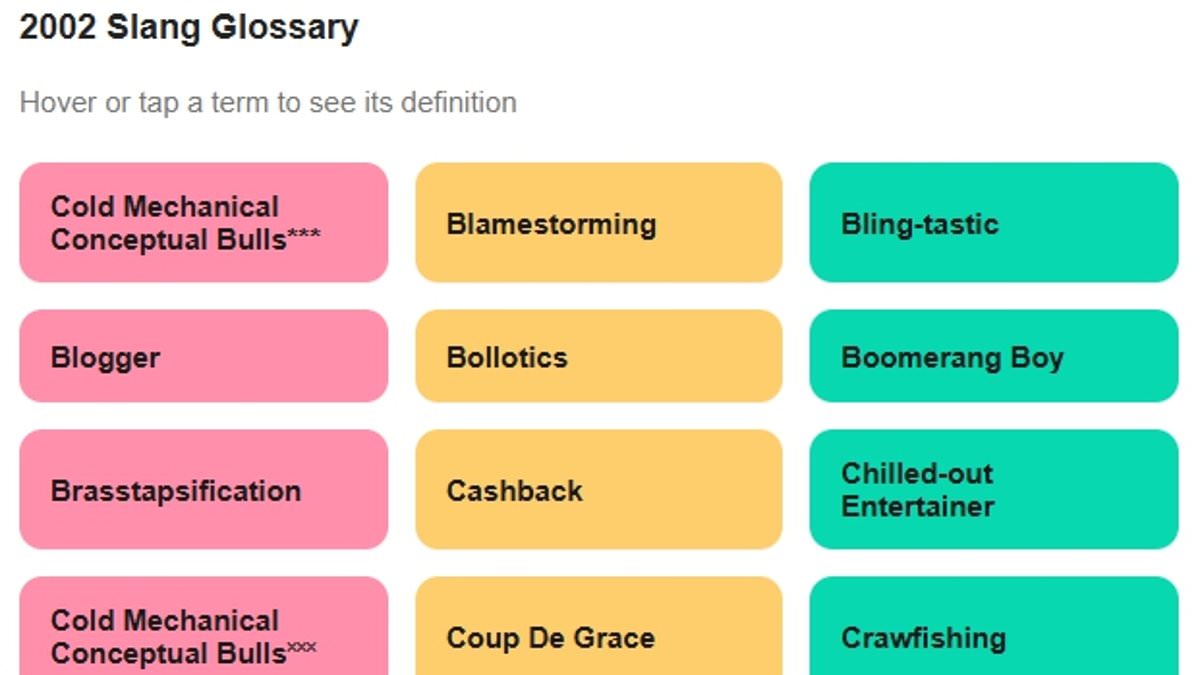
From '6,7' to 'vibe–coding', new slang words and phrases seem to pop up on an almost daily basis. But it's time to wind the clock back, as language learning app Preply has unearthed a hilarious 2002 glossary of slang. The glossary, produced by the BBC, includes several terms that have stood the test of time, such as 'blogger', 'lifestyle guru', and 'minging'. However, others now seem wildly outdated, including 'bling–tastic', 'do a Google', and 'T9 slang'. 'As we have seen time and time again through history, the usage of slang ebbs and flows, contributing to quickly evolving language,' said Anna Pyshna, a spokesperson for Preply. 'Alongside cultural developments in our society, language follows the same pattern – changing in line with technology, fashion, and politics. 'Societal changes often have a strong influence over language change, and when past slang resurfaces, encourages a deep, personal connection to the past.'So, how many of these 2002 slang words and phrases do you remember?
'Bling–tastic' was once used to describe someone or something flashy, showy or extravagant. Pictured: the Ali G premier in London in 2002 (left) and Beyonce as Foxxy Cleopatra in Austin Powers (right)Preply sifted through the 2002 slang and found three words that have managed to stick around, 24 years later. 'Blogger' – a person who writes a blog – saw a 1,245 per cent increase in usage in literature from 2002 to 2022, according to Preply's analysis. 'The extended lifespan of this term is deeply rooted in technological advances, and in a quickly evolving digital world, has become a permanent fixture in everyday vocabulary,' Ms Pyshna said. 'Babe' – a term of endearment – has increased by 245 per cent over this same time period, while 'buzzing' (a term to describe excitement) has spiked by 209 per cent. 'The phrase "buzzing" is still commonly used to express excitement,' Ms Pyshna added. 'While back in 2002, the phrase was more frequently used in reference to the effects of drugs, usage of the term continues to rise, despite adaptations of the meaning.'However, other slang words that were hugely popular in 2002 have evolved. 'Bling–tastic' was once used to describe someone or something flashy, showy or extravagant. Evolution of 2002 slang 'Bling-tastic' becomes 'extra''Lifestyle guru' becomes 'influencer''Minging' becomes 'ick''Baller' becomes 'boss''Gangsta' becomes 'G' Today, you might hear someone describe something as 'extra' instead, according to Preply. 'This shift towards "extra" reflects a move away from material–focused displays of wealth within fashion, and towards exaggerated self–expression,' Ms Pyshna explained. '"Bling–tastic" typically boasted about visible luxury, whilst "extra" encapsulates a broader cultural movement towards embracing personality, performance, and in some cases online identity.''Minging' – meaning unpleasant, unattractive, or disgusting – has now been replaced by 'ick'. 'The rise of "ick" can be attributed largely to social media and reality television, evolving alongside the rise of reality dating shows,' Ms Pyshna said. 'This reflects a more nuanced, emotionally driven way of communicating and an approach to dating.'Likewise, instead of someone calling you a 'baller', you might hear them say 'boss' instead. 'The term "baller" rose in 2002, deeply rooted in hip–hop and sports culture,' Ms Pyshna added. 'The change away from "baller" to "boss" suggests a broader societal change – moving away from money–centred thinking towards empowerment, control, and personal achievement.'WHY YOU SHOULD NEVER USE FULL STOPS IN TEXT MESSAGES You may think of emoji as silly additions to text messages, but a new study has revealed that the characters can help convey meaning.The study found that far from being annoying, smiley faces, as well as abbreviations and acronyms, are valuable additions to text messages.But ending messages with a full stop people was found to be a heartless move that changed the meaning of texts.Researchers from Binghamton University in New York suggest that new additions to written communication called 'textisms' like LOL and CUL8 are not sloppy nor a sign that written language is dying a death, but provide vital clues only usually found in face-to-face meetings.Even the use of slang such as 'yeah', 'yup' and 'nope' in text messages provides telltale signs of someone's real emotions and feelings.Professor Celia Klin, lead author of the study, said: 'In contrast with face-to-face conversation, texters can't rely on extra-linguistic cues such as tone of voice and pauses, or non-linguistic cues such as facial expressions and hand gestures.'In a spoken conversation, the cues aren't simply add-ons to our words; they convey critical information.'A facial expression or a rise in the pitch of our voices can entirely change the meaning of our words.'One way that texters add meaning to their words is by using textisms - things like emoticons, irregular spellings (sooooo) and irregular use of punctuation (!!!)', she said.An earlier study by Dr Klin found that text messages ending with a full stop are seen as less sincere than text messages that do not end with a period.These results suggest that punctuation can misconstrue or influence the meaning of text messages.Skipping punctuation indicates you are answering more spontaneously and heartfelt.The new study found that full stops are increasingly being replaced with abbreviations, emoticons and the even more recent trend of emoji which include pictures of a cake for someone's birthday or a pint of beer for a night out.