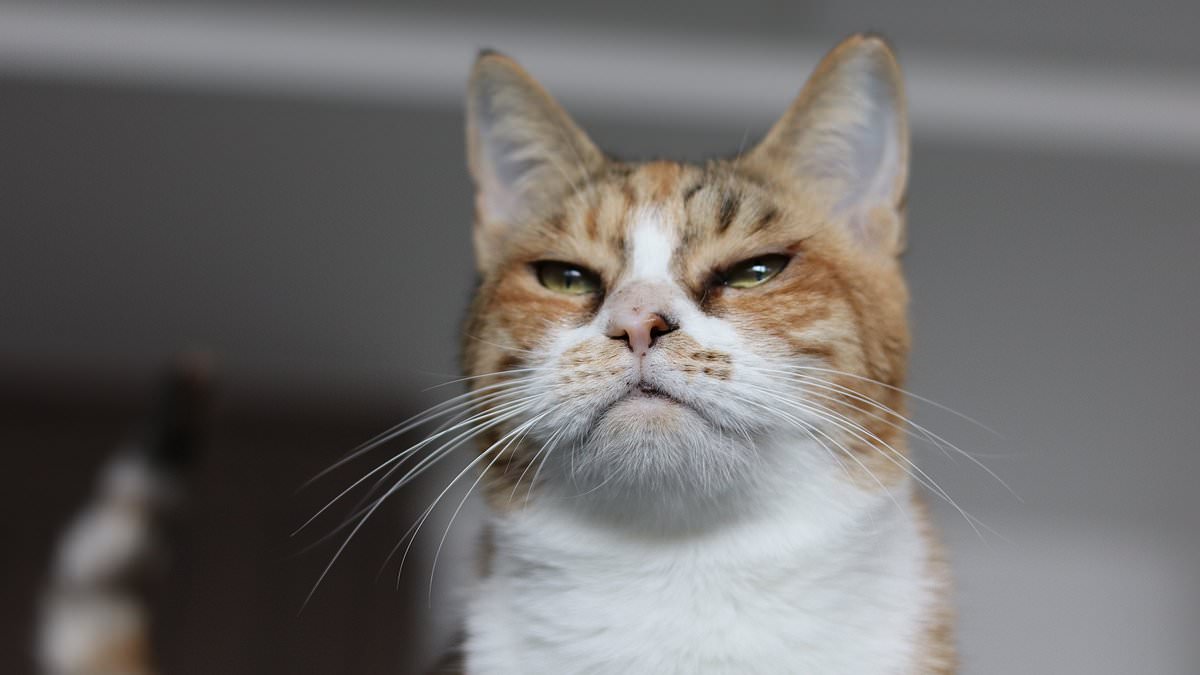
Face it, your cat doesn't care about you: Felines are more independent than dogs - and don't need their owners emotionally at ALL, study finds
It's a stereotype that has prevailed for years – dogs are friendly, while cats are aloof. Now, a study has confirmed that this cliché really is true. New evidence suggests that cats are more independent than dogs, and don't need their owners emotionally at all. While dogs look to their owners for reassurance and protection, cats are no more likely to seek comfort from their owner than a stranger, an experiment found.Experts say while dogs depend on us, making them more like our 'fur children', cats are entirely self–reliant.Dr Péter Pongrácz, who led the study from Eötvös Loránd University in Hungary, said: 'Cats may get along with us, but they don't depend on the help or security we can provide.'So while dogs can be a bit like our children, and rely on us, that is not the case for cats.'It is likely because they are still able predators who can catch their own food, so don't technically need us to feed them, and because cats whose owners leave them just end up going feral and living independently.' In the study, cats were no more likely to seek out their owner than a stranger, nor more likely to stay close to them or greet them when they entered the room It's a stereotype that has prevailed for years – dogs are friendly, while cats are aloof. Now, a study has confirmed that this cliché really is trueThe conclusion comes from a study of cats placed in six scenarios.Sometimes they were alone with their owner in a room, sometimes they were alone with a stranger, and at times both people were present.Cats were no more likely to seek out their owner than the stranger, nor more likely to stay close to them or greet them when they entered the room.The findings came from 15 'therapy' cats, such as those who visit schools and nursing homes, because regular cats are nervous being tested away from home in a laboratory.Researchers say this is evidence that there is 'no sign of cat–owner attachment'.Cats may tolerate or even like people, but they absolutely don't need us.'Dogs show strong reliance on human support when they face a problem, while cats do not,' Dr Pongrácz said. 'Dogs are stressed when they are left alone, and this stress cannot be efficiently eased only by the presence of the owner – but that's not the case for cats. The study, published in the journal Applied Animal Behaviour Science, used the Strange Situation Test, which has been successfully trialled in dogs'It may not make us feel very special but cats stuck with us through thousands of years of coexistence with humans largely just because our houses and farms came with an abundance of their main prey – rodents.'The study, published in the journal Applied Animal Behaviour Science, used the Strange Situation Test, which has been successfully trialled in dogs.These results have been described as showing dogs have a deep bond with owners that is like a 'child–parent relationship'.To judge if animals are dependent on their owners, researchers measure their attachment to their owner, anxiety when the owner is absent, and acceptance of a friendly stranger.The current study first looked at cats in a room with their owner, then in a room with both their owner and a stranger.Next, the owner left and the cat remained with the stranger.Then the owner came back, after the cat had spent time with the stranger, and the cat's behaviour was judged.Finally, the cat was largely alone in the room, but their owner came in for 30 seconds on one occasion, and the stranger came in for 30 seconds separately.Each scenario lasted less than two minutes, with the whole experiment taking 12 minutes in total.Signs of attachment in cats included staying within a metre of their owner most of the time when not exploring or playing, and watching their owner, who was instructed to carry toy building blocks between two tables.The same measures were used to track how cats behaved with the stranger.There was no significant difference in cats' apparent attachment to the owner they lived with or an unknown woman they had met for a few minutes.There was also little difference in anxiety behaviours with an owner or stranger, which were judged looking at things like cats hiding under a chair or following a person to the door when they left.Cats were about as likely to accept a stranger in their space as their owner, which was judged by behaviours like greeting them when they came into a room.The experiment was also done with 13 pet cats not used for animal therapy, but this group of animals were so stressed at being in a strange place that their attachment behaviours could not be judged accurately.The researchers believe their findings – which saw some cats play with strangers and rub against them affectionately like they did their owners – will apply to most cats. A previous study uncovered how to interpret your cat's facial expressionsFriendly cats are likely to be just as open to chin scratches from owners and strangers, and wary cats are likely to be equally uncertain of both.Dr Pongrácz said: 'Unlike for dogs, people are not the 'safe haven' to which the cat returns when experiencing fear, as we know because they waited for their owner at the door, or followed them, about the same amount as they did a stranger.'Unlike for dogs, owners are also not the 'secure base' from which the cat confidently departs to explore the unknown environment, as they were just as likely to involve strangers in their play.''Cats and humans can absolutely have a friendship, and it's advantageous for domesticated cats to be sociable with humans so they will take care of them.'But they just aren't dependent in the way dogs are.'HOW WELL DO YOU KNOW YOUR CAT? THE 13 SECRET SIGNALS FELINES GIVE THEIR OWNERS Cats are often branded aloof and solitary creatures who spend their days plotting their human owner's demise, but such characterisations could not be further from the truth.In fact, our feline friends constantly communicate their feelings of affection to us, whether it be through their whiskers, tail, face or body language.In her eye-opening new book Kitty Language: An Illustrated Guide to Understanding Your Cat, author Lili Chin - with the help of animal behaviourists - explains how to interpret your pet's movements.Below are some of the most common behaviours and what they could signal. Our feline friends constantly communicate their feelings of affection to us, whether it be through their whiskers, tail, face or body language