Who are the people defending Peter Mandelson?
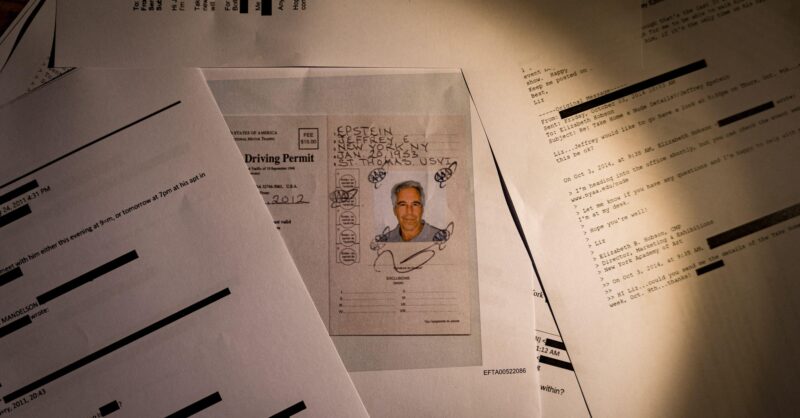
Elon Musk messaged Jeffrey Epstein on Christmas Day, begging to attend a “wild” party. Richard Branson jokily referenced Epstein’s “harem”. Duke University’s Dan Ariely complimented a “redhead” he met at one of his parties. Harvard’s Larry Summers sought advice on how to engage in an affair with a younger Asian colleague, while referring to her as “peril”. Across millions of documents, in between exchanging sleazy anecdotes, theories on race science and financial wheezes for the uber-wealthy, the Epstein files document the disturbingly close relationships that hundreds of global elites maintained with a man they knew to be, at the very least, a convicted child predator, even if they had no knowledge of his other crimes.
For some, however, these revelations are disturbing for other reasons, namely the guilt by association that risks falling on Epstein’s pen pals. The Atlantic’s Gilad Edelman took aim at the “conventional wisdom” that “even friends who didn’t participate in [Epstein’s] crimes were surely aware of them, and chose to consort with him anyway”. In a Washington Post podcast – breezily titled “We are all in the Epstein files” – columnists Megan McArdle, Ben Dreyfuss, Josh Barro and Ross Douthat played down the idea that everyone in the files was themselves a child predator. A straw man argument which was, it must be said, somewhat damaged by McArdle’s willingness to redraw the definition of paedophilia itself throughout the conversation. “It’s not like a paedophile, right?” she said at one point, “There are 16-year-old girls around who are vulnerable and can be exploited… they’re just around, and they’re close enough to the age of consent that a lot of people probably felt like it was okay to hit on them”.
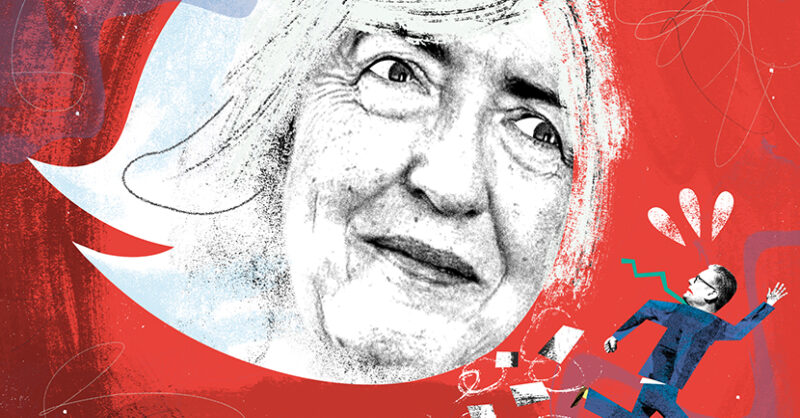
In the UK, Melanie Phillips went one further, warning that claims of vicarious culpability are “a persistent tool of repressive regimes… an ideological purification process, extending from the Salem witch trials through the Soviet entrapment of ideological enemies all the way to present-day cancellation culture”. This description of guilt-by-association’s fatal consequences may sound a tad rich, coming from someone cited admiringly in Anders Bering Breivik’s manifesto without having it knock her career off its stride.
It’s tempting to address the most obvious hypocrisy at play in all this discourse, namely that the very people now deploying a miser’s algebra to diminish or equivocate suspicions around associates of Jeffrey Epstein, are almost uniformly those who have never shown much restraint in tarring their preferred antagonists with whatever brush was available. In Britain, we might even marvel that there appear to be journalists, read and admired everywhere from Westminster to Washington (and, in at least one case, the maximum-security wing of Norway’s Ringerike Prison) who believe that communicating extensively with the world’s most famous paedophile is not nearly so serious a scandal as having once pronounced that paedophile’s name as “Epshteen”.
Subscribe to the New Statesman today for only £1 a week.
Sadly, for this slippery slope argument, once we map it to the Epstein case we immediately run into problems. At time of writing, almost no serious consequences have fallen on anyone whose behaviour follows the “guilt by association” rubric. In the cases of Mandelson and Andrew Mountbatten-Windsor, their mere association with Epstein would have caused little more than embarrassment, had it not been for the files showing much more concerning levels of interaction, some of it suggestive of criminality. We know this because said association was already well known, with few consequences.
There are edge cases we could cite, like that of Senator George Mitchell, whose interactions with Epstein appear more tangential, even if they did take place after Epstein was already a convicted child predator. Mitchell has subsequently had his name stripped from a scholarship programme, and a bust removed from Queen’s University, Belfast – a tarnishing of his legacy, no doubt, but very far from what any ordinary person might term a truly grave consequence.
This is because the Epstein files is self-evidently not a story about excessive consequences, but one of very few consequences at all. The president of the United States, whose deep and troubling ties to Epstein have been exhaustively documented, is mentioned in the files more than one million times, has faced practically no repercussions at all. And the testimony of thousands of women and girls, some whose abuse began when they were as young as 13, have not yet led to a single charge against any of their alleged abusers, barring Ghislaine Maxwell, who has herself been moved by Trump’s Department of Justice to a minimum-security prison for the remainder of her 20-year term.
Choosing to rebrand any of this as a slippery slope towards the justice of the mob, rather than a story of elite impunity, demeans us all. It asks us to prioritise those for whom consequences must always be sieved through ever finer grills of caveat until only the thinnest grains of accountability risk falling on their heads; to shrink in horror, not at Epstein’s greasy world of clubbable elites cackling together about nubile young women and IQ differences among the races, but at the thought that some rich people might now have to explain why they sent the world’s most famous paedophile some emails.
Slippery slopes are, after all, always scarier for those who live so high above the rest of us. The kind, perhaps, who believe that they should stay up there, unchallenged, forever.
[Further reading: Talking to Jeffrey Epstein]
Content from our partners
Related