Your Party has a lot to learn – from Remainers
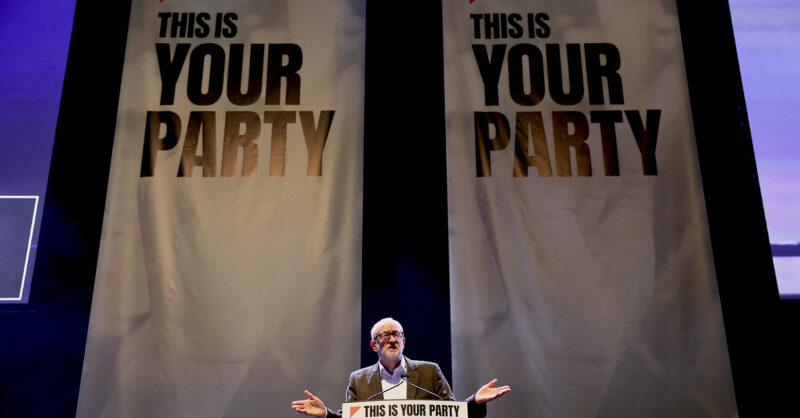
“Messy” does not begin to cover the first few months of Your Party. Launches and retractions; arguments over the precise ownership of large amounts of members’ money; the very public falling out between Zarah Sultana and Jeremy Corbyn (who refused to say that the pair were friends when asked last week); the steady drip of stories about MPs departing and internal strife. All of this culminated last weekend in a conference where accusations of witch hunts flew, Sultana boycotted the first day, and videos of dramatic mic-cut-outs on the conference floor circulated widely.
No one said it was easy to start a new party. And maybe all unhappy new political parties are unhappy in their own way. Your Party’s special blend of SWP members, independent MPs, people whose natural state is 2018’s most toxic CLP meeting, and Jeremy Corbyn (character limitations thereof) is unique. But watching proceedings in Liverpool from afar, there remain comparisons to be made with, and larger lessons to be drawn from, another period in recent political history.
I have recently written a book on the anti-Brexit movement, whose greatest flourishing was in the 2017 to 2019 parliament. This was one of those interregnums we hear so much about, a time of great political volatility and uncertainty. One of the morbid symptoms arising was a surprisingly large number of people trying to recreate the Liberal Democrats from first principles and failing miserably. None of them were successful, but a look at the anatomy of their failure shows how new parties can lose out in the UK system.
The most major of these attempts at the creation of a new centrist party came in early 2019, with Change UK. Initially a break of seven MPs from Labour due to discontent over Brexit and Corbynism, they were subsequently joined by one other Labour and three similarly Brexit-discontented Tory MPs. By the end of the same year, they would all lose their seats.
Treat yourself or a friend this Christmas to a New Statesman subscription for just £2
Your Party might recognise the tribulations of Change UK. Like Your Party (which we now know will continue to go by that name, after a ballot rejected alternative offerings Our Party, For the Many and Popular Alliance), Change UK had naming difficulties. The electoral commission has rules about what parties can be called, which are rarely considered in the head rush of separation. Change UK was initially called the Independent Group (TIG), but registered for the European Elections as Change UK – The Independent Group (ChUK-TIG); its logo was initially rejected for having a hashtag in it. Like Your Party, they also had leadership difficulties. Despite being in many ways one-time-Labour-leadership-hopeful Chuka Umunna’s show, with former Tory Anna Soubry the other dominant personality, their leader going in to the 2019 European elections was technically, for some reason, Heidi Allen.
There were many other new parties in this period, too. Renew was probably the strongest of them, and the political birthplace of Chris Coghlan, since 2024 the Liberal Democrat MP for Dorking and Horley. We were also graced with Jolyon Maugham’s effort Spring, the Party; United for Change, which existed mostly a series of briefings to the Times about how much money they had; journalist Jeremy Cliffe’s mostly-just-a-blogpost effort The Radicals, and, slightly later on, Gina Miller’s True and Fair Party, and the Rejoin EU Party.
Some of these people knew that it is hard to get a footing as a startup party. Rejoin EU, for example, view themselves explicitly as a reverse-Ukip, a long-term project for salience raising rather than something that can win seats. But others were more optimistic, particularly those coming out of Labour or the Conservatives. An origin party shapes priorities and blind spots; both Change UK and Your Party suffer from the fact that many of the individuals involved seem unable to psychologically leave the Labour Party.
Someone I interviewed made an astute comment about Change UK that sticks in my mind: many of its politicians had only ever contested fairly safe seats (Chuka Umunna in Streatham, Luciana Berger in Liverpool Riverside, Heidi Allen in South Cambridgeshire), and even those who had been in tougher contests had certainly never tried to play the game as third (or fourth) parties, scrapping for column inches and relevancy. It’s an altogether different position, requiring different tactics and an abandonment of the assumption that if you show up people will pay attention to you. If you ask the Liberal Democrats about it, they’ll tell you; so will Nigel Farage, whose long career leading UKIP and the Brexit Party means his new-party-that-isn’t-exactly-new, Reform, also understands how to play the game. I’d be less confident in the advice offered by Zarah Sultana, selected for a retirement seat in 2019.
Despite this, Your Party will, I think, be more successful than any of the post-Brexit centrist parties. The space it is seeking to occupy isn’t already taken by the Liberal Democrats, for one thing. While it might come to be occupied by the Greens if public debacles continue, I’d still bet on Your Party or YP-adjacent MPs winning seats at the next election, even if they do it as independents. Change UK needed to pose an immediate, large scale threat to the major parties and, once it became clear that it didn’t, it winked out of existence. Your Party can use the Gaza independents’ wins at the last election as a template and take a slower, less zero-sum path.
Your Party hopefuls also benefit from a climate which is generally more favourable to smaller parties. At the 2017 election, 82 per cent of people voted either Labour or Conservative. The cover story in last week’s Economist styles ours as “slot machine politics”, where so many parties trading at similar levels will produce hard-to-predict results that vary wildly with only small changes to input. Today’s is an easier market to get into. That being said, Your Party’s shambolic start shows that then as now, even against a more favourable electoral backdrop, the actual process of setting up political parties is always more difficult than it looks.
[Further reading: Is Your Party doomed to petty squabbling forever?]
Content from our partners
Related