Jane Austen made us moral
To my mind, the most important moment in the history of the English novel comes about five pages into Sense and Sensibility (1811). We have just met the Dashwood family, who, like the families of the protagonists in all Jane Austen’s novels, are having money trouble. John, the eldest son, is on the verge of disinheriting his three maiden sisters, and his wife is not best pleased:
“Mrs John Dashwood did not at all approve of what her husband intended to do for his sisters. To take three thousand pounds from the fortune of their dear little boy would be impoverishing him to the most dreadful degree. She begged him to think again on the subject. How could he answer it to himself to rob his child, and his only child too, of so large a sum?”
Look at the second and fourth sentences again. Who is speaking here? The grammar is all in the third person: there is no “I” to signal that we have slipped into monologue, no “you” to suggest some kind of direct address. But clearly, in some mysterious way, these words belong to Mrs. John Dashwood. This is a literary discovery of the most dramatic order. “Free indirect style” or “free indirect discourse”, had never been used systematically in an English novel before. It has been used in just about every realist novel since.
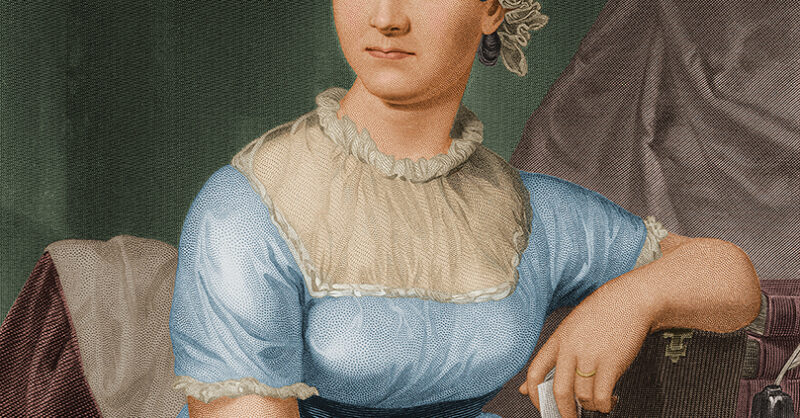
Some writers are victims of their own success, of their complete assimilation by the culture. Freud is one: people who preach confidently about how psychoanalysis is for quacks will quite happily talk about others’ unconscious desires, or denial, or repression, forgetting where these terms originate. Jane Austen, the 250th anniversary of whose birth will be celebrated this month, is another. When the big day comes, there will be plenty of festivities in a kitschily traditionalist vein: a “quilting workshop” at Chawton where she lived, a “regency ball” at Winchester Cathedral where she is buried. But there will be surprisingly little concerned with what she did for the form of the novel – and for language in general. This is a pity. Because like all radical new literary forms, Jane Austen’s new method for slipping into the consciousnesses of others did not just change the way we write; it changed the way we think.
Treat yourself or a friend this Christmas to a New Statesman subscription for just £2
The first indication that Austen might, with her new technique, have discovered a new novelistic superpower comes with her second novel, Pride and Prejudice (1813). I reread Pride and Prejudice for this piece, and again, as with every other time I have read it, spent all 400 pages helpless with desire for Elizabeth Bennett and Mr Darcy – two minor members of the rural gentry – to end up married. Martin Amis, a lifelong admirer, was certainly right when he said that “Jane Austen makes Mrs. Bennets of us all.” How does she manage it? The sheer sexiness of the two protagonists is of course not to be underestimated (the shocking arrival of Elizabeth at Netherfield “with weary ankles, dirty stockings, and a face glowing with the warmth of exercise,” is every bit as enticing as Mr Darcy’s famously aphrodisiac ten thousand a year). But again, the true hero of the novel is free indirect discourse. Whenever Elizabeth storms off to think – and thinking, in Jane Austen, is only ever really to be attempted when alone – we inhabit, with her, the slow, dawning realisation that she and Darcy are perfect for each other.
By the time she completed her masterpiece, Emma (1816), Austen had perfected her technique to such a degree that she was able to accomplish a near-impossible task. Emma, as every novelist senses upon reading it, really should not work (“I am going to take a heroine whom no one but myself will much like,” wrote Austen in a letter to her niece before publication). Its protagonist, Emma Woodhouse, though “handsome, clever, and rich,” is also an astonishing brat: she converts the sweet, pliable Harriet Smith into becoming a kind of glorified doll, and utterly humiliates the stolid, half-deaf Mrs Bates on their excursion to Box Hill. Out of a sense of sheer justice, then, we really ought to want Emma to get her comeuppance. She should end up alone, unmarried – the most terrible fate imaginable for a Jane Austen heroine – and certainly not in the dependable, manly arms of Mr. Knightley.
But we do not want this to happen to Emma. Indeed, it is hard to think of another place in fiction where we end up willing an unpleasant character’s reform, then reward, so fervently. Once again, free indirect discourse is what makes the impossible possible. Take, for instance, the scene in which Emma resolves to take Harriet under her wing:
“Encouragement should be given. Those soft blue eyes, and all those natural graces, should not be wasted on the inferior society of Highbury and its connexions. The acquaintance she had already formed were unworthy of her. The friends from whom she had just parted, though very good sort of people, must be doing her harm.”
There is a thought process here, driven by a kind of warped but undeniably altruistic logic. Of course, we are not meant to agree with this line of reasoning – if we were, the passage would not be funny – but we are meant to recognise the attempt to do the right thing, the fact that in Emma Woodhouse’s universe, her treatment of Harriet is nowhere near as horrendous as we outsiders intuit.
I do not think it is an exaggeration to say that this technique – this subtle ebb and flow of authorial sympathy, subsequently refined by Flaubert, George Eliot, Henry James – represents a serious advance in human beings’ capacity for moral reasoning. Jane Austen lived in a world that was beginning to grow enchanted with abstract system-building: she was born the same year as the American revolution, thirteen years before the French, and there is a constant sense in her novels that just over the English Channel, and the Atlantic Ocean, men were busy attempting to solve all human problems with a few lofty ideas and some paper on which to draw up a constitution. Moral thought, meanwhile, was dominated by Immanuel Kant, for whom morality had a tendency to distil itself into neat little rules, carried out by cold, rational beings. Reason, or at least the rhetoric of reason, was becoming all the rage.
In Jane Austen, however, reasoning is always kept squarely in its place. Because free indirect discourse allows us to see rational processes unfolding in characters’ heads in real time, we come to realise how freighted all thought is with emotion, error. When Emma makes her “deduction” about how Mr Knightley ought not to marry her great rival Jane Fairfax, it is completely obvious to us that she is seething with unacknowledged jealousy, perhaps even love:
“Her objections to Mr. Knightley’s marrying did not in the least subside. She could see nothing but evil in it… A real injury to the children—a most mortifying change, and material loss to them all; —a very great deduction from her father’s daily comfort—and, as to herself, she could not at all endure the idea of Jane Fairfax at Donwell Abbey. A Mrs. Knightley for them all to give way to!—No, Mr. Knightley must never marry.”
In other words, Jane Austen gives the lie to the idea that our moral lives can be boiled down to a convenient set of cold, emotionless rules. For Austen, morality is not about system-building at all; it is about flexibility, sympathy, recognising the fact that the world looks radically different through different sets of eyes. Perhaps this is why Jane Austen’s heroines each learn such different lessons. Emma Woodhouse is already pretty and vivacious and selfish; over the course of the novel, Austen has her learn the more stolid virtues of discretion and honour. Austen’s next novel, Persuasion (1817), by contrast, is about the well-behaved Anne Elliot, quietly yearning to rekindle her old affair with the dashing Captain Wentworth. The narrator spends a good chunk of the novel practically screaming at her to put away propriety and self-sacrifice and follow her heart.
In the decades after Austen’s premature death in 1817, the technology that she invented took on a life of its own. Printed novels flooded Europe, most of them built on the technique Jane Austen invented. Millions of readers were taught to scorn and swoon and grieve and fall in love with fictional characters; the extension of sympathy became easier than ever. At least one popular social scientist holds the 19th-century novel responsible for a global “Humanitarian Revolution.” Certainly, on a remarkable number of occasions, novels were what galvanised people to remember all the people the grand abstractions of the eighteenth century had conveniently excluded: in Oliver Twist (1937-9), Dickens reminded the English of all the poor people locked up in workhouses; in Uncle Tom’s Cabin (1952), Harriet Beecher Stowe reminded the Americans that their vaunted freedoms were built on the backs of slaves; in Les Misérables (1862), Victor Hugo reminded the French that precious little of the liberté, égalité and fraternité promised by their revolutionaries had actually materialised. Jane Austen may have been a Tory, but the technology she unleashed on the world was anything but.
In a way, though, Jane Austen is richer than any of these more politically engagé novelists who followed her. She is too circumspect; she never uses her new techniques simply to extol or apologise for her creations, and is certainly not the kind of progressive for whom “enemy is just someone whose story we have not heard.” Her characters are obviously flawed, fallen, delusional, risible (it is no surprise that the most influential essay in all of Austen studies characterises her method as one of “regulated hatred”). But when Jane Austen laughs at her characters – and laugh at them she definitely does – the laughter is usually accompanied by a burst of warmth and understanding. It may well be involuntary: this is simply the way you laugh when you have become adept at seeing the world from the point of view of others. It is, however, the best way to laugh. If you use next week’s anniversary to let Jane Austen elicit some of it from you, then you will have celebrated in a way that does the English language’s greatest novelist justice.
[Further reading: Jane Austen and me]
Content from our partners
Related