Tom Fletcher: I hope my Paddington songs are bigger than McFly
Popstars, on the whole, are surprisingly bad at writing musicals. I am not talking about jukebox musicals, made up of their own hits – they require no writing at all – but original musicals of story and character and narrative arc. Only Elton John can do it, it seems. Perhaps, offers Tom Fletcher diplomatically, the gods of rock are not accustomed to asking the following questions of their songs as they write them. What information am I trying to get across? Where do I want to end up? Perhaps they are not used to being edited. Fletcher – the one with the high hair and glasses out of the noughties boyband McFly – knew what it was to be edited when the first of his multiple children’s books came back covered in red. “You don’t want to hear that everything is great when it isn’t.”
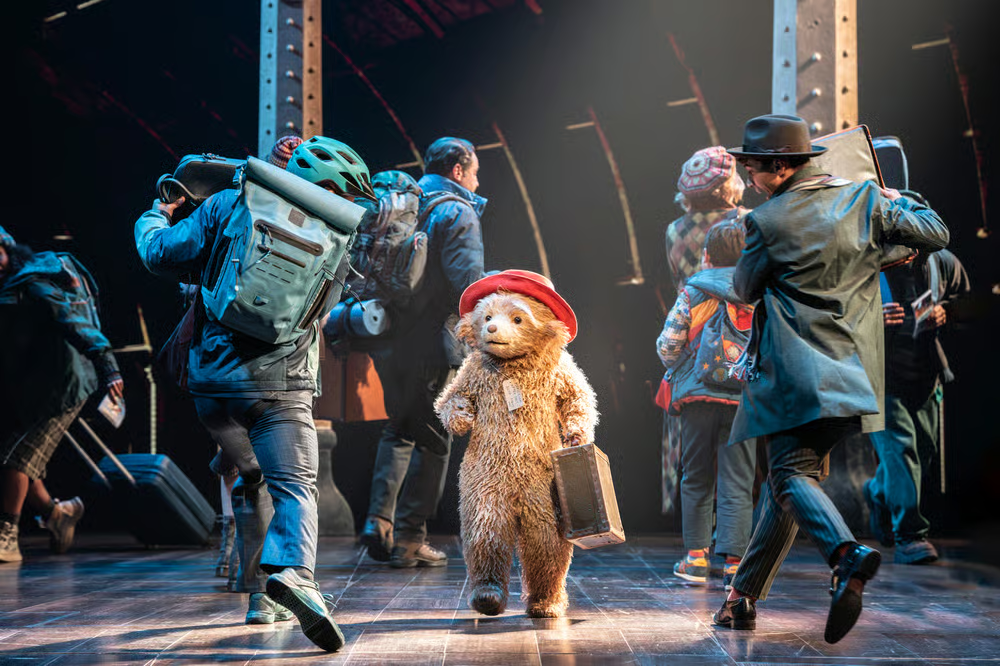
Fletcher’s songs for the beloved new Paddington musical, now playing at the Savoy Theatre, London, are likely to become more famous than songs by McFly: “I hope so!” he says. The first one he wrote – “Marmalade” – came to him during the phone call in which the producer Eliza Lumley pitched him the original idea. He wrote four others as part of his try-out, and they are still in the show. Sitting at his piano, Fletcher composed Hungarian Jewish folk tunes for Mr Gruber; Windrush-infused celebration in “The Rhythm of London”; an eye-prickling love song for Mr Brown and a classic West End jazz handsy number for Bonnie Langford, who does the splits as Mrs Bird. Everyone knows we are living in a golden age of musicals – that serious people go and see them now; yet there have been no household names among the composers, the way there were in the fifties and sixties, seventies and eighties; no celebrity writers who have the West End sewn up. Is Fletcher the next Lloyd Webber? Is he too normal for that?
We met at the mixing desk for Studio Two in Abbey Road, birthplace of OK Computer, Hounds of Love, Dark Side of the Moon, and of course, Abbey Road by the Beatles. A string section laid down the music for Mr Brown’s ballad while Fletcher, one trainer swinging, hummed the melody high and soft over the top. He was a very straight child, he admits. “Very well behaved. Never a naughty kid. I was very sensitive and I loved musical theatre. I did not fit in at normal school – the boys liked sport, and that wasn’t me. When we got to teens and people were going out, I wasn’t into that either.”
He was enrolled at the Sylvia Young Theatre School from the age of eight, full time; got his first role in the West End as a member of Fagin’s gang called Kipper, and seems to have spent his youth in Oliver!, playing the title role at ten and 11 at the London Palladium.
Treat yourself or a friend this Christmas to a New Statesman subscription for just £2
This background may or may not have been relevant when Fletcher auditioned for Busted in 2001, losing out to Charlie Simpson, then formed the rival band McFly. It was a very strange time for music, the early noughties, and Fletcher, who sounds like an old industry lag at 40, gives a quick summary.
“Noughties pop was confused and didn’t know what it was,” he says. “Everything shifted after our first release – it was the end of the boyband era, and any that emerged after us had no success. It was Arctic Monkeys instead.”
In 2003, at the time of their debut, there was still, he points out, just the right “infrastructure” within the industry for McFly to make it through. There was the weekend kids’ show SMTV Live, where McFly played every week: “A year into our career it just disappeared.” Their fans were teenage girls, and radio play was less important, say, than getting on the Smash Hits tour and the summer festivals – which they did, playing on a constant carousel with Girls Aloud and Blue: “We caught the tail end of it all.”
Then suddenly, it was the age of downloads. The record shops were shut down, and people stopped buying physical singles. “We had a fan base that was under 18, so they didn’t have credit cards,” Fletcher remembers. “They had to ask their parents to put a card number into some weird site to legally download music. It was the first generation of teenagers to get mobile phones, and at one point you could text DOWNLOAD to a number, and the text cost a pound, and that was a single sale. Then streaming came, and you didn’t sell any songs at all!”
Now, he can recline comfortably into the musical world he wanted to be in, all along. All the greats have written a song that transcends the stage show: “There is nothing worse than going to the theatre and having a lot of narrative and lyrics chucked at you in a melody you’re not going to remember,” he says.
His own “hit” might be “Pretty Little Dead Thing”, the song sung by the show’s villain, Millicent Clyde – it is a luxurious journey into the world of taxidermy. Fletcher sums it up in his own way: “Who is Millicent? Who is her dad? What does she want? She wants a bear! Why does she want a bear?” He drew melodic reference from the early noughties hardcore band The Used, though you wouldn’t necessarily know it.
In the time between my seeing the musical, and speaking to Fletcher for this piece, the funniest line from the song – “When the family pup has had enough, I can pump it up with lots of fluff” – has been brutally axed by someone high up at the theatre.
“I know!” Fletcher says, as if consoling the New Statesman. “But it doesn’t drive the narrative forward, and if something doesn’t drive the narrative forward, at some point someone is going to cut it.”
What about the second funniest line, I ask, eagerly? “If you reverse on the neighbour’s cat, I can pump it up in seconds flat”?
“Gone!” he cries.
He is so professional, so breezy. You’ve got to be edited, he says. Besides, you can still hear them both on the cast recording.
[Further reading: Taylor Swift is bad at this]
Content from our partners
Related