
Remember me


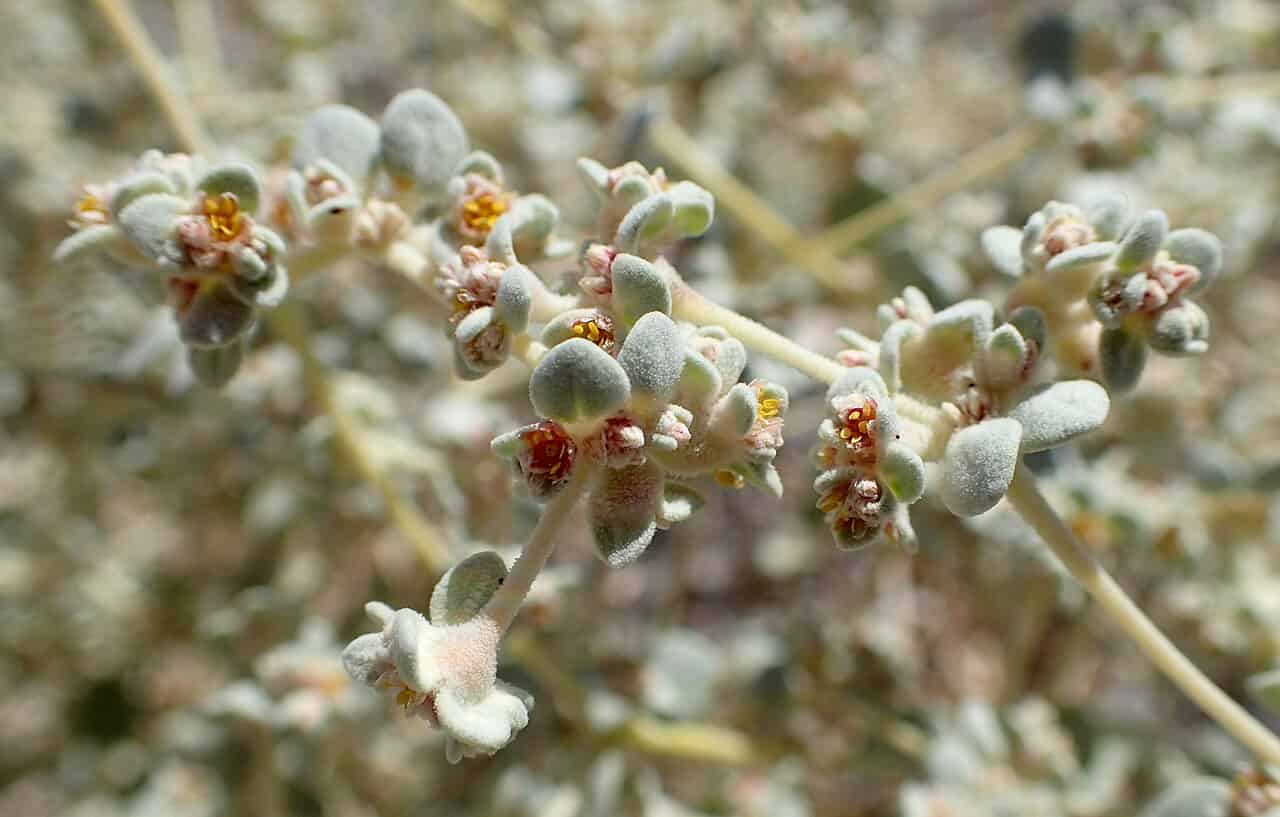




 The Arizona honeysweet. Credit: Wikimedia Commons.
We first covered Tidestromia oblongifolia in January 2026 because the plant seemed to mock one of summer’s basic rules: when temperatures become brutal, growth should slow down.
Arizona honeysweet, as the plant is commonly known, does the opposite. Under laboratory conditions designed to mimic a Death Valley summer, it grew faster.
Now, a new preprint from researchers at Michigan State University and Carnegie Science goes one step deeper. The plant doesn’t survive extreme heat through cellular resilience alone. It also appears to cool its leaves by releasing water through tiny pores—essentially running a biological evaporative cooler.
From Heat-Lover to Self-CoolerOur earlier coverage of this plant focused on a startling finding from a Current Biology study suggesting that Arizona honeysweet thrived in what should be disastrous Death Valley conditions. In lab chambers built to mimic the desert’s brutal light and temperature swings, the plant tripled its biomass in 10 days, while related heat-tolerant plants stopped growing.
The plant was so well-adapted to heat it was striking even to researchers.
They recreated the desert’s intense light and daily temperature swings inside growth chambers. Over 10 days, T. oblongifolia tripled its biomass. Closely related plants known for tolerating heat stopped growing under the same conditions.
“This is the most heat-tolerant plant ever documented,” Seung Yon “Sue” Rhee said in a statement.
The new study looks at how this actually happens. When the air reaches 60°C, can the plant stop its tissues from burning out?
×
Thank you! One more thing...Please check your inbox and confirm your subscription.
The Seeds Are AlrightThe researchers collected seeds from 223 plants across the species’ range, including Death Valley, nearby higher-elevation sites and other desert regions.
They raised more than 1,200 seedlings and gradually acclimated them to hotter conditions. The seedlings were then exposed to 60°C air for six to eight hours a day, with the treatment continuing for more than a week.
Many seedlings died. But not all of them.
Survival ranged from just under 2% to more than 34%, depending on the genetic line and experiment. But some survivors thrived. They stayed healthy enough to make new leaf tissue even after the 60° Celsius treatment stretched to 20 days.
To figure out how they did it, researchers look at the infrared cameras.
The Trick Comes With a Big Water BillThe researchers found that surviving plants kept their leaves far cooler than the surrounding air. After eight days of 60° Celsius heat, survivors held leaf temperatures between about 54° Celsius and 59° Celsius. The most dramatic individual measurement showed a leaf running 13.03°C below the air temperature.
At ordinary temperatures, that difference might not seem remarkable. But this plant is near the thermal boundary of living tissue, where a few degrees can separate survival from getting scorched alive.
But how do they do it?
Plants cool themselves through transpiration. Water travels from the roots into the leaves and escapes through microscopic pores called stomata. Evaporation carries heat away, much as sweat cools human skin.
But the strategy comes with an obvious cost: it consumes water.
 Illustration: ZME Science (AI-generated).
The coolest leaves showed molecular signs that their stomata (the tiny pores that release water vapour) remained open. That matters because open stomata allow transpiration: as water evaporates from the leaf, it carries heat away. Hotter leaves, by contrast, showed stronger signs of stomatal closure and photorespiration, a wasteful stress process that increases when the plant cannot take in enough carbon dioxide.
To test whether open stomata were actually driving the cooling, the researchers treated leaves with abscisic acid, a hormone that causes stomata to close.
The leaves quickly became less effective at cooling themselves and died about four days earlier than untreated leaves. This strongly suggests that transpiration is central to the plant’s survival at extreme temperatures, although abscisic acid also influences other stress responses, so the experiment does not prove that stomatal closure alone caused the earlier deaths.
Could This Help Plants Survive Heatwaves? Looks like a fictional Mars environment. Credit: Wikimedia Commons
Many desert plants survive by saving water, storing it, or shutting down during brutal heat. Arizona honeysweet seems to spend water to shed heat. As there’s obviously not that much water in the desert, and the plant isn’t particularly good at storing water, it suggests it must be extremely good at absorbing water.
“We think Tidestromia probably has a root system that is very good at taking up water, specialized hydraulics that move water well through the plant, and compositions of salts/sugar/proteins inside their cells that keep them hydrated as they transpire to cool,” Feehan added.
Encouraging wheat, maize or soybeans to transpire more aggressively could cool their leaves, but it could also make them run out of water sooner. Any useful crop trait would need to balance cooling against drought resistance.
The researchers also found three broad regions of DNA associated with survival at 60°C. They have not yet identified the exact genes, but the result suggests that some Arizona honeysweet lineages carry stronger heat-survival tools than others.
With climate change in full swing, that’s never been more important.
“We’re breaking heat records globally and crop yields are very vulnerable to increasing temperatures,” Feehan noted. “Tidestromia has figured out how to survive at temperatures that are otherwise lethal to plants, animals, and fungi. If we can learn those survival mechanisms, we will have more, and likely very unique, tools to make crops more resilient against heat waves.”
The preprint is available on bioRxiv. The article has not yet been peer-reviewed.

