
Remember me




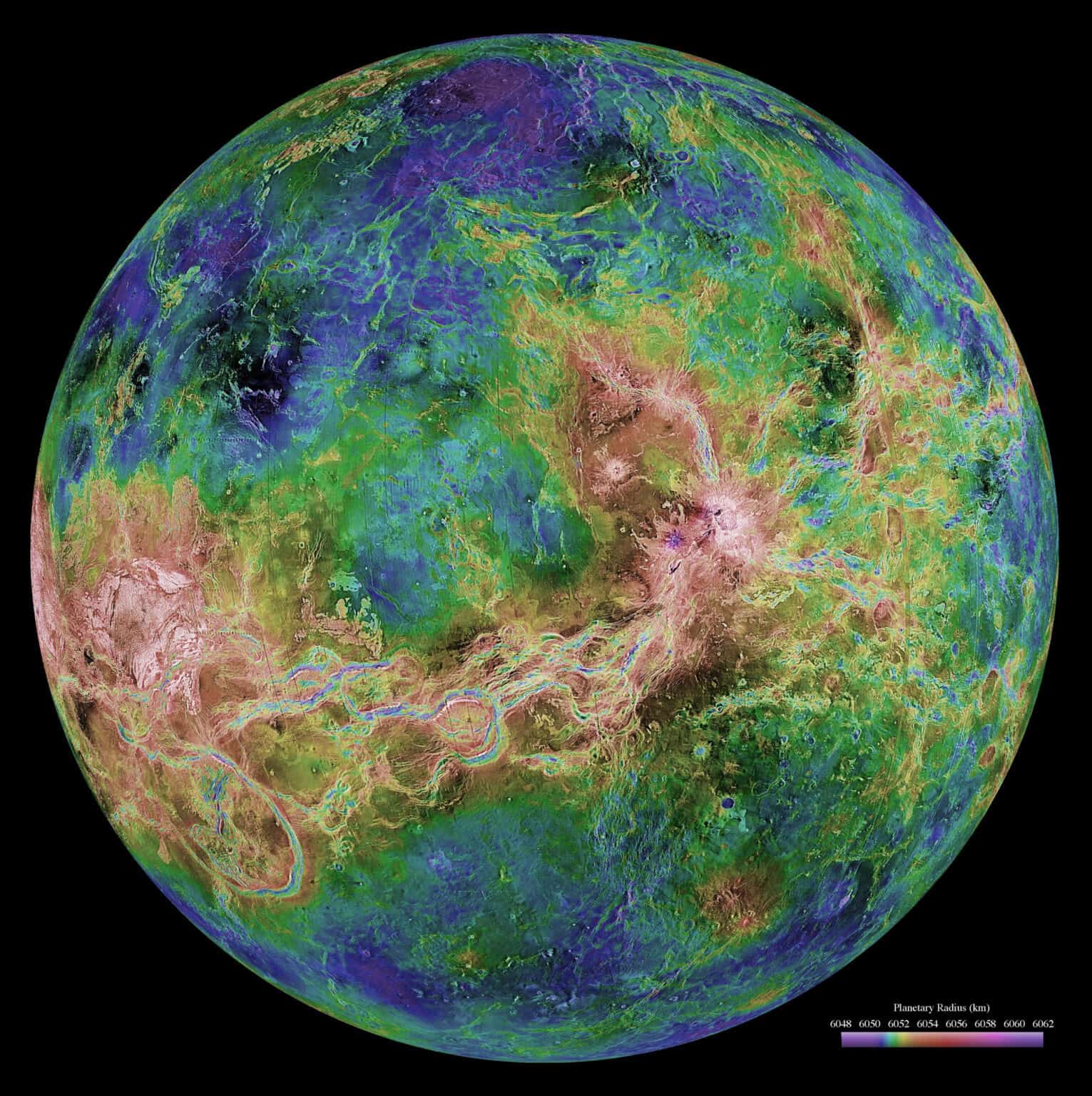


 Digital rendering of the Atahensik corona on Venus and the Dali Chasma rift system—based on radar data from the Magellan spacecraft. Credit: NASA/JPL
Venus has long looked like a dead world wearing a volcanic mask. But beneath its scorching atmosphere, the planet may be far more restless than it appears.
New high-resolution 3-D simulations suggest that several of Venus’s enormous rift systems are still widening or stopped moving only recently.
Venus May Be More Dynamic Than It LooksVenus is an unforgiving place. Its average surface temperature is about 465°C, hot enough to melt lead, while its atmospheric pressure is roughly 90 times that at Earth’s surface. Sure, Venus might look like Earth’s twin, but its surface is extremely different, and so is its geology.
For years, many planetary scientists treated Venus as largely geologically inactive. The planet lacks Earth’s global network of moving tectonic plates. Yet Venus has increasingly refused to behave like a completely dormant planet.
 Topographic map of the East African Rift. Credit: Wikimedia Commons
Studies of radar images captured by NASA’s Magellan spacecraft have reported possible volcanic changes and new lava flows. Researchers continue to debate some of those interpretations, but the evidence has renewed interest in the possibility that Venus remains volcanically and tectonically active.
The new study, published in Nature Geoscience, examines another possible sign of activity: Venus’s immense rift valleys.
Rifts form when a planet’s rigid outer layer, or lithosphere, stretches and begins to pull apart. On Earth, the East African Rift is one of the clearest examples. Venusian rift systems, known as chasmata, can extend for as much as 10,000 kilometers. The biggest rift on Earth is the Great Rift Valley in eastern Africa, stretching about 4,000-miles (6,400-kilometers).
But how do you figure out if these rifts are still active?
×
Thank you! One more thing...Please check your inbox and confirm your subscription.
 Basic illustration of rift formation. Illustration: ZME Science.
Because Venus has no rain, rivers or oceans to rapidly erode its landscape, ancient geological features can remain visible for extraordinarily long periods. Many rifts have therefore been interpreted as remnants of activity more than 100 million years ago.
The new simulations point to a younger and more dynamic possibility.
The research was led by Xi Yang and Taras Gerya of ETH Zurich, together with Anna Gülcher of the University of Freiburg. The team built detailed 3-D thermomechanical models showing how Venusian rock stretches, fractures and gradually relaxes under different conditions.
Reading the Shape of a Rift Comparison between the simulated rift topography after 700,000 years of model time (top figure) and the actual topography data of the Dali Chasma rift system on Venus (bottom). Credit: Xi Yang/ETH Zurich
A rift is a complex crack in a planet’s surface. As the lithosphere stretches, broad areas of elevated terrain can rise on either side of the central valley. These uplifted regions are known as rift flanks.
The simulations showed that wide, prominent flank uplifts are most pronounced while a rift is actively extending or shortly after the movement ends. Once extension stops, the topography gradually relaxes and the uplifts subside.
On Earth, rain, rivers and other forms of erosion can wear elevated terrain down. Venus has little conventional surface erosion. Instead, the model suggests that its rift flanks flatten largely because the stressed lithosphere slowly relaxes.
This is what researchers hope to use as a timekeeper. A Venusian rift bordered by broad, elevated flanks may have moved much more recently than one whose surrounding topography has already flattened.
 Illustration: ZME Science.
The team compared its simulations with topographic observations derived from Magellan data. Several real systems—including parts of Ganis, Dali and Devana Chasmata—resembled young rifts in the models.
In other words, although Venus doesn’t have plate tectonics as Earth does, its rifts may still be active.
“These state-of-the-art 3D simulations let us read Venus’s rift topography as a direct signal of ongoing tectonic activity”, said Gülcher, in a University of Freiburg statement. “This gives future space missions concrete targets: places where we might catch the planet in the act.”
A Target for the Next Venus Missions Elevation map of Venus. Credit: NASA/JPL/USGS
Magellan mapped most of Venus with radar during the early 1990s, producing the best global view of its surface currently available. But its measurements weren’t detailed enough to reveal small changes in the terrain over time.
A new generation of spacecraft could provide the necessary resolution.
ESA’s EnVision mission is currently planned for launch in November 2031. The orbiter will investigate Venus from its deep interior to its upper atmosphere, using radar and other instruments to study how the planet’s geology, atmosphere and climate interact.
NASA’s VERITAS mission, planned for no earlier than 2031, is also designed to map Venus’s surface and examine its geological history.
The new simulations could help mission teams decide which rifts deserve particularly close attention. Repeated radar observations may eventually reveal whether the ground is deforming, while improved topographic maps could test whether the broad flanks really indicate recent extension.
Gerya and Gülcher are involved in EnVision’s scientific work. Their team is helping identify promising regions for the spacecraft to examine.
“As a member of the mission’s scientific team, I am currently focusing, alongside my colleagues, on compiling a preliminary list of the most interesting target regions on Venus”, Gülcher added. “EnVision will let us test our simulations against the real planet. I’m especially looking forward to seeing the high resolution data on the rift valleys of our study.”
For now, the study offers a compelling but model-dependent case. Venus may not possess Earth’s style of plate tectonics. But it may still have a hot interior capable of bending, stretching and reshaping the surface above it. Future missions could soon reveal just how restless Earth’s planetary neighbor really is.
The study was published in the journal Nature Geoscience.

