
Remember me



For more than a century, archaeologists have puzzled over the enormous piles of woolly mammoth bones found at Ice Age camps.
Did human hunters create these accumulations by repeatedly killing and processing mammoths? Or did people settle beside natural bone deposits and make use of animals that had already died?
Ancient DNA has now revealed another tantalizing clue. After examining genetic data from 521 woolly mammoths, researchers found that animals recovered from human-associated sites were overwhelmingly female. Meanwhile, mammoths from natural deposits showed the opposite pattern.
So, did humans specifically target female mammoths. And, if so, why?
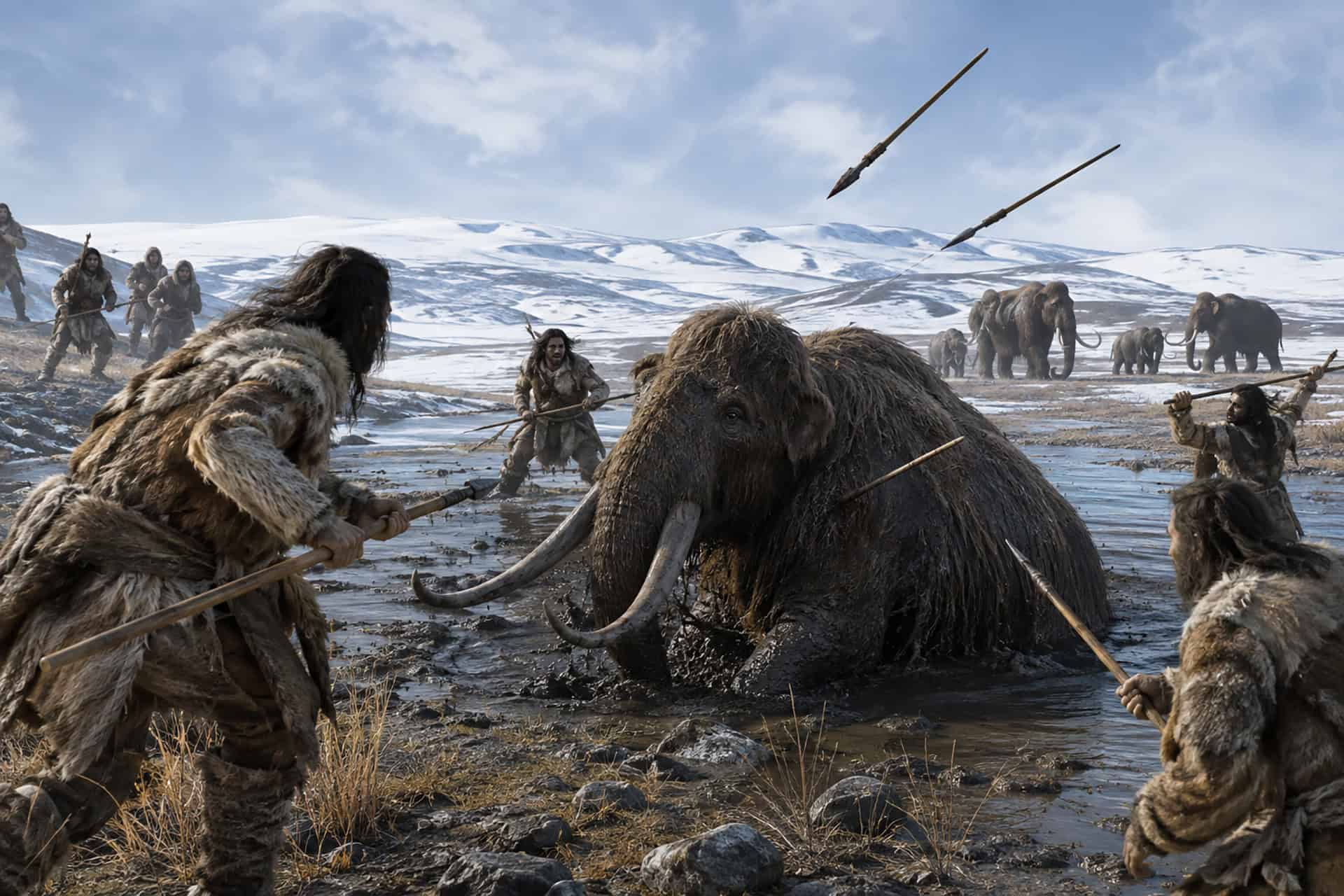
 An illustration showing a woolly mammoth surrounded by Ice Age hunters (AI-generated).
“The elephant in the room, so to speak, is a new line of evidence that humans contributed to the extinction of mammoths,” Audrey Rowey, an expert in palaeoecology from the University of Alaska Fairbanks, told New Scientist. She wasn’t involved in the study.
To investigate the mystery, researchers analyzed genome-wide ancient DNA from 521 woolly mammoths spanning roughly the last 50,000 years across Eurasia and North America. Of these, 448 genomes were newly sequenced, mostly from teeth, while the remaining data came from previously published genomes.
The team divided the animals into two groups:
one consisted of 100 mammoths recovered from 11 archaeological bone accumulation sites dating between 20,000 and 30,000 years ago, where mammoth remains occur alongside evidence of human activity such as stone tools and butchery. the second group included 421 mammoths from natural deposition sites, where animals are thought to have died without human involvement.The difference between the two groups was hard to miss.
Some 66% of the natural settings mammoths were male. That fits earlier genetic research suggesting that solitary males were more likely than herd-living females to die in natural traps or other environments where their remains could be preserved. Meanwhile, at the archaeological sites, the trend was almost completely reversed. Around 70% of the mammoths were female, and this female bias appeared repeatedly across multiple sites.
×
Thank you! One more thing...Please check your inbox and confirm your subscription.
“The people weren’t just fooling around — they knew what they were doing. They probably had a structured way to interact with mammoths, one that we cannot really understand,” David Díez-del-Molino, one of the study authors and an evolutionary geneticist at CPG, said.
Rather than merely scavenging animals that had died naturally, hunters appear to have repeatedly killed or otherwise procured mammoths from female-dominated groups.
Why Hunt Female Mammoths? Image via Wiki Commons.
It’s hard to say for sure, but researchers have some ideas. Like living elephants, woolly mammoths probably lived in matriarchal family groups composed of adult females and young animals. Adult males, meanwhile, likely spent much of their time alone or in loose male groups.
Those different social structures could explain both sides of the DNA pattern.
“While it is tempting to assume that hunters would have targeted females because they were smaller than adult males, the reality may have been more complex,” Hannah Moots, first study author and a postdoc researcher at the Centre of Palaeogenetics (CPG) in Stockholm, said.
These family groups likely followed predictable seasonal routes, making them easier for hunters to find repeatedly. Females protecting calves may also have been less willing to flee, giving hunters more opportunities to trap entire groups. Adult male mammoths were also larger. They weighed up to about 6 tonnes and stood roughly 3.4 meters (11 feet) tall at the shoulder, compared with about 4 tonnes and 2.9 meters (9.5 feet) for adult females.
A Rare Genetic Clue from the Last MammothsWhile examining the genomes, the researchers also came across an unexpected finding.
One mammoth from Wrangel Island — the last known refuge of the species, where mammoths survived until around 4,000 years ago — carried XX/X0 mosaicism, a condition in which some cells have two X chromosomes while others have only one.
In humans, a similar chromosomal pattern forms the genetic basis of Turner syndrome.
According to the researchers, this is the first documented sex chromosome mutation ever identified in an extinct species. It remains unclear whether the mutation was linked to the island’s small, isolated population or was simply a rare developmental event that could have occurred in any mammoth population.
The finding demonstrates that ancient DNA is now detailed enough to detect rare genetic disorders in species that disappeared thousands of years ago, opening a new way to study the health and biology of extinct animals.
A New Piece of the Extinction PuzzleThe new analysis provides some of the strongest genetic evidence yet that humans played an active role in forming many famous mammoth-bone accumulations.
By scaling up sample sizes, ancient DNA can go beyond evolutionary history to teach us about animal behavior and human culture tens of thousands of years ago,” Love Dalén, one of the study authors and a professor in evolutionary genomics, said.
But the study doesn’t settle the mammoth-extinction debate. Simply put, humans may have not been the only cause for the mammoths’ extinction.
Rapid warming at the end of the Ice Age transformed the open, grassy habitats on which mammoths depended. Mainland mammoth populations disappeared roughly 10,000 to 12,000 years ago as forests and wetter tundra expanded across much of their former range.
Future studies combining ancient DNA with archaeology could help reveal just how much human hunting influenced the fate of these Ice Age giants.
The study is published in the journal Current Biology.

