
Remember me


The 1872 Two-Cent Piece did more than close a short-lived coin series. It marked the final circulation issue of a denomination born during a national emergency.
The Philadelphia Mint produced only 65,000 business strikes that year. That total makes the 1872 the undisputed key date among regular-issue Shield Two-Cent Pieces. Moreover, collectors rarely encounter it with clean surfaces, original color, and full Mint State detail.
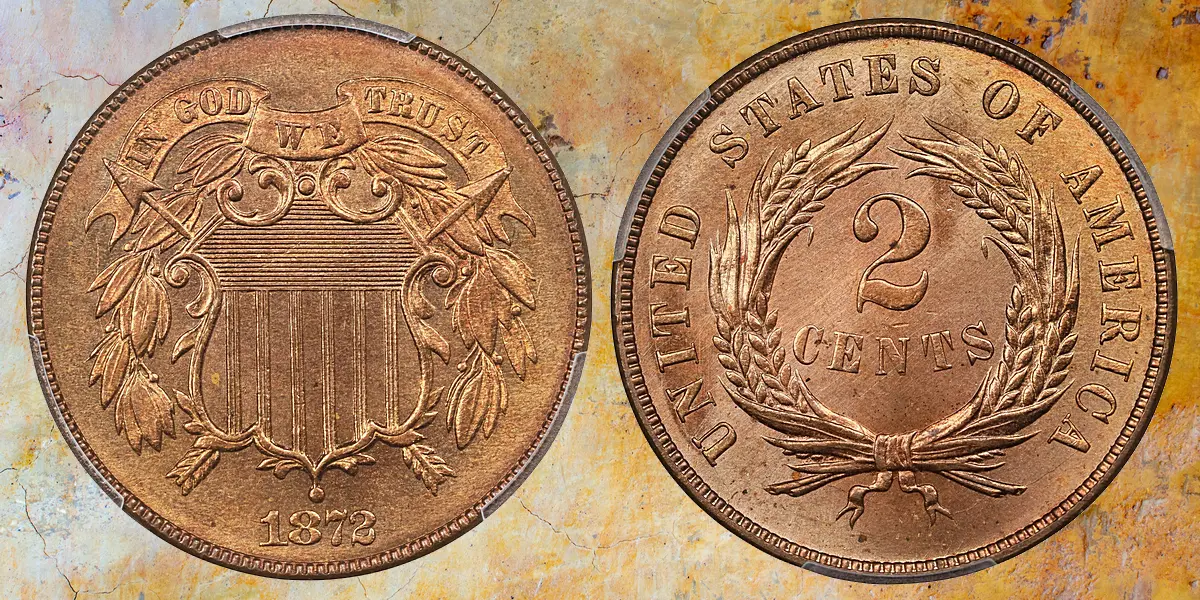
 1872 Two-Cent Piece. MS-66 RB (PCGS). CAC. CMQ.
Yet the coin’s importance reaches far beyond its low mintage. The series emerged from the economic chaos of the Civil War. It introduced one of America’s best-known national mottos. Then, less than a decade later, changing commerce pushed the denomination into extinction.
In other words, the 1872 Two-Cent Piece represents the last survivor of a coinage experiment that America no longer needed.
America Ran Out of ChangeThe Civil War disrupted almost every part of American economic life. It also stripped coins from circulation.
Americans began hoarding gold and silver soon after the fighting started. As the crisis deepened, they also removed copper cents from everyday commerce. People wanted tangible money with recognizable metal value. They did not know what the next military defeat, bank failure, or government policy might bring.
Consequently, merchants struggled to make change. They used postage stamps, privately issued paper scrip, fractional currency, and millions of Civil War tokens. These substitutes kept small transactions moving. However, they also highlighted the government’s inability to provide enough federal coinage.
Treasury Secretary Salmon P. Chase and Mint Director James Pollock sought a more permanent answer. Congress supplied one on April 22, 1864, when it authorized a bronze two-cent coin. Chief Engraver James B. Longacre created the design.
The Philadelphia Mint moved quickly. It produced 19,847,500 Two-Cent Pieces during 1864. That first-year output came close to 20 million coins. By comparison, the Mint produced just 65,000 circulation strikes during the denomination’s final year.
The contrast tells the entire story. America urgently needed the coin in 1864. By 1872, the public had nearly abandoned it.
“In God We Trust” Changes American CoinageThe Two-Cent Piece also introduced a motto that would reshape the nation’s money.
During the Civil War, religious appeals reached Secretary Chase and other Treasury officials. Supporters urged the government to acknowledge God on federal coinage. Chase then directed Mint officials to develop suitable wording. Pollock worked with Longacre as the Mint considered several mottoes and designs.
 The 1864 Two-Cent Piece marked the first time IN GOD WE TRUST appeared on a United States coin. Image: CoinWeek.
Longacre eventually placed IN GOD WE TRUST above the shield on the new Two-Cent Piece. Therefore, the 1864 coin became the first United States coin to display those exact words. Congress later expanded the motto’s use across other denominations.
Every 1872 Two-Cent Piece carries that legacy. The inscription does not serve as a minor design element. Instead, it connects the coin directly to the religious, political, and emotional atmosphere of the Civil War.
Longacre Builds a Coin Around the Union Shield James B. Longacre -The fourth chief engraver of the United States Mint – 1855
Longacre gave the Two-Cent Piece a forceful design.
The obverse features a Union shield. Crossed arrows and an olive branch appear behind it. A ribbon above the shield carries IN GOD WE TRUST, while the date appears below.
The reverse places a large numeral 2 above the word CENTS. A wheat wreath surrounds the denomination. Finally, UNITED STATES OF AMERICA follows the outer border.
The shield communicated strength and national unity. Meanwhile, the arrows represented military readiness. The olive branch offered a message of peace. Longacre later adapted the shield concept for the Shield Nickel, which Congress authorized in 1866.
The design looked appropriate during wartime. However, the coin itself soon faced a different battle.
Why the Two-Cent Piece FailedThe denomination solved an immediate crisis. Still, it never secured a permanent place in American commerce.
Congress authorized the copper-nickel Three-Cent Piece in 1865. Then, in 1866, Congress approved the nickel five-cent coin. Both denominations gave the public smaller and more durable alternatives. At the same time, cent production recovered from its wartime disruption.
As a result, demand for Two-Cent Pieces collapsed.
The Philadelphia Mint reduced production from almost 20 million coins in 1864 to 13.64 million in 1865. Output continued to fall during the following years. By 1871, the Mint produced only 721,250 pieces. Then, in 1872, production plunged to 65,000.
The 1872 mintage amounted to less than one-tenth of the previous year’s output. It also represented well under 1% of the series’ total circulation-strike production.
Congress formally abolished the denomination through the Coinage Act of February 12, 1873. The Mint produced only Proof Two-Cent Pieces in 1873. Therefore, the 1872 stands as the final issue intended for circulation.
Collectors often connect the Coinage Act of 1873 with the phrase “Crime of 1873.” However, that nickname primarily concerns the law’s treatment of silver and the standard silver dollar. The same sweeping legislation also ended the Two-Cent Piece.
Why the 1872 Two-Cent Piece Became the Key DateThe low mintage provides the clearest reason for the coin’s rarity.
The Philadelphia Mint produced 721,250 business strikes in 1871. That figure already ranked as low for the series. Yet the 1872 output reached only 65,000 pieces. No other regular issue comes close.
Moreover, many examples entered circulation. Bronze reacts easily with moisture, chemicals, and environmental contaminants. Consequently, surviving coins often display corrosion, dark surfaces, scratches, cleaning, or other problems.
Collectors should treat precise survival claims with caution. No complete census exists. In addition, grading-service reports count submissions rather than unique coins. Owners may submit the same coin more than once.
Still, the market leaves little doubt about the issue’s scarcity. Collectors pay strong premiums for problem-free circulated pieces. Meanwhile, Mint State examples attract advanced specialists. Coins with substantial original red color occupy an even higher tier.
Brown, Red-Brown, and Red: Why Color MattersGrading services divide copper and bronze coins into three primary color categories.
Brown, or BN, describes coins that show mostly brown coloration. Red-Brown, or RB, identifies coins that retain a noticeable mixture of original mint red and later brown toning. Finally, Red, or RD, describes examples that preserve most of their original copper brilliance.
A Red designation does not automatically guarantee quality. Spots, carbon, fingerprints, or uneven color can still affect eye appeal. However, full-red 1872 Two-Cent Pieces remain major condition rarities.
Current PCGS data contradict the older claim that MS65RD coins rank as the finest known. PCGS lists one grading event at MS67RD, one at MS66+RD, and three at MS66RD. Its report also lists several MS65RD and MS65+RD submissions. Population totals can include resubmissions, but the data clearly show that MS65RD does not represent the top grade.
PCGS estimates that about 50 full-red examples survive at MS65 or better across the entire market. That estimate includes certified and uncertified coins. It also reflects expert opinion rather than a physical census.
The public auction record confirms the demand. Heritage Auctions sold a PCGS MS66RD example for $72,000 on September 17, 2020. That result provides a stronger market benchmark than a general estimate of $30,000 to $50,000.
A Premium Gem Brings $14,640 in 2026Stack’s Bowers Galleries offered an exceptional 1872 Two-Cent Piece during its June 2026 Showcase Auction.
PCGS graded the coin MS66RB. CAC approved it, while CMQ also recognized its quality. The coin came from the William J. Heisler Collection.
The piece displayed dominant autumn-orange color with delicate rose-brown iridescence. Frosty surfaces produced unusually strong flash. In addition, the fields showed a faint prooflike character. A sharp strike and minimal distractions completed its premium appearance.
Stack’s Bowers sold the coin for $14,640 on June 16, 2026. The result shows how strongly collectors value originality, eye appeal, and technical quality within the Red-Brown category.
The price also illustrates an important point. Color designation alone does not determine value. A beautiful MS66RB coin can outrank many lower-grade red examples in overall quality and desirability.
 Philadelphia Mint Circa 1870
The 1872 Proof Two-Cent Piece
Philadelphia Mint Circa 1870
The 1872 Proof Two-Cent Piece
The Philadelphia Mint also produced 950 Proof Two-Cent Pieces in 1872. Mint employees prepared these coins for collectors rather than everyday commerce. Their mirrored fields and carefully produced surfaces separate them from circulation strikes.
PCGS identifies PR67RB as the top entry in its Red-Brown Proof condition census. The company reports a $6,900 auction record for a PR67 example that Heritage Auctions sold in January 2008.
Meanwhile, an online seller currently advertises an NGC PF67 RB Cameo at $74,000. The seller describes the coin as population 1 with none finer. However, the $74,000 figure represents an asking price, not a completed private-treaty or auction transaction. Moreover, the NGC designation shown in the listing reads Cameo, not Ultra Cameo.
Therefore, collectors should not treat that listing as a verified market record. Public auction results provide a more reliable measure of realized value.
1872 Two-Cent Piece Specifications Collecting the 1872 Two-Cent PieceCollectors should approach any uncertified 1872 Two-Cent Piece carefully. Its key-date status creates strong incentives for alteration and misrepresentation.
First, examine the date closely. Added digits and altered dates can transform common earlier pieces into apparent 1872 rarities. Next, inspect the surfaces for corrosion, smoothing, recoloring, and harsh cleaning. Finally, consider professional authentication before buying an expensive example.
Original circulated coins offer a practical entry point for many collectors. However, even these pieces command substantial premiums. Mint State coins require a larger budget, while Gem Red examples rank among the great condition rarities of post-Civil War copper coinage.
A Civil War Coin Makes Its Final StandThe 1872 Two-Cent Piece tells a larger American story.
War created the denomination. A coin shortage gave it purpose. Longacre’s shield gave it a national identity. Moreover, IN GOD WE TRUST gave it a permanent place in the history of United States coinage.
Then peace changed the nation’s monetary needs. Cents returned to circulation. Nickel coins gained public support. Demand vanished, and the Two-Cent Piece disappeared.
That rise and fall gives the 1872 issue its power. It does not merely represent a low-mintage key date. Instead, it marks the final chapter of a coin born from war, made obsolete by recovery, and preserved today as one of the defining rarities of 19th-century American numismatics.