
Remember me
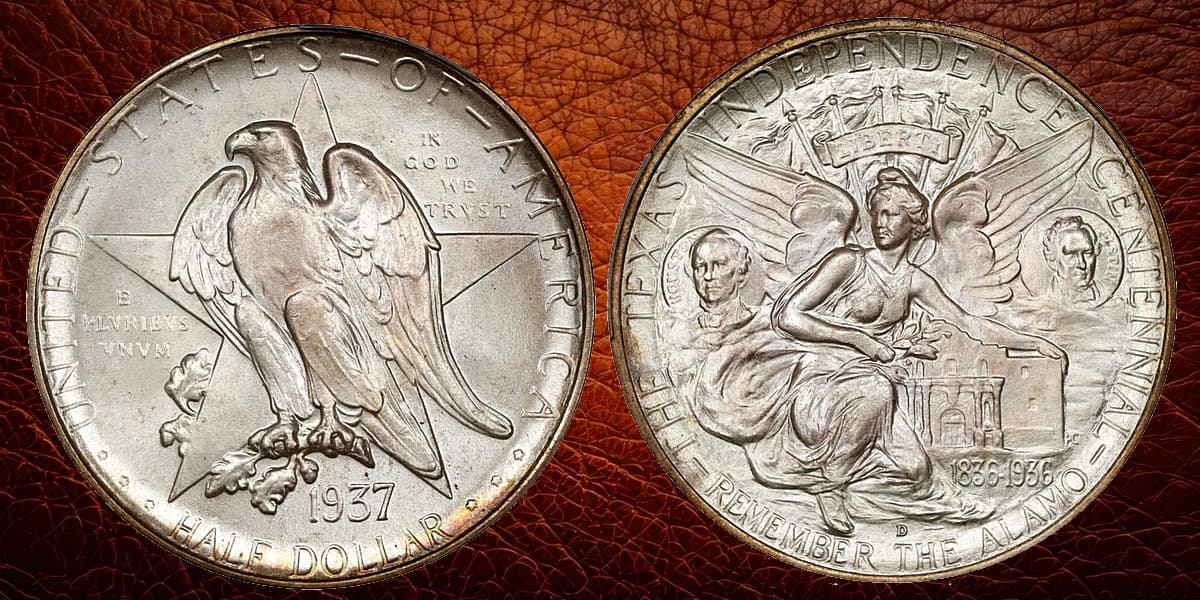


A superb 1937-D Texas Independence Centennial Half Dollar now offered through Stack’s Bowers Marketplace combines Texas history, classic commemorative controversy, and remarkable preservation.
PCGS graded the coin MS-68. It also carries the Collectible Market Qualified, or CMQ, designation. Stack’s Bowers lists the coin for $12,900.
More importantly, PCGS has graded only nine examples at MS-68. None rank finer. That places this intensely toned half dollar at the summit of the PCGS population for the issue, according to the marketplace description.
 1937-D Texas Independence Centennial. MS-68 (PCGS). CMQ. – Available at Stack’s Bowers Marketplace
A Top-Population 1937-D Texas Half Dollar
1937-D Texas Independence Centennial. MS-68 (PCGS). CMQ. – Available at Stack’s Bowers Marketplace
A Top-Population 1937-D Texas Half Dollar
The offered coin displays strong satin luster beneath light antique-silver and pearl-gray toning. Stack’s Bowers also notes a sharp strike and exceptionally clean surfaces with little or no evidence of handling.
Those qualities matter at the MS-68 level. Even a minor contact mark can prevent a classic commemorative from reaching this grade.
Moreover, the design gives graders little room for compromise. Sculptor Pompeo Coppini filled both sides with raised devices, fine lines, lettering, and small symbolic details. Every exposed surface offers another place for a mark, abrasion, or incomplete strike to appear.
Nevertheless, this coin survived with its visual balance and surface quality intact.
Stack’s Bowers previously offered the coin in its Spring 2024 Showcase Auction. The company listed it on Stack’s Bowers Marketplace on July 1, 2026.
Texas Independence Becomes a National CommemorativeThe Texas Centennial Half Dollar honored the 100th anniversary of Texas declaring independence from Mexico in 1836.
Congress authorized the program through Public Law 73-59. President Franklin D. Roosevelt signed the measure on June 16, 1933.
The legislation permitted the production of as many as 1.5 million half dollars. It also directed the United States Mint to release the coins only at the request of the American Legion Texas Centennial Committee in Austin. The committee paid the coins’ face value and then sold them at a premium.
The committee hoped to use the proceeds to support Texas centennial activities and a memorial building in Austin. That museum campaign later became associated with the Texas Memorial Museum on the University of Texas campus.
Therefore, the half dollar did more than recall the Texas Revolution. It also served as a fundraising tool.
The Centennial Coin That Arrived Two Years EarlyThe actual Texas independence centennial took place in 1936. However, the first Texas commemorative half dollars carried the date 1934.
The committee needed money before the celebration. Early sales could generate funds for centennial planning, publicity, and the proposed memorial project.
Consequently, the Texas program began two years before the anniversary. It then continued through 1938.
That five-year run created one of the most complicated date-and-mint combinations of the classic commemorative period.
Collectors could buy a single 1934 Philadelphia issue. Beginning in 1935, however, the committee requested coins from Philadelphia, Denver, and San Francisco. The same basic design then appeared with new dates and mintmarks in 1935, 1936, 1937, and 1938.
A collector who wanted a complete Texas set eventually needed 13 coins.
How Commemorative Marketing Created Collector FatigueThe Texas series arrived during the great commemorative coin boom of the 1930s.
Sponsors quickly learned that one commemorative program could produce several collectible issues. Congress often authorized a maximum quantity without restricting production to one year or one mint.
As a result, sponsoring organizations could request new dates and multiple mintmarks. Each variation encouraged collectors to place another order.
The Texas committee followed that model. It requested three-mint sets even though each coin carried the same Coppini design.
At first, collectors supported the program. However, enthusiasm weakened as new sets continued to appear. Other commemorative programs also competed for limited collector dollars.
Therefore, sales declined. The committee returned thousands of unsold coins for melting, while the net mintages fell sharply.
The Texas program became one of the prominent examples behind later criticism of commemorative coin marketing. Congress eventually reacted to the flood of repetitive issues and suspended new commemorative authorizations in 1939.
How Rare Is the 1937-D Texas Half Dollar?PCGS reports a mintage of 6,605 coins for the 1937-D Texas Half Dollar. That figure serves as the standard published mintage used by the grading service.
However, Stack’s Bowers states that 6,599 examples entered distribution. The six-coin difference reflects pieces reserved for assay rather than sold to collectors. Therefore, both figures can appear in reliable references, but they describe slightly different totals.
The Denver Mint originally struck 8,000 pieces for the 1937 issue. The committee returned unsold coins for destruction.
PCGS lists the three 1937 mintages as:
1937 Philadelphia: 6,571 1937-D Denver: 6,605 1937-S San Francisco: 6,637Thus, the 1937-D holds the middle position by mintage within the year. However, all three issues remain scarce compared with the large first-year production.
The 1934 issue had a net mintage of more than 60,000 pieces. By contrast, each 1937 issue had a surviving production total of fewer than 6,700 coins.
A Coin Designed by a Monumental Texas Sculptor Sculptor Pompeo Luigi Coppini
Pompeo Luigi Coppini designed both sides of the Texas Centennial Half Dollar.
Born in Italy in 1870, Coppini came to the United States in the 1890s. He later moved to Texas and built his reputation through large public monuments.
His Texas works included statues, memorials, fountains, and heroic historical groups. That background shaped his approach to the half dollar.
Coppini treated the coin like a monument in miniature.
Instead of simplifying the story, he attempted to compress Texas independence, state identity, military memory, political leadership, and national symbolism onto a silver disk only 30.6 millimeters wide.
The result remains one of the most ambitious designs in American commemorative coinage.
The Obverse: An Eagle Against the Lone StarThe obverse features a left-facing American eagle in front of a massive five-pointed star.
The eagle grips an oak branch, a traditional symbol of strength. Coppini also included the inscriptions UNITED STATES OF AMERICA, HALF DOLLAR, IN GOD WE TRUST, and E PLURIBUS UNUM.
The design makes an immediate visual statement. The Lone Star identifies Texas, while the eagle connects the state’s history to the United States.
Notably, Coppini placed the eagle on the obverse. Many United States coins traditionally placed the national bird on the reverse.
The date appears below the star.
The Reverse: The History of Texas on One Half DollarThe reverse became Coppini’s great numismatic balancing act.
At the center, a kneeling and winged female figure extends her left arm over the Alamo. The United States Mint identifies the figure as Liberty. Other catalog descriptions call her Nike or Victory.
She holds a laurel spray in her right hand. Meanwhile, portrait medallions of Sam Houston and Stephen F. Austin flank the central scene.
Houston played a central military and political role in the Texas Revolution and the Republic of Texas. Austin led the early Anglo-American colonization of Mexican Texas and earned recognition as the “Father of Texas.”
Above the central figure, Coppini placed the Six Flags over Texas. They represent the governments of Spain, France, Mexico, the Republic of Texas, the United States, and the Confederate States of America.
A banner bearing LIBERTY crosses the flags. The inscriptions also include THE TEXAS INDEPENDENCE CENTENNIAL, HOUSTON, AUSTIN, 1836-1936, and REMEMBER THE ALAMO.
The Denver “D” mintmark appears below the central figure, near her foot. It does not appear beside the base of the Alamo, as some online descriptions claim.
Too Much History, or a Numismatic Masterpiece?Coppini’s design faced criticism before the Mint struck the first coin.
Members of the United States Commission of Fine Arts considered the original models overcrowded. They argued that the small portraits and numerous symbols would lose clarity when reduced to half-dollar size.
The commission suggested a simpler design centered on the Alamo, Houston, and Austin. However, Coppini and the Texas sponsors defended the broader composition.
After revisions, the commission approved the design in June 1934.
The debate has continued ever since.
Some collectors see a congested reverse with too many competing elements. Others view it as a remarkable piece of miniature sculpture.
Either way, the coin never lacks visual impact. Few American coins ask the viewer to discover so much within such a small space.
Why MS-68 Is a Different Level of RarityMost Texas Centennial Half Dollars went directly to collectors. Therefore, circulated examples remain unusual, while Mint State coins survive in meaningful numbers.
However, survival in Mint State does not guarantee survival in MS-68.
Original cardboard holders and paper envelopes could produce toning. They could also allow coins to slide, rub, or acquire small marks. In addition, Coppini’s crowded design includes exposed high points that demand careful inspection.
Collectors should examine the eagle’s breast and feathers on the obverse. On the reverse, they should study Liberty’s knee, face, wings, and surrounding fields. The small portraits, Alamo details, and flag lines also reward close inspection.
At MS-68, a coin must unite an excellent strike, superior luster, attractive color, and nearly pristine surfaces.
According to Stack’s Bowers, PCGS has graded nine 1937-D Texas Half Dollars at MS-68, with none finer. That population makes the offered coin a genuine condition rarity rather than simply a low-mintage commemorative.
Specifications of the 1937-D Texas Centennial Half Dollar 1937-D Texas Independence Centennial. MS-68 (PCGS). CMQ.
Country: United States
Denomination: Half Dollar
Year: 1937
Mint: Denver
Mintmark: D, below the central reverse figure
Designer: Pompeo Coppini
Composition: 90% silver and 10% copper
Weight: 12.5 grams
Diameter: 30.6 millimeters
Edge: Reeded
Published mintage: 6,605
Number distributed: 6,599
PCGS number: 9391
1937-D Texas Independence Centennial. MS-68 (PCGS). CMQ.
Country: United States
Denomination: Half Dollar
Year: 1937
Mint: Denver
Mintmark: D, below the central reverse figure
Designer: Pompeo Coppini
Composition: 90% silver and 10% copper
Weight: 12.5 grams
Diameter: 30.6 millimeters
Edge: Reeded
Published mintage: 6,605
Number distributed: 6,599
PCGS number: 9391
PCGS confirms the coin’s weight, diameter, composition, designer, Denver Mint origin, and published mintage.
A Texas Commemorative at the Top of the PopulationThe 1937-D Texas Centennial Half Dollar occupies an important place within the classic commemorative series.
Its low mintage reflects declining collector demand. Its complex production history captures the excesses of the 1930s commemorative boom. Meanwhile, its design compresses an entire state mythology into one of the busiest silver canvases the United States Mint ever produced.
The Stack’s Bowers Marketplace example adds another dimension.
Its MS-68 grade, top-population standing, sharp strike, satin finish, delicate toning, and nearly undisturbed surfaces transform a scarce commemorative into a major condition rarity.
For the advanced Texas specialist or classic commemorative collector, this coin represents more than another space in an album.
It represents the point where Texas history, controversial coin design, and extraordinary preservation meet.