
Remember me


A mysterious gold striking once ranked among the most intriguing experimental pieces linked to the Liberty Head Quarter Eagle.
For decades, the piece carried an impressive pedigree. Major numismatic references also documented it. Moreover, respected dealers handled it as a genuine United States Mint die trial.
Now, however, three major grading services have declined to authenticate it.
Mike Byers of MintErrorNews reports that Professional Coin Grading Service (PCGS) identified the piece as a counterfeit struck from false dies. Numismatic Guaranty Company (NGC) determined that it was not genuine. Meanwhile, CAC Grading questioned its authenticity.
The findings stunned many pattern and error specialists. After all, collectors had known the piece for more than 60 years.
Yet its celebrated history could not overcome the physical evidence.
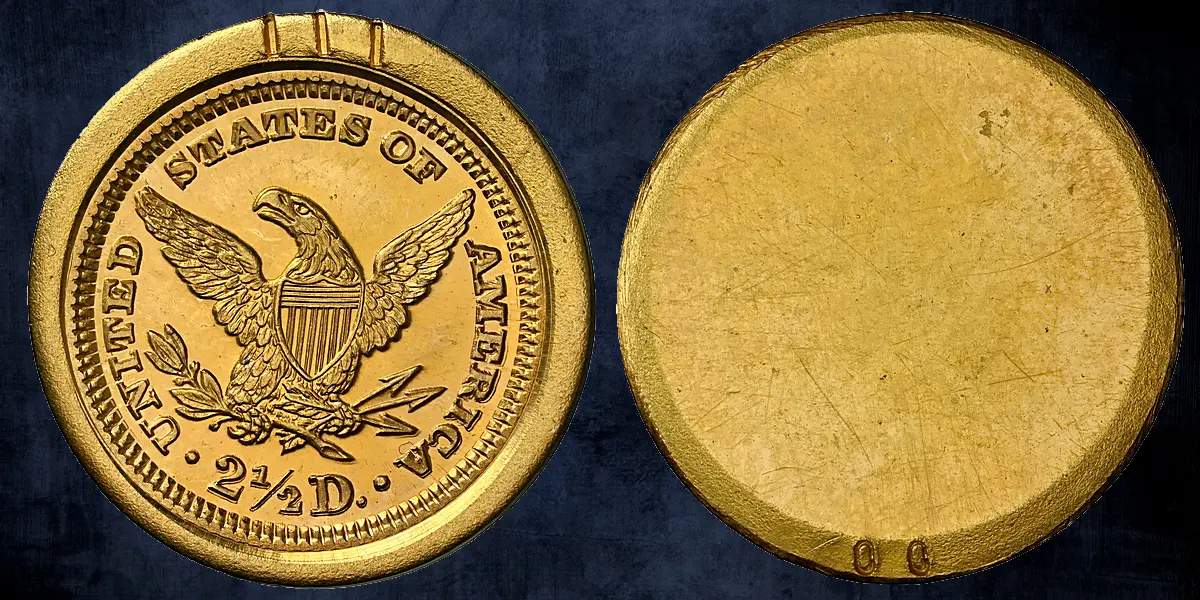
 Counterfeit 1859 $2½ Liberty Gold Proof Reverse Die Trial Uniface – Judd # A-1859-8
What Is the 1859 Quarter Eagle Reverse Die Trial?
Counterfeit 1859 $2½ Liberty Gold Proof Reverse Die Trial Uniface – Judd # A-1859-8
What Is the 1859 Quarter Eagle Reverse Die Trial?
The piece carries the designation Judd Appendix A-1859-8, or J-A1859-8.
It displays only the reverse of the Liberty Head Quarter Eagle. Therefore, numismatists describe it as uniface. The design shows the heraldic eagle and inscriptions used on the adopted quarter eagle reverse.
The opposing side has no conventional coin design.
In addition, the maker struck the piece twice. The strikes spread beyond the intended diameter because no retaining collar restricted the metal. Numismatists call this effect a broadstrike.
The piece also rests on an oversized gold planchet. It weighs 5.4 grams.
By comparison, a standard Liberty Head Quarter Eagle weighs 4.18 grams. It measures 18 millimeters and contains 90% gold and 10% copper. Christian Gobrecht designed the series.
Therefore, the purported trial weighs about 29% more than a regular $2.50 gold coin.
That unusual weight once supported the theory that the Philadelphia Mint had produced the piece while testing a revised quarter eagle reverse. However, an unusual planchet alone cannot prove Mint origin.
A Pedigree That Reached Back to 1962The piece first gained broad attention through Q. David Bowers and the Empire Coin Company.
Bowers featured it in Empire Review No. 16 in 1962. That early appearance gave the piece a documented numismatic history extending back more than six decades.
Next, prominent New York dealer Lester Merkin offered the gold striking in his October 1973 auction. It appeared as lot 469.
Merkin earned considerable respect for his careful catalogs and his handling of important United States coins. Consequently, the auction appearance strengthened the piece’s reputation.
 Q. David Bowers Empire Review #16 1962
 Lester Merkin auction October 1973, lot 469
David Akers Added the Piece to the Quarter Eagle Literature
Lester Merkin auction October 1973, lot 469
David Akers Added the Piece to the Quarter Eagle Literature
The die trial later entered one of the standard references for United States gold coins.
David W. Akers discussed it on page 120 of United States Gold Coins: An Analysis of Auction Records, Volume II: Quarter Eagles, 1796-1929.
Akers called it a “very interesting uniface die trial” of the new reverse. He also noted its appearance in Merkin’s October 1973 sale.
That reference gave the piece another layer of authority. Collectors and researchers often rely on Akers because he traced auction appearances and rarity information long before searchable online archives existed.
The Judd pattern reference also placed the piece in Appendix A under the number J-A1859-8. In addition, the USPatterns website documented it among uncertain issues and counterfeits.
USPatterns explains that pieces in this category may lack Mint origin or may represent other forms of manufacture. The site includes them to alert collectors, not to endorse them as genuine Mint products.
Why Did Experts Question the Die Trial?A long pedigree can establish that an object existed at an earlier date. However, pedigree cannot establish who made it.
That distinction matters.
During the 19th and 20th centuries, private manufacturers created deceptive pieces, fantasy strikes, electrotypes, casts, and altered coins. Some entered major collections. Others appeared in important auctions. In several cases, numismatists accepted them for decades before modern examination exposed problems.
According to Byers, PCGS concluded that false dies produced the 1859 gold piece. NGC declined to recognize it as genuine. CACG also questioned its authenticity.
Those independent conclusions carry substantial weight.
Modern authentication combines die analysis, surface study, metal examination, strike characteristics, and comparisons with known genuine coins. Experts also look for tooling marks, incorrect letter shapes, impossible die characteristics, artificial aging, and evidence of manufacture outside the Mint.
Still, not every specialist agrees.
Byers reports that most experts now consider the piece counterfeit. However, a small number continue to believe that it might represent a genuine Mint product.
Therefore, debate may continue even though the major grading services have refused to authenticate it.
The Larger Lesson for Pattern CollectorsThe 1859 Quarter Eagle reverse trial offers a powerful warning.
Documentation matters. Pedigree matters. Published references matter.
However, none of those factors can replace authentication.
A famous dealer can make an honest mistake. Likewise, an respected author can document a piece using the best information available at the time. Later technology may then reveal evidence that earlier generations could not detect.
In this case, the paper trail remains real. Bowers featured the piece in 1962. Merkin offered it in 1973. Akers discussed it in his quarter eagle reference. The Judd appendix assigned it a catalog number.
Yet those appearances only document the history of the object. They do not prove that the United States Mint made it.
That tension gives the piece its lasting importance.
The gold striking may no longer qualify as a genuine Mint die trial. Nevertheless, it now tells another compelling story. It shows how numismatic knowledge evolves, how authentication standards improve, and how even a famous rarity can face a complete reassessment.
 USPatterns.com
CoinWeek Fact-Check Notes
USPatterns.com
CoinWeek Fact-Check Notes
CoinWeek confirmed the standard Liberty Head Quarter Eagle weight of 4.18 grams, its 18-millimeter diameter, and its composition of 90% gold and 10% copper through PCGS and NGC references.
Mike Byers documents the piece’s 5.4-gram weight, double strike, broadstrike, Judd appendix number, 1962 Empire Review appearance, October 1973 Merkin auction appearance, and Akers reference. He also reports the conclusions reached by PCGS, NGC, and CACG.
Publicly accessible grading-service pages did not provide enough information to independently reconstruct each submission or examination. Therefore, CoinWeek attributes those specific authentication findings directly to Byers.