
Remember me



 by Nino LeitnerYesterday
EBU Sport has published “Raising the Bar”, a set of practical camera and broadcast direction guidelines aimed at ending the sexualization of women athletes in live athletics coverage. Developed with input from Olympic athletes Holly Bradshaw, Ivana Španović, and Blanka Vlašić, the free publication breaks down positive and negative camera positions, shot sizes, and replay practices for high jump, pole vault, horizontal jumps, and running events.
For directors, camera operators, and VT operators working in live sports, this is a rare document: a broadcaster-driven style guide that addresses framing and replay decisions shot by shot, using illustrated examples drawn entirely from real broadcast coverage. The European Broadcasting Union (EBU) represents 113 member organizations in 56 countries, so the guidelines carry weight far beyond a single production company or federation. European Athletics has endorsed the initiative, with its president Dobromir Karamarinov calling the filming guidelines a crucial step toward eliminating harmful portrayals of women in the sport while maintaining storytelling and technical excellence.
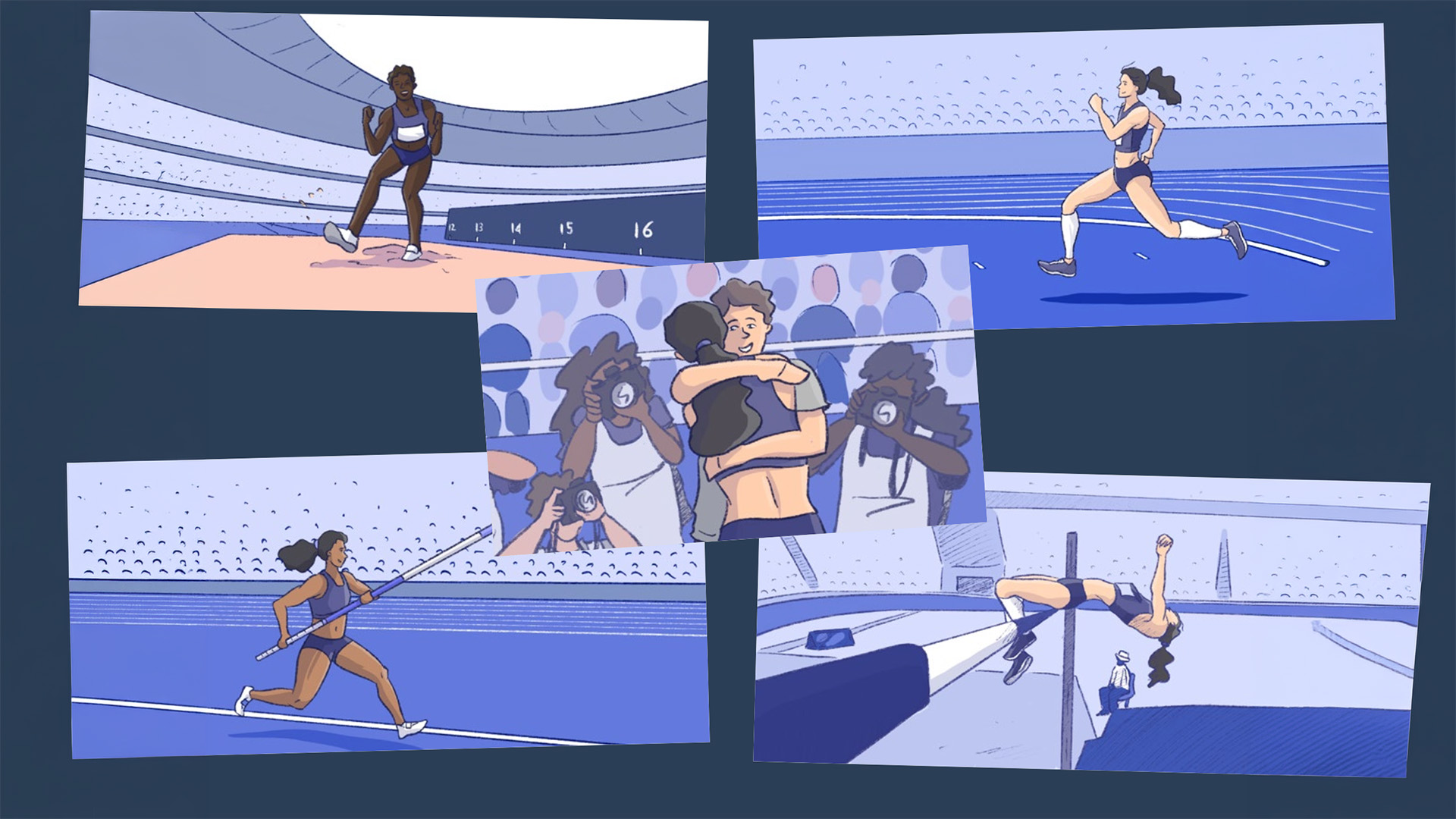
 EBU’s “Raising the Bar” Camera Guidelines give clear instructions which kind of angles are okay, and which ones aren’t. Image credit: EBUWhy the EBU is stepping in
In his foreword, EBU Sport Executive Director Glen Killane identifies the core problem: the sexualization of women athletes through selective camera angles and editing choices remains a significant concern across many sports broadcasts. The document names the specific practices at issue, including lingering shots on bodies, low-angle cameras that capture revealing views, and excessive slow-motion replays that serve no technical or storytelling purpose.
The consequences go beyond audience perception. According to the publication, athletes arriving at major competitions can become more focused on camera positions than on their own performance, or worry about footage later being misused online. Pole vaulter Holly Bradshaw states in the document that she has “received social media abuse and witnessed inappropriate videos online” of herself and colleagues when slow-motion content of competition is captured. Long jumper Ivana Španović adds that certain camera angles combined with gender stereotypes cause discomfort and distraction during competition, and can have serious long-term effects on athletes’ mental health; she also notes that poorly placed cameras can even pose an injury risk during warm-up.
The guidelines were developed by Elsa Arapi, Women’s Sport Lead at the EBU, together with director Clair Goodwin, commentator Hannah England, and graphic designer Christel Saneh, with feedback from a group of working directors, camera operators, and VT operators.
Camera plans, event by eventThe core of the document is a series of annotated camera plans for high jump, pole vault, horizontal jumps, and running events. Each plan maps typical camera positions (C1 through C6, plus mini cams and pico cams) and pairs them with illustrated examples of positive and negative angles.
 One of the camera plans in the guide. Image credit: EBU
The recurring pattern is consistent across events. Wide side-on angles covering the run-up and the technical phases of a jump are flagged as positive: they serve commentators, coaches, and viewers, and they are the same angles athletes themselves want shown. Low cameras positioned underneath or behind athletes, tight zooms during bar clearance and landing, and close framing of athletes exiting the sand pit are flagged as high-risk for producing what the EBU calls compromising images, while offering little or no analytical value in return.
For high jump, the document recommends staying wide for replays of the final strides and cutting away from overhead-style replay angles before the athlete touches down on the mat. For pole vault, handheld roaming cameras are acknowledged as valuable for capturing coach interactions and celebrations, but operators are cautioned about low or rear positions when athletes bend to pick up a pole. In horizontal jumps, the sand pit exit is identified as a particular trouble spot, with the advice to hold a wider shot or cut to the athlete’s face. For running events, the guidance is to stay in front of athletes where possible and avoid very tight shots during starting-line preparations and moments of fatigue after the finish.
 EBU’s “Raising the Bar” Camera Guidelines are specific for each athletic sport. Image credit: EBUSlow motion under particular scrutiny
Super slow-motion replays receive the most repeated warnings in the document. SSM cameras are standard equipment at athletics broadcasts, and the guidelines do not argue against them; instead, they ask VT operators and directors to review slow-motion replays before airing them and to favor side-on technical angles over tight low-angle material. Bradshaw makes the editorial case in the publication: the approach, take-off, and invert technique make up the vast majority of a pole vault, and focusing replays on those phases both delivers more insight for commentators and naturally eliminates compromising angles.
 They also try to cover ceremonial images from sports events. Image credit: EBU
This lands at an interesting moment for slow motion in live production. High frame rate capture is spreading rapidly through the broadcast chain, most recently with the ARRI ALEXA 35 Live Xtreme, which pushes up to 480fps baseband slow motion into standard SDI workflows with sports coverage as its primary target. As the tools for capturing ever more detailed slow-motion imagery become more capable and more cinematic, the editorial responsibility for how that material is deployed grows with them. Slow motion is a powerful storytelling device, as we explored in our look at super slow motion in films, and the EBU’s point is precisely that its power demands intent.
Guidelines, not restrictionsThe EBU is careful to frame the publication as the start of a conversation rather than a rulebook. The introductory note stresses that athletics is visually extraordinary and that the directors and camera operators covering it are highly skilled professionals. The argument is that the uncomfortable angles are simply avoidable without any loss of storytelling, technical insight, or visual quality, and that the angles which best showcase power, precision, and technique are often the same ones that treat athletes with dignity.
 EBU’s “Raising the Bar” Camera Guidelines are available to download for free from the EBU website. Image credit: EBU
Notably, the document states that the same principles apply to smaller crews working with fewer cameras and limited resources, not only to large-scale host broadcast operations. That makes the guidelines relevant to anyone shooting athletics, from national federations streaming domestic meets to independent crews producing highlight packages. Španović also points toward constructive alternatives: slow-motion shots that highlight technical precision such as the take-off moment, innovative aerial perspectives that emphasize the dynamics of an event, and educational graphics that explain biomechanics.
For CineD readers, the document is also a useful reminder that the EBU shapes far more of the live production landscape than many filmmakers realize. It is the organization behind the Eurovision Song Contest, where we recently went behind the scenes of the ARRI ALEXA 35 Live deployment, and its recommendations tend to propagate through public broadcasters and their production partners across Europe and beyond.
“Raising the Bar: Guidelines for Respectful Media Coverage in Women’s Athletics” is available now as a free PDF download from the EBU website.
Have you worked on live athletics coverage, and how do these guidelines match your experience behind the camera? Don’t hesitate to let us know in the comments below!