
Remember me






 by Johnnie BehiriToday
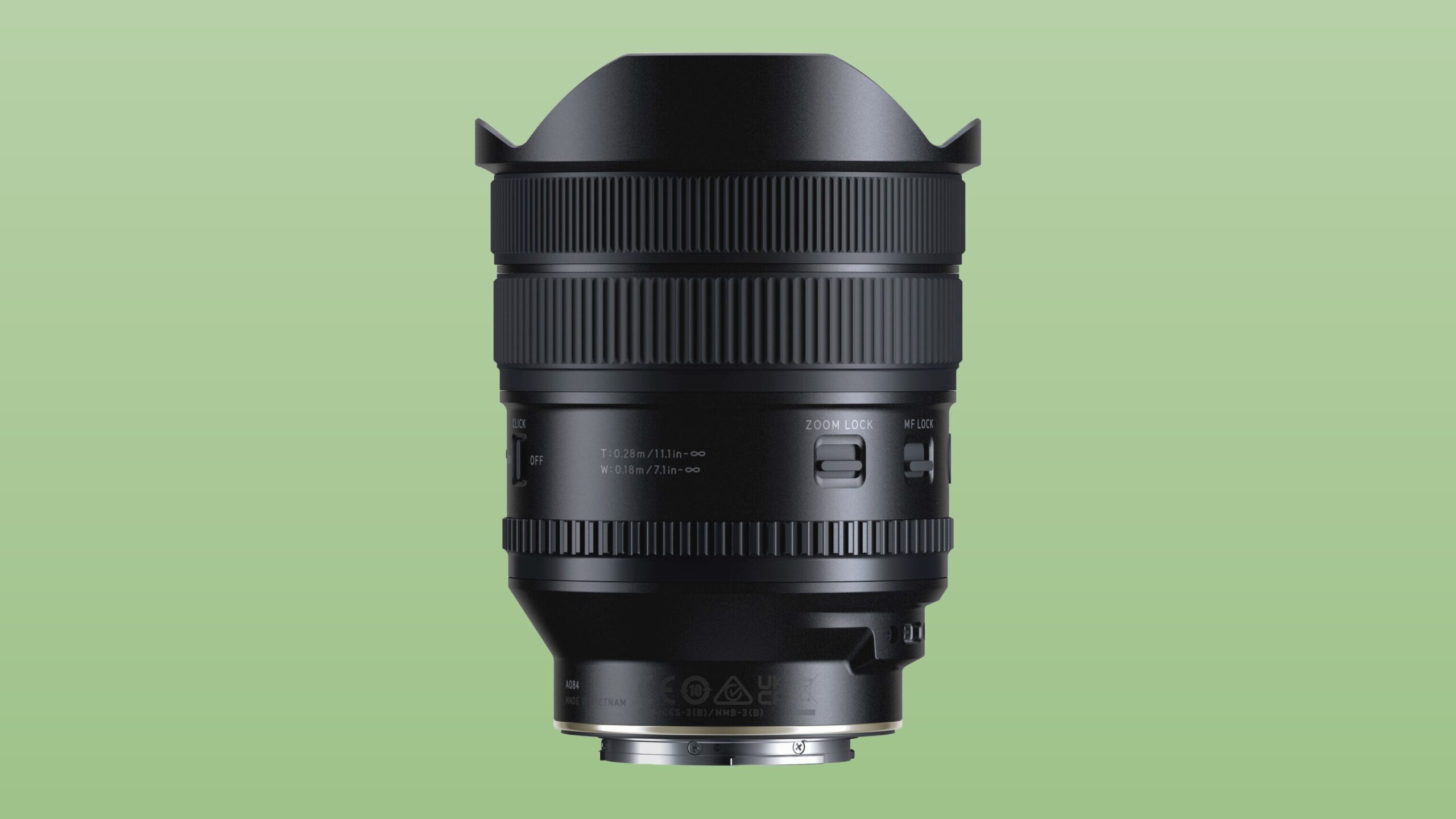
Tamron has launched the 12-20mm f/2.8 (Model A084), the widest full-frame lens the company has ever made and the first to debut its new Toned Profile Next lens design. The fast ultra-wide zoom for Sony E-mount and Nikon Z mount weighs just 570g / 20.2oz, focuses down to 0.18m / 7.1in, and features Tamron’s VXD linear autofocus motor.
Tamron has been busy filling out its mirrorless lineup over the past year, from the 16-30mm f/2.8 Di III VXD G2 that completed the company’s f/2.8 zoom trinity to the versatile 25-200mm f/2.8-5.6 ultra-zoom for Sony E-mount. The new 12-20mm f/2.8 pushes into territory the brand has never covered on full frame, going a full 4mm wider than the 16-30mm while maintaining a constant f/2.8 aperture across the zoom range. Tamron itself points out that while 14mm or 16mm lenses are already considered wide, the 12mm perspective delivers a different sense of scale altogether.
 Tamron 12-20mm f2.8 lens. Credit: TamronGoing wider than 14mm without the usual bulk
Ultra-wide f/2.8 zooms have traditionally been heavy, front-loaded lenses that dominate a camera bag, yet Tamron has kept this one remarkably small. The Sony E-mount version measures 119.3mm / 4.7in in length and weighs 570g / 20.2oz, while the Nikon Z variant comes in at 121.3mm / 4.8in and 585g / 20.7oz. Both share a maximum diameter of 90mm, which Tamron says makes the lens among the smallest in its class.
The focal range covers a diagonal angle of view from 121°58′ at 12mm to 94°30′ at 20mm on full-frame sensors. That 12mm starting point is the headline here: it opens up the kind of exaggerated perspective that works for architecture, interiors, real estate work, vehicle rigs, and establishing shots in tight locations, and the constant f/2.8 keeps it usable in dim interiors and under night skies. The trade-off is the short 1.7x zoom ratio, so this is a specialist optic rather than an everyday wide zoom.
An optical design aimed at night skiesThe optical construction consists of 17 elements in 12 groups, including one XGM (eXpanded Glass Molded Aspherical) element, three GM (Glass Molded Aspherical) elements, one XLD (eXtra Low Dispersion) element, and three LD (Low Dispersion) elements. According to Tamron, this arrangement suppresses peripheral blurring and color fringing while specifically correcting sagittal coma flare, the aberration that stretches point light sources into wing-like shapes toward the edges of the frame. If it holds up, it makes the lens a serious candidate for astrophotography and nighttime timelapse work, where a constant f/2.8 across an ultra-wide range is genuinely useful.
Tamron also introduces its AX (Anti-reflection eXpand) coating on this lens. The company says the coating achieves a uniform film thickness across the strongly curved front element via vapor deposition, which should help control ghosting and flare when bright light sources sit inside or just outside the frame, a common scenario at 12mm.
Close focusing opens up dramatic foregroundsThe minimum object distance is 0.18m / 7.1in at the 12mm wide end and 0.28m / 11.1in at 20mm, which translates to maximum magnification ratios of 1:5.8 and 1:9.1 respectively. At its closest, the front of the lens sits just 50mm / 2in from the subject. Combined with the extreme perspective of 12mm, this allows the classic ultra-wide close-up look, with an oversized foreground subject set against a sweeping background. For run-and-gun documentary or product-adjacent b-roll, that is a genuinely flexible tool to have in a lens this small.
Autofocus is handled by Tamron’s VXD (Voice-coil eXtreme-torque Drive) linear motor, the same mechanism found in recent lenses such as the 90mm f/2.8 macro for Sony E and Nikon Z. Tamron promises fast, quiet, and precise operation for both stills and video, though, as always, real-world tracking performance will depend on the camera body driving it.
 The lens mount is equipped with a dedicated rear filter holder. Credit: TamronControls and video-friendly customization
Despite the compact housing, Tamron says the 12-20mm f/2.8 offers comprehensive control features to meet professional demands, including a custom switch, a focus set button, and a USB-C connector port alongside its zoom and focus rings. The USB-C port connects the lens to the TAMRON Lens Utility software, which allows firmware updates and function customization for both stills and video, including focus ring response, A-B focus transitions, and focus presets.
The aperture mechanism uses a 12-blade circular diaphragm, and according to Tamron, the opening stays almost perfectly circular up to two stops down from wide open. The minimum aperture is f/16.
 Tamron 12-20mm f2.8 lens specifications. No front filters, but a rear holder and weather sealing
As with most fast ultra-wides, the bulbous front element rules out conventional screw-in filters, and Tamron lists no front filter size for this lens. The company compensates with an integrated rear filter holder for cut sheet filters, a non-removable flower-shaped lens hood, a locking front cap, and an included wrapping cloth for scratch protection. The lens features moisture-resistant construction with a fluorine coating on the front element, so it should tolerate the landscape and nightscape environments it is clearly designed for.
The lens is also the first to introduce Tamron’s new Toned Profile Next design, marking a visible evolution of form for the company’s mirrorless lineup. Notably, the official product name is simply 12-20mm F2.8 (Model A084), without the extended letter designations found on Tamron’s earlier mirrorless zooms.
The Tamron 12-20mm f/2.8 launches on July 30 for Sony E-mount at $1,699 and on August 27 for Nikon Z mount at $1,799. For full specifications, head to the Tamron product page.
Could this compact ultra-wide earn a place in your kit, or is f/2.8 still not fast enough for your astro and low-light work? Don’t hesitate to let us know in the comments below!