
Remember me

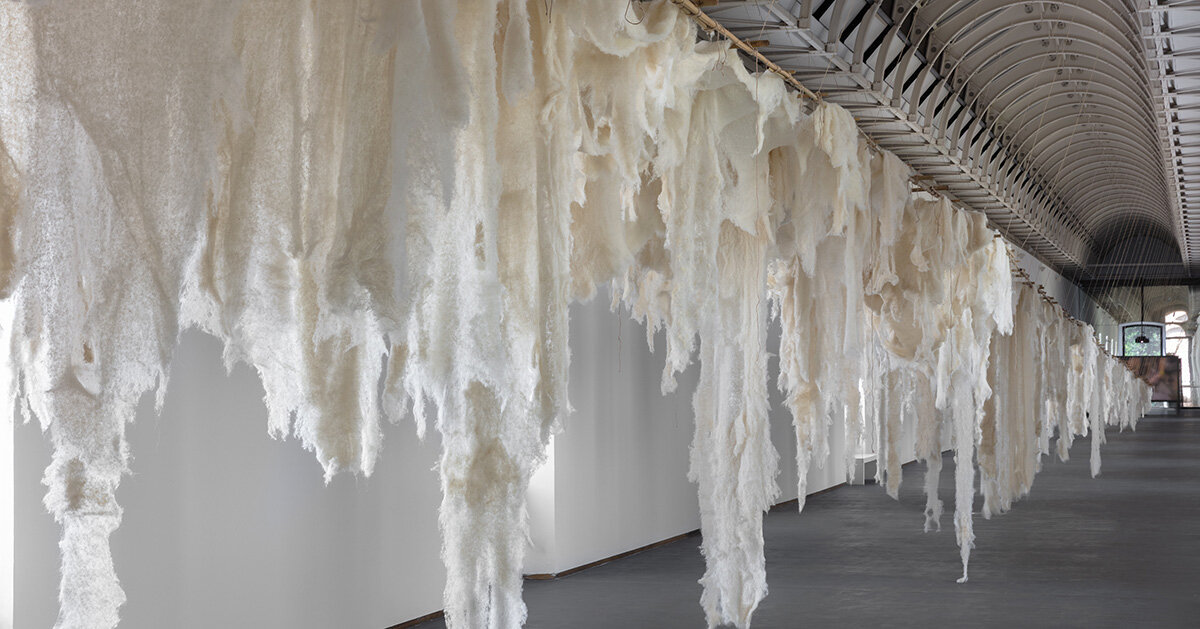
Cecilia Vicuña fills the soaring Manica Lunga at Castello di Rivoli with a suspended quipu that stretches for more than one hundred meters through the historic gallery. Titled El glaciar ido (The Vanished Glacier), the Chilean artist’s first solo museum exhibition in Italy draws on an ancient Andean system of knotted cords to reflect on disappearing glaciers, Indigenous knowledge, and the ways materials carry memories. Vicuña transforms the quipu into an immersive environment made from bamboo and raw wool.
Artist, poet, and activist, Vicuña has spent decades expanding what she calls Arte Precario, a practice grounded in ephemeral materials, collective participation, and ancestral forms of making. Since the 1960s, her installations have transformed discarded objects, raw fibers, and natural debris into works that exist between sculpture, ritual, and performance. At Castello di Rivoli, that approach takes the form of a monumental quipu acostado, a ‘lying-down’ quipu suspended throughout the historic gallery of the museum.‘The exhibition itself privileges the idea of being in the same place with the artworks. I would say that this is the case in which art becomes an experience, a true “embodied” experience,’ curator Marcella Beccaria tells designboom.

Cecilia Vicuña El glaciar ido (The vanished glacier / Il ghiacciaio scomparso), 2026 Veduta dell’allestimento / installation view Castello di Rivoli Museo d’Arte Contemporanea, Rivoli-Torino Foto | all images by Sebastiano Pellion di Persano © CECILIA VICUÑA, by SIAE, unless stated otherwise
a monumental installation recalls vanished glaciers
Used for centuries across Andean civilizations, quipus recorded information through cords, knots, colors, and fibers long before the arrival of European colonizers. For Vicuña, they remain more than historical artifacts. They are systems of knowledge that connect material, memory, and community while reclaiming cultural practices that colonial histories attempted to erase.
The new installation draws directly from the landscape surrounding Rivoli. Constructed from bamboo canes and strips of untreated wool, including fleece sourced from the indigenous Biellese sheep breed, the work evokes the glaciers that once shaped the Susa Valley during the Pleistocene and have since retreated or disappeared. Rather than illustrating climate change, Vicuña uses natural materials to suggest geological time itself, allowing fibers to recall melting ice, flowing water, and the gradual accumulation of memory across generations.

the suspended quipu stretches for more than one hundred meters
collective making shapes the exhibition beyond the museum
Used across Andean civilizations for centuries, quipus recorded information through cords, knots, and color long before Spanish colonization. Vicuña returns to the form throughout her career, treating it as a living practice that carries stories, histories, and relationships the colonial project sought to suppress.
For Castello di Rivoli, the artist anchors the quipu in the landscape surrounding the museum. The suspended structure is built from bamboo canes and strips of untreated wool, including fleece from the native Biellese sheep breed. Its flowing form recalls the glaciers that once shaped the Susa Valley and the moraines on which Rivoli now stands, while also pointing to the rapid retreat of alpine ice today.

layers of raw wool create an immersive landscape within the exhibition
craft becomes a tool for carrying memory
Poetry and sound extend the installation beyond its suspended structure. Newly written wall poems accompany the exhibition, while videos including Semiya (Seed Song) (2015) and Quipu Mapocho (2017) bring the artist’s voice, songs, and performances into the gallery, expanding Vicuña’s exploration of water, memory, and Indigenous knowledge, treating poetry, language, and gesture as materials that can preserve histories as powerfully as fiber or wool. Through local materials, collective making, and ancestral forms of knowledge, the artist suggests that craft is all about continually renewing our relationship with place, community, and the environment.
The exhibition also began long before visitors entered the gallery. In keeping with Vicuña’s vision of Arte Precario, a series of spontaneous public actions preceded the installation, including asking permission from the surrounding mountains before the work was created. None of these gestures were documented. ‘In line with the artist’s vision of Arte Precario, the exhibition was preceded by a series of spontaneous actions that happened in the public sphere, starting with the artist asking the mountains in the area permission to do the exhibition. These actions were not recorded and stay in the memory of the few people who collaborated on the exhibition, including the installers, our curatorial team, and myself,’ the curator shares with us.

untreated wool evokes the retreat of glaciers across the Susa Valley | image by Alberto Nidola © CECILIA VICUÑA, by SIAE

image by Alberto Nidola © CECILIA VICUÑA, by SIAE