Humpback whales are rewriting the calendar in Irish waters
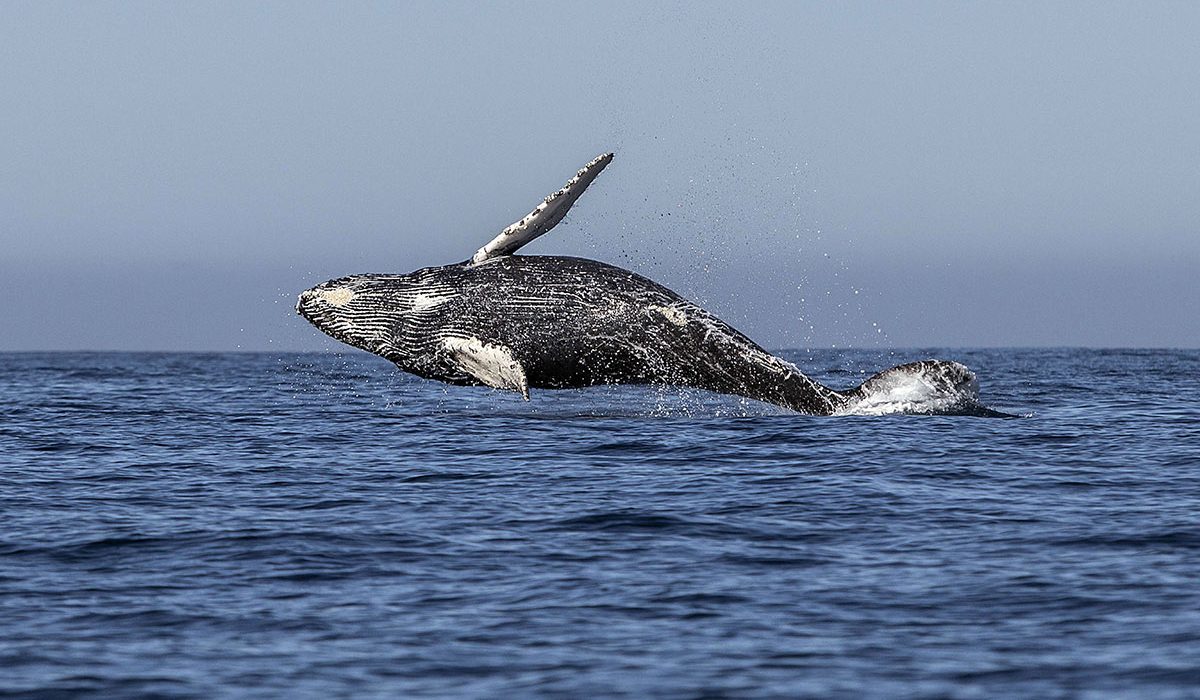
New academic research has revealed that humpback whales are visiting Ireland earlier each year in correlation with rising ocean temperatures.
ATU Galway PhD student Miguel Blásquez led the research by combing through around 20 years of humpback whale data collected through the Irish Whale and Dolphin Group (IWDG).
It found that the first humpback sighting of the season off the coast of Ireland went from September 15 in 1999, to May 2 in 2015 and then to March 2 in 2023.
Humpback whales are visiting Ireland earlier each year in correlation with rising ocean temperatures. Pic: JOAQUIN SARMIENTO/AFP via Getty Images
Since 1999, the IWDG has been collecting sightings and photos for a citizen science project named Whale Track Ireland.
The project has seen images being submitted by naturalists, citizen scientists, and observers, before their sightings were validated by strict methodologies.
Between 1999 and 2023, 1,127 humpback whale photo identification sightings were recorded by 226 different contributors.
Since 1999, the IWDG has been collecting sightings and photos for a citizen science project named Whale Track Ireland. Pic: Alfredo Martinez/Getty Images
Over the 24 years, the first annual sightings have shifted at a rate of around nine days earlier per year, as the study published in the Marine Mammal Science Journal indicated.
The researchers believe that such steep rates have not been documented elsewhere, though the last sighting of the season remained stable.
The whales range in size from 12 to 18 metres in length and can travel thousands of kilometres across all major oceans.
The researchers believe that such steep rates have not been documented elsewhere. Pic: Padraig Whooley/Irish Whale and Dolphin Group/PA Wire
According to the study, Ireland’s waters may serve as a feeding ground for certain humpbacks that mainly reproduce near Cape Verde.
It found that 70% of identified humpbacks were recorded again across different calendar years, with 25% of those being resighted in five or more years.
While in Irish waters, the humpbacks spent a minimum of 20 days patrolling, hunting and feeding within a 100km range, as the study suggests.
The research has been recognised as the most comprehensive analysis to date of humpback movement patterns in Irish waters.
It aligns with predictions on climate change effects in oceans, with rising sea temperatures believed to alter prey availability and distribution.
When the project began, Dr Simon Berrow of the IWDG explained that the whales were typically found off the coast of Cork, but in recent years, they have been more frequently seen in Donegal Bay.
He said: ‘We’ve loosely correlated this to sea surface temperatures. We know the seas are warming and this has profound impacts on the prey and how the whales behave…
‘It’s not all about sea temperature. It’s probably more about the distribution of food, pelagic fish and foraged fish. The whales are here to feed.’