Loch Ness monster hunter is STUNNED as a fast-moving creature is filmed rising and sinking out the water - as experts say 'no animal we know of can reach this speed'
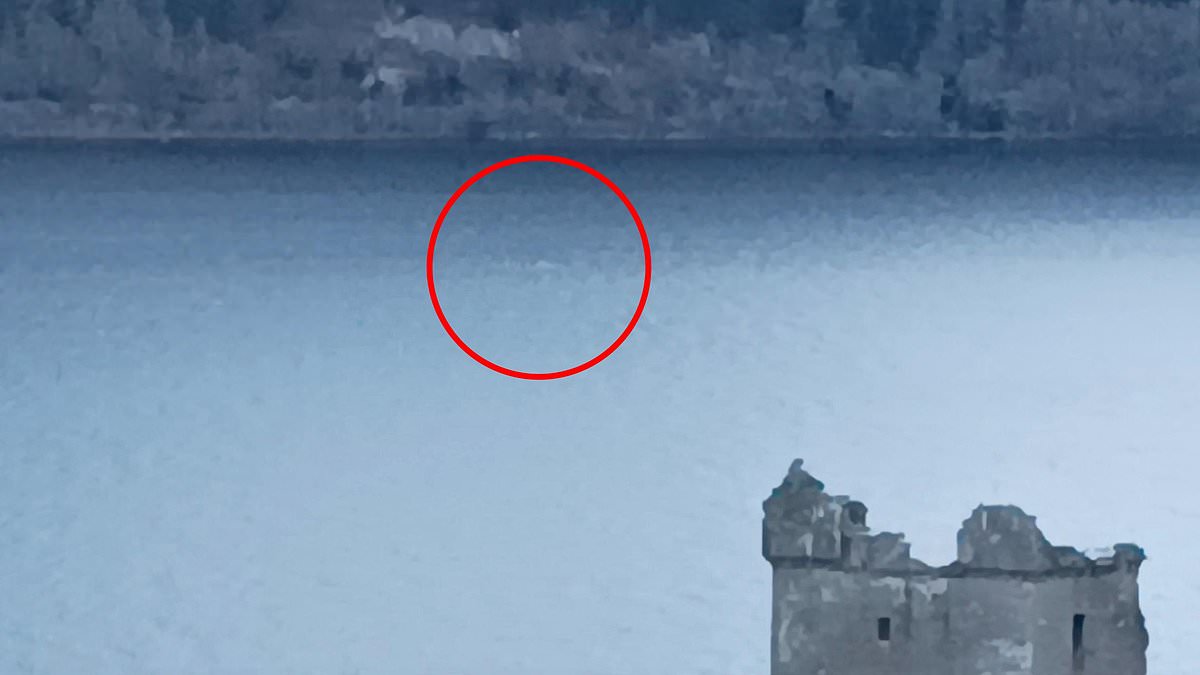
A fast–moving creature has been filmed rising and sinking out of Loch Ness – sparking excitement that it could be the Loch Ness monster. Sasha Lake, 31, was standing on the banks of the loch on 1 March at around 6pm, when he spotted something moving in the water. The mysterious object was moving at incredible speed against the waves – and luckily Mr Lake had his phone at the ready to capture it on camera. 'I was excited and intrigued. I only stopped filming because it went out of view,' he said. Mr Lake, from Bath, showed the footage to Alan McKenna, the leader of Loch Ness Exploration, who claims there is 'no animal that we know of in Loch Ness that can reach this speed.'While its identity remains unclear, this is the first possible sighting of the Loch Ness monster this year. It comes after the monster, nicknamed 'Nessie', was 'spotted' five times in 2025, according to the The Official Loch Ness Monster Sightings Register. A fast–moving creature has been filmed rising and sinking out of Loch Ness – sparking excitement that it could be the Loch Ness monster Sasha Lake, 31, was standing on the banks of the loch on 1 March at around 6pm, when he spotted something moving out of the waterThe mythical creature has been a staple feature of Scottish folklore for centuries, but gained worldwide attention in 1933, when the first photo was snapped.'I was there with the mystery in mind, of course, but there are so many aspects of Loch Ness that interest me,' Mr Lake said. 'But the potential of possibly experiencing something unusual is always in my thoughts, and part of the excitement.'I always have my phone ready in my pocket. I'm not as easily fooled by things I see on the surface these days, so this really was an interesting experience.'After seeing the movement on the surface of the water with his own eyes, he was even more shocked and excited to have captured it on video.'I was incredibly intrigued, I was excited about the possibility that what I was filming and seeing was something out of the ordinary,' Mr Lake said.'The way it moved, and the quickness of it, made me think, okay, alright, I definitely think this is something a little bit odd.'There was a lot going through my mind. After seeing the movement on the surface of the water with his own eyes, he was even more shocked and excited to have captured it on video'I was just observing it and just thinking, right, I have a strong feeling that this could be something unusual, and I should film this.'Freaked out, Mr Lake added: 'I stood there for a moment, processing what I had just experienced.'I sat down, and tried to think of anything that could explain this, and I simply couldn't think of anything.'I was in a state of confusion. I feel there is a strong possibility that I have filmed something unknown in Loch Ness. It has people scratching their heads.'Mr McKenna, who runs the independent research group, Loch Ness Exploration said the speed of the object is what stands out to him the most. 'The first thing that jumps out straight away is the speed. You can definitely see the wash its creating at the head of the wake,' he explained.'Hand on heart there's no obvious candidate for what it could be. It is far too fast for a seal, it's not a swimmer or kayaker, definitely not wind turbulence either.'There's no animal that we know of in Loch Ness that can reach this speed.'I think it's a really intriguing piece of footage. It's mad. There is definitely something there.'Shaun Sloggie, who works for cruise Loch Ness in Fort Augustus, was equally intrigued by the footage – particularly the fact the object appears to be moving against the waves.'Whatever it is, it's moving fast and it's moving against the wind and waves,' Mr Slogie said.And it must be pretty big making a wave like that.'What IS the Loch Ness Monster?Rumours of a strange creature living in the waters of Loch Ness have abounded over the decades, yet scant evidence has been found to back up these claims.One of the first sightings, believed to have fuelled modern Nessie fever, came in May 2, 1933. On this date the Inverness Courier carried a story about a local couple who claim to have seen 'an enormous animal rolling and plunging on the surface'.Another famous claimed sighting is a photograph taken in 1934 by Colonel Robert Kenneth Wilson.It was later exposed as a hoax by one of the participants, Chris Spurling, who, on his deathbed, revealed that the pictures were staged.Other sightings James Gray's picture from 2001 when he and friend Peter Levings were out fishing on the Loch, while namesake Hugh Gray's blurred photo of what appears to be a large sea creature was published in the Daily Express in 1933. Robert Kenneth Wilson, a London physician, captured arguably the most famous image of the Loch Ness Monster. The surgeon’s photograph was published in the Daily Mail on April 21, 1934 - however it was later proven to be a fake The first reported sighting of the monster is said to have been made in AD565 by the Irish missionary St Columba when he came across a giant beast in the River Ness.But no one has ever come up with a satisfactory explanation for the sightings - although in 2019, 'Nessie expert' Steve Feltham, who has spent 24 years watching the Loch, said he thought it was actually a giant Wels Catfish, native to waters near the Baltic and Caspian seas in Europe.An online register lists more than 1,000 total Nessie sightings, created by Mr Campbell, the man behind the Official Loch Ness Monster Fan Club and is available at www.lochnesssightings.com. So what could explain these mysterious sightings? Many Nessie witnesses have mentioned large, crocodile-like scutes sitting atop the spine of the creature, leading some to believe an escaped amphibian may be to blame.Native fish sturgeons can also weigh several hundred pounds and have ridged backs, which make them look almost reptilian.Some believe Nessie is a long-necked plesiosaur - like an elasmosaur - that survived somehow when all the other dinosaurs were wiped out.Others say the sightings are down to Scottish pines dying and flopping into the loch, before quickly becoming water-logged and sinking.While submerged, botanical chemicals start trapping tiny bubbles of air.Eventually, enough of these are gathered to propel the log upward as deep pressures begin altering its shape, giving the appearance of an animal coming up for air.