'Learn your lesson': Dark message is found inscribed on a 2,000-year-old sling bullet from the ancient Holy Land
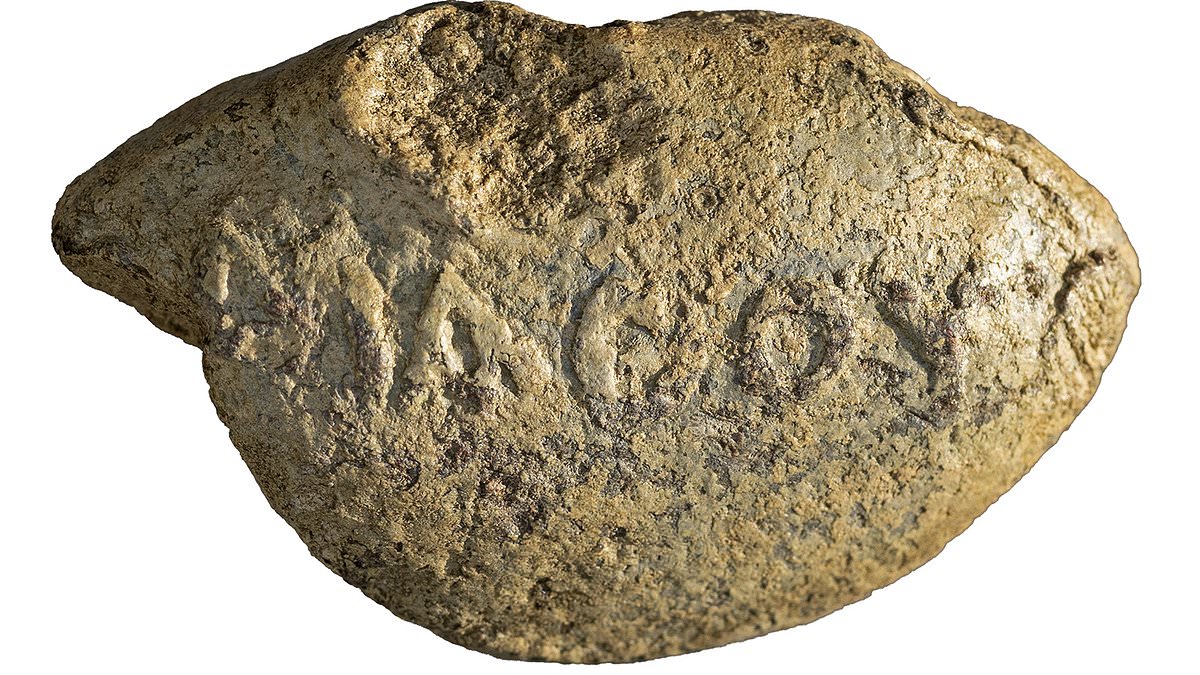
Archaeologists have uncovered a 2,000–year–old sling bullet with a taunting message for its target – 'Learn your lesson'.The small, almond–shaped weapon, which would have been shot out of a handheld projectile pocket, was found in the remains of the ancient city of Hippos in Israel.It measures 3.2 x 1.95cm (3.2 x 0.76 inches), weighs 38 grams and was likely used by the Greek defenders of the city.While dozens of lead sling bullets have been found at the site, this one stands out – as it is the first one to bear this specific inscription.'Sling bullets were a cheap munition, a hand–thrown projectile, used for millennia,' Michael Eisenberg, an archaeologist at the University of Haifa, told the Daily Mail. 'This is the first instance of the Greek word "learn" attested on sling bullets – probably the local defender's sense of sarcasm.'His team believe the word can be interpreted as a mocking order addressed to enemies advancing up the road.And it joins similar bullets inscribed with dark humour uncovered in the region – including those that read 'catch' and 'take a taste'. The lead sling bullet is inscribed with Greek letters that form the word ΜΑΘΟΥ, which the researchers believe is a command in ancient Greek to 'learn'The inscription was likely created by pouring molten lead into a mould emblazoned with the Greek letters ΜΑΘΟΥ.The authors have interpreted the inscription as a form of the word 'mathaíno', which means 'learn', and they believe the spelling indicates it was a command that meant 'learn your lesson'.'This represents local sarcastic humour on the part of the city's defenders, who wished to teach their enemies a lesson with a wink,' Dr Eisenberg said.The ancient city of Hippos, now known as Sussita, was located around a mile east of the Sea of Galilee.The archaeologists believe the bullet was fired by a defender from the city walls, which overlooked a road.It was uncovered by a metal detector in 2025, close to an area that would have been 'the most convenient point of attack towards the city's main gate'. And it was found at a distance of 260m (853 feet) from the city walls, indicating the impressive distance they could be fired.One side of the bullet was destroyed in a powerful impact, with experts suggesting it originally weighed 45 grams.'At short distances they were highly effective at hitting individual targets, while at longer distances they were effective against a cluster of enemies,' Dr Eisenberg said. The ancient city of Hippos, now known as Sussita, was located around a mile east of the Sea of Galilee. Pictured: An aerial view of the area What are sling bullets? A sling bullet was a small, almond–shaped projectile that was made of lead or stoneIt would be placed in the central pouch of a slingshot and then rotated around the head or side to build up momentumThe attacker would then release one cord at a precise moment to send the bullet flying towards the enemySome calculations suggest the projectile could fly as far as 400 metres (1,312 feet) Most are blank, but some have been found to bear the names of gods, military units, cities, personal names and acclamations of victory Alongside 'learn your lesson', other inscriptions include 'catch' and 'take a taste' While most sling bullets are blank, some have been found to bear the names of gods, military units, cities, personal names and acclamations of victory, the team wrote in the journal Palestine Exploration Quarterly.'Although some are decorated with a scorpion or a thunderbolt, the bullet described in this paper is the first one with an inscription,' they added.Sling bullets were among the most common munitions of the time, the researchers explained, as they were cheap and easy to make.Analysis of this sling bullet dates it back to the second half of the second century, or the beginning of the first century BC.Dr Eisenberg said it's possible the bullet was used during the battle between the Jewish Hasmonean kingdom expanding toward the Galilee and the Golan.'In 101 BC, we see Alexander Jannaeus trying to conquer Hippos and this region,' he added.He said other scenarios are also possible, including that the slingshot was launched in earlier confrontations between different Greek kingdoms or that it was used during training.'We don't know if it was a rock or a person, but there was definitely an impact,' he said.A sling bullet would have been fired by placing an almond–shaped projectile made of lead or stone into the central pouch of a sling.The operator would hold the cord ends and rotate the sling rapidly over their head or side to build up kinetic energy.They would then release one cord at a precise moment, sending the bullet flying quickly towards an enemy.Some calculations suggest the projectile could fly as far as 400 metres (1,312 feet).