Niall Quinn, 35 years on since THAT goal at Wembley and singing on stage with Saw Doctors to celebrate
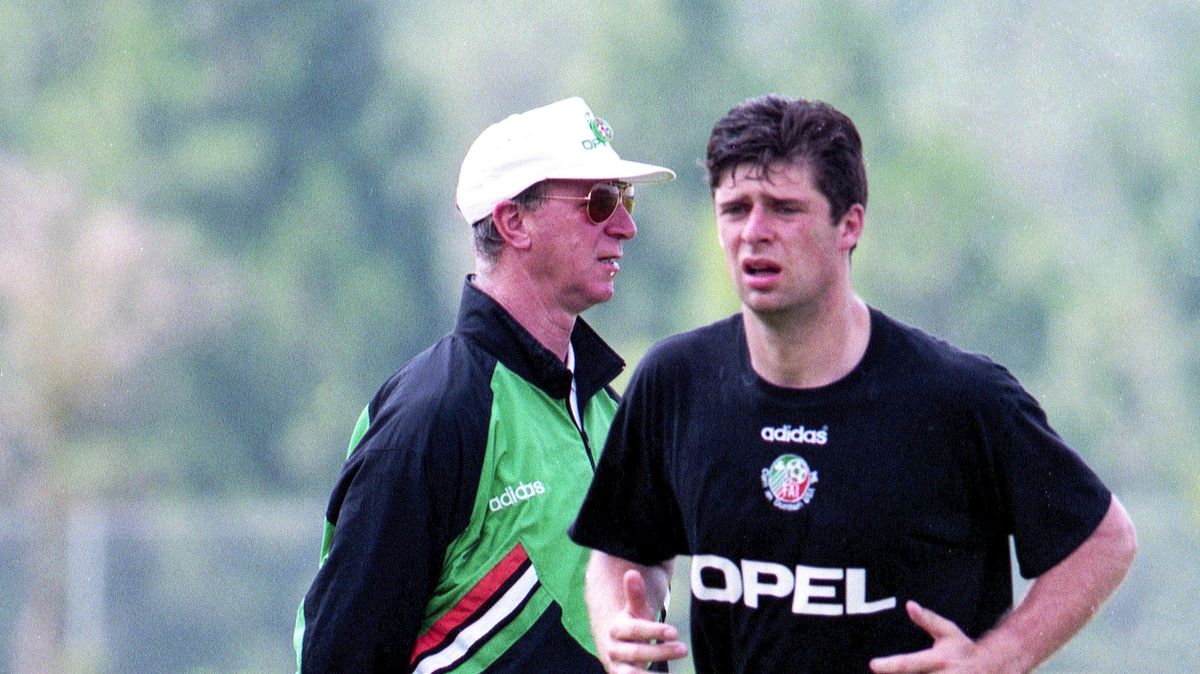
Niall Quinn considers Troy Parrott conjuring those five flashes of November brilliance, a butterfly breaking out of the chrysalis, and he is instantly transported back across the decades.To a night in Wembley against England, the tyranny of the clock insisting it was all of 35 years ago this week, when Quinn, 24 then, as Parrott is now, gave full thrilling vent to the bounty of his talent.“I’ll tell you how long ago it was. I was dating [his now wife] Gillian at the time. And after the game, I had to queue up at a public phone box outside Wembley to ring her to tell her I’d scored against England,” says Quinn.“A pile of English 20 pence coins in my hand to throw into the phone. And the guy in front of me in the queue recognised me and said he had 3,000 people down at the Galtymore (the storied dance hall in Cricklewood) and he’d give me a ‘hand’, which was £500, to come down.“I had a few friends and we were going drinking anyway. I was earning £350 a week at the time. So, I said ‘fuck it’. I ended up on stage with Kathy Durkin singing The Saw Doctors song, I Useta Lover.”As we speak, the Dubliner is tending to his five-month old grandson, Billy, (“as a first time father I was running around chasing my own tail, as a grandfather, you are more emotionally prepared”), but his mind reverses to the evening a mighty London moment arrived, and he was its equal.Even before his March 1991 goal that so moved the spirit of the nation, a strike that would instantly and radically elevate his status in the game, Quinn had an inclination something momentous was stirring.Hugh Callaghan, one of the then recently released Birmingham Six and a keen football fan, was a guest at the Irish training session on the eve of the game.For Quinn, politically and historically aware, stirred by the huge injustice visited upon Callaghan, it was a profoundly moving experience.He recalls: “It resonated very deeply with me. I had joined the Birmingham Six protests. Christy Moore had sent out a big message to help in any way we could. I had subscribed.“That was an incredible time. It is hard for a younger generation to understand the significant impact of the release of the Guildford Four and then the Birmingham six. Then, for Hugh to turn up at our pitch.“You are talking about DNA and digging deep for inspiration and commitment to win a game against England, and you have something like that happening the night before a game.“It was colossal, colossal. We were in awe. Maybe one or two of the lads wouldn’t have understood the full cultural significance. They would just have known that lad was in jail, but for those of us who knew the struggle and the history, it got us in the heart.“I left Ireland shortly after the Hunger Strikes to go to England and when I got to England, what were they doing, they were beating the s**t out of the miners. That was my introduction to a new life in England.“So a few years later to have a man like Hugh Callaghan come and watch your training session, it was huge. Talk about inspirational.“We all spoke to him. There were no mobile phones to take picture back then and I will always regret that.Then the next night I think he left the game early because he got recognised and got abuse.”English anger might have been fuelled by events on the pitch, an Irish team gnawing at the skyline of history delivering one of their supreme performances under Charlton.Completely outplaying their hosts, Quinn’s deftly side-footed equaliser triggered an Irish masterclass of precision, at odds with the team’s long-ball reputation.Niall still gets giddy remembering Jack’s response: “His exact words at half time were, ‘who told you to play like that?’”Only a glaring Ray Houghton miss denied Ireland the momentous victory their outstanding display merited, but the quality of football impelled the imagination to soar.As with Troy in recent months, it was a transformative time in Niall’s career.“After that goal, there was a noticeable difference in how people treated me,” Quinn remembers, recognising the parallel with the surge in Parrott’s reputation and form post-November.“We played Wimbledon toward the end of the season and we were in the tunnel on the way out and Big John Fashanu came up to me and said ‘respect man, you’re on fire.’ I’d never even met the guy.“I was in a bit of a patch where I was finding out about myself and I was getting confident. That was the difference. When you are at Arsenal and waiting three years for Alan Smith to get sent-off or injured, which he never did, it was hard going.“I remember being desperate to get into the World Cup squad for Italy. Then I got away to Man City. The year we played at Wembley 1991, that was my best year. I think I got 22 goals.“I was flying. I think we finished fifth. I was kind of the target man, the important player, if you like, in the way we played.“For the first time I was the focal point. I was beginning to think I could do the same for Ireland. Which was a long way from just trying to get on the plane as the last man, which was how it had always been for me up to then, what with Frank and Aldo and then Cassie coming in to push me further down the line.”Quinn rejoiced as Parrott, at moments of extreme pressure against Portugal and Hungary, had the ability to conjure something the nation feared lost forever.A capacity to frighten higher ranked teams, to conjure results not through superior talent but through unbending will.“The FAI asked me to speak in their lounge before the Portugal game. I spoke about going down as heroes, playing the way to which our DNA is best suited, to turn an opponent, make them uncomfortable,” says Quinn.“After we’d won, I met a very well known Irish football person, I won’t say who, and he said to me, ‘wasn’t it brilliant? Shite to watch, but brilliant.’“I was going to strangle him, I tell you I was going to strangle him, because I’ve watched five years of tip-tapping about, across the backline from one corner flag to the other, knocking it around and having teams laugh at us.“So I apologise to nobody for saying, making teams look uncomfortable, understanding that they are playing an Irish team that have a way of playing that opponents don’t like, is us at our best.”As Parrott’s long heralded promise was properly unveiled, Quinn could see a huge upgrade in the former Belvedere boy’s body language and he immediately understood it might be life-changing.“Self-belief can be completely transformative for an athlete,” he says.“Howard Kendall took a chance on me when he brought me to City. He believed in me and made me feel a million dollars. The same has happened to Troy in The Netherlands.“He’s a different player. And he’s done that himself. His manager obviously gave him the opportunity and confidence, but you have to have the ability and the guts to go for it and be great."If I look at Troy two, three years ago, coming in, no football behind him at Spurs, similar to me at Arsenal. No game time, hoping, searching for something that might kick start it for you, that you might get a couple of international goals.“Or that another club will come in like Manchester City came in for me. When it does happen and you find that missing piece, it’s not something you can coach, it is where somebody just has belief in you.“When Jack started believe in me after Howard Kendall, when two managers of that stature believe in you - which is probably what is happening with Troy right now - you can fell like you can probably go anywhere and perform against anybody. You can feel you can do anything.”Even if Parrott delivers further evidence of resurrection this week by providing another memory that will never shrivel, his post-match celebrations are unlikely to rival Quinn’s all those years ago.Required at training in Manchester the morning after the Galtymore night before, Niall stopped at a motorway services to pump himself full of caffeine. Only to promptly fall asleep.Quinn is giggling uproariously as he recounts what happens next. “A gang of Welsh fans just off the boat from their match woke me up.“Can you imagine if there were mobile phones back then? The next day’s headlines: ‘Wembley goal scorer asleep at a motorway services!’”And yet, Heimir Hallgrimsson’s side are two games from doing something Charlton’s exalted class of 9i/92 could not — qualifying for a major finals.Quinn sees that campaign as the one that got away: “We probably peaked at that time and the tragedy was that we didn’t get to Euro ‘92. A late English goal in their last game in Poland killed us.“We were over playing in America on the beer when we should have been playing in a tournament we could have won.”Click here to sign up to our sport newsletter, bringing you the top stories and biggest headlines from Ireland and beyond.