Electric truck charging: Booking across technical interfaces
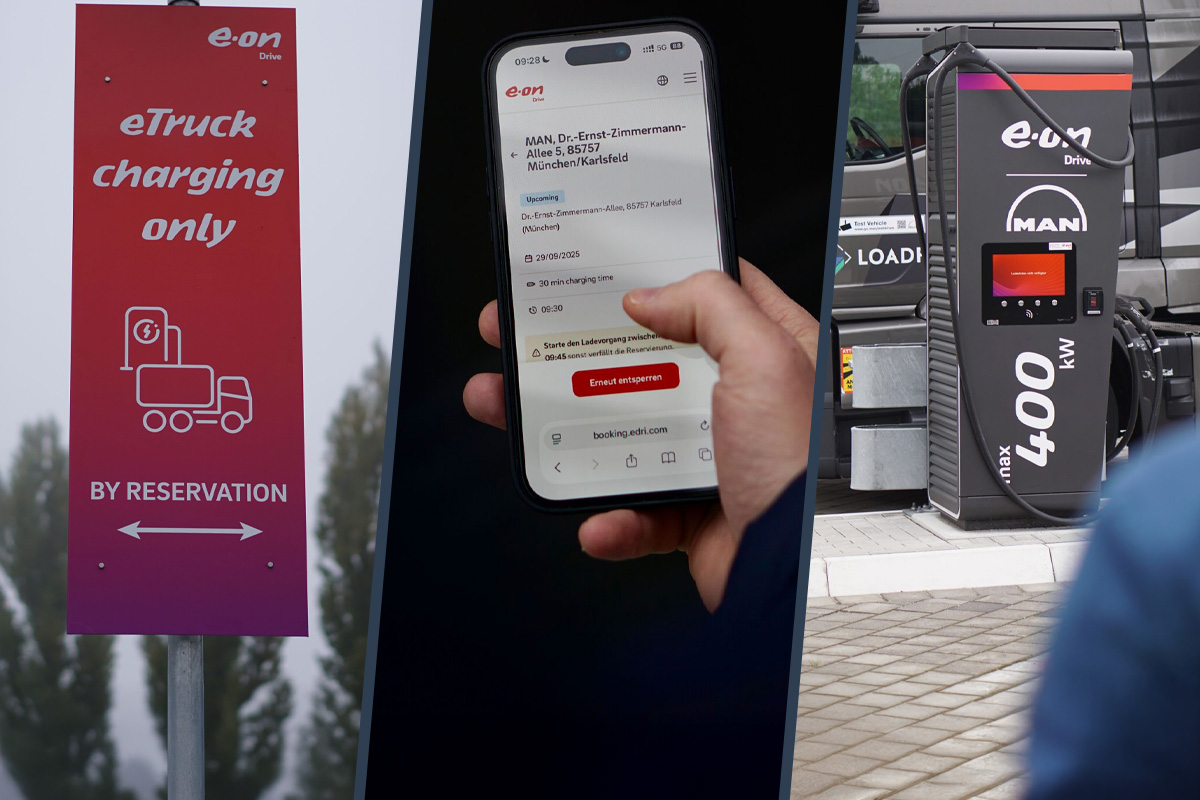
Project work often runs for three or four years. Not so with ‘Truck Charging,’ an initiative coordinated by the founding and innovation centre UnternehmerTUM. The Munich-based hub brings companies, start-ups, municipalities and researchers together for six months to develop a prototype with tangible market impact.Applied to ‘Truck Charging,’ this meant stakeholders worked intensively in workshops held every two weeks for six months to develop an interoperable reservation system for charging battery-electric trucks (BETs)—both on the road and at third-party depots. More on this below. The project involved key industry players, including MAN Truck & Bus, E.ON Group Innovation, Alpitronic, AVL, Fryte Mobility, Metzger Spedition, Cosmic Cat, the City of Munich, and, of course, UnternehmerTUM as the organiser.The challenge is clear: as the use of electric trucks grows, so does the complexity of fleet operations, as existing planning and operational processes are often not designed to meet the demands of BETs.“In many companies, charging planning is managed manually—often using spreadsheets, experience, and last-minute coordination in day-to-day operations,” writes UnternehmerTUM. There is often a lack of end-to-end transparency regarding available charging infrastructure, plannable time slots, or binding booking options. At the same time, ‘depot operators face the question of how to make their charging points accessible to third parties without jeopardising their own operations or supply security,’ the project leaders highlight as another critical aspect.The consensus is clear: logistics providers cannot afford unpredictable downtimes or a lack of coordination. From the project participants’ perspective, only a booking system can provide a solution—a view widely shared across the industry. Initial approaches are already underway, driven by players such as E.ON, Fryte, Volvo Trucks, as well as alliances (e.g., Hubject, Fryte, Bosch Road Services, and SBRS) and major organisations like the EVRoaming Foundation. All agree: for the optimal use of electric trucks, charging during statutory driver breaks is crucial—and reserving a charging spot for a specific period can significantly enhance planning reliability.In the ‘Truck Charging’ project, participants worked for six months—from defining the problem to integrating a booking system and testing it in practice. The result is a functional minimum viable product (MVP) designed to evolve through user feedback. The consortium recently presented a live demo at the Verkehrszentrum transport museum in Munich.Now to the system architecture: at the core of the project are the digital booking platform from the start-up Fryte and E.ON’s ‘Truck Reservation’ platform. Fryte’s system—specifically the first beta version of its so-called ‘Matchmaking’ platform—connects vehicles, charging infrastructure and energy systems via open interfaces. The E.ON platform provides the booking backend.Both platforms are components of a complex, coordinated IT ecosystem, explain those responsible: “Fryte acts as a central platform that connects E.ON’s booking backend. At the same time, Fryte performs this function as part of the connection for charging point operators, both private and public, who do not provide their own booking functionality.” Both systems work in an integrated manner in a joint technical interaction.
Graphic: Truck ChargingThis enables the overall solution to link with existing infrastructure, platform and fleet systems, as UnternehmerTUM explains. As a result, different providers and systems can communicate with each other via standardised interfaces, including those based on OCPI. “This enables cross-manufacturer and cross-operator reservation of charging time slots,” the participants explained. This interoperability creates the technical foundation to efficiently link and utilise both depot and public charging infrastructure. A classic win-win: “We provide planning certainty for fleet operators while enabling efficient capacity management for depot operators,” says the project team.In practice, dispatchers will soon be able to plan their charging needs along routes and reserve charging points bindingly. On the other side, depot managers and operators of public charging infrastructure can control the availability, time slots, and access rules for their chargers, ensuring efficient utilisation of their infrastructure. So much for the theory.At the end of the ‘Truck Charging’ project, participants tested their prototype system in real-world conditions. In February, an electric MAN truck from Metzger Logistik & Spedition covered over 300 kilometres in winter conditions, stopping at several booked charging stations—for example, at the GVZ – Kloiber GmbH depot in Augsburg, at Metzger’s own depot in Kupferzell, and at an E.ON charger in Karlsfeld at the local MAN service centre. The first two stops represented the use case of a shared depot, while the latter was a public charger.“We tested the entire journey under real conditions—from route and charging planning to reservation, authentication, and execution of the charging processes,” the project team explains. The test drive covered a public charging park and logistics depots in Bavaria and Baden-Württemberg, reflecting real-world daily logistics operations. The trial and further meetings of the project partners were also documented on camera. Here is the corresponding video (in German):Maximilian Ritz, Project Manager at UnternehmerTUM, concluded: “The pilot demonstrated that interoperable reservations are a key lever to use charging infrastructure more efficiently, establish robust processes, and make electrification in heavy-duty transport scalable.”Ritz also outlined the next steps: “The conclusion of Truck Charging lays the foundation for the next stage of development. The next goal is to create an interoperable, scalable ecosystem for depots in follow-up projects, combining transport, charging and energy management with billing and business solutions.”This will also involve analysing and evaluating the potential for flexibility and the interaction between the energy market and route planning in order to derive possible business models for market participants and ultimately bring them to market. After all, a smart reservation system can also act as a lever for intelligent energy management.The conclusion: “OEMs, logistics and energy sectors must collaborate even more closely in the future. We have shown: it works,” said Ritz.Two projects will follow. First, the System Orchestration TCO Blueprint project. This focuses on the currently fragmented landscape of electric truck depot charging and aims to develop an interoperable ecosystem for the cost-effective operation of electric truck fleets. The participants aim to ‘define clear roles, interfaces, and data flows between TMS, CPMS, EMS, and payment providers and implement them prototypically in the form of a concept or MVP.’The second project, Flexible Energy Hubs, addresses the challenge of aligning the increasing electrification of trucks with volatile electricity prices, limited grid capacity, and new grid fee regulations. The goal is to design logistics depots as ‘Flexible Energy Hubs’ by systematically linking operational flexibility (e.g., routes and time slots) with energy flexibility (e.g., load shifting, storage, price signals).unternehmertum.de, linkedin.com, mobility.unternehmertum.de (all links in German)