Once upon a time, saving your bits meant punching holes in floppies
Microsoft's Raymond Chen took a delightful trip down memory lane this week, tracing how write protection for removable media has changed over the decades.
The vast majority of removable media today consists of flash drives, some with a write-protect switch or a software setting to prevent accidental writes. In the days of yore, however, notches and tabs ruled, though their implementation was not always consistent.
Chen began with the eight-inch floppy disk, widely attributed to IBM in 1971, which stored around 80 kilobytes. "The write protect notch was at the top of the leading edge," Chen wrote.
"The presence of a notch made the floppy write-protected, so you started with a write-enabled floppy, and if you wanted to protect it, you punched a notch at just the right spot."
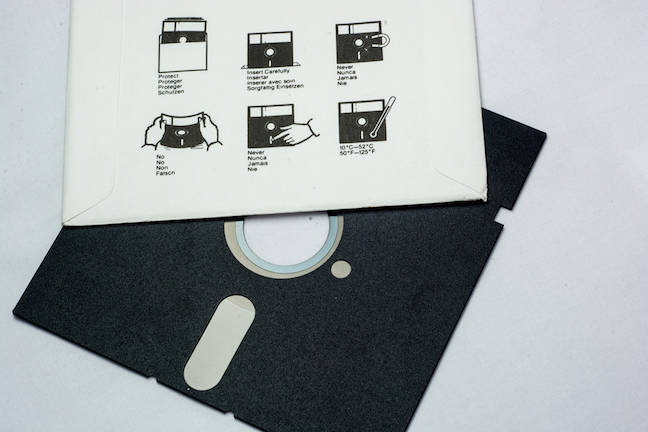
The 5.25-inch disk superseded the eight-inch floppy. Here, the write-protect notch was on the right edge, near the top. "The presence of a notch made the floppy write-enabled," recalled Chen. "To protect it, you covered the notch with a sticker. So it was really a write-enable notch, not a write-protect notch."
Chen doesn't mention one popular modification for 5.25-inch disks in the days before double-sided drives became ubiquitous. As well as the notches, it was possible to take a disk and use a hole punch to create a "flippy disk," in which a user flipped the disk to use the other side (e.g. on a Texas Instruments 99/4A). It required a hole punch, a sacrificial disk, and, in this writer's experience, a fair amount of teenage optimism.
The advent of the 3.5-inch floppy simplified things, introducing a sliding switch on the underside of the disk. An open hole meant the disk could be written, while closing the hole protected the disk.
Then there was the compact cassette – familiar to many a computer user of the 1980s. Break the tab at the top of the cassette to protect the tape. Pop some Sellotape over it, and writing was possible.
It is more than a decade since Sony, one of the last major manufacturers, finally pulled the plug on floppy disk production, although supplies of the media can still be found.
Chen's career at Microsoft dates back to when the company's software shipped on floppy disks. The installation media for Windows 3.1 came on half a dozen disks, while Windows 95 required 13, according to the veteran engineer.
It's worth pausing to wonder how many Windows installation disks were repurposed by users thanks to a flick of the write-protect tab or the addition of a write-enable notch. ®