Tesla identifies 66 sites for proprietary truck charging network
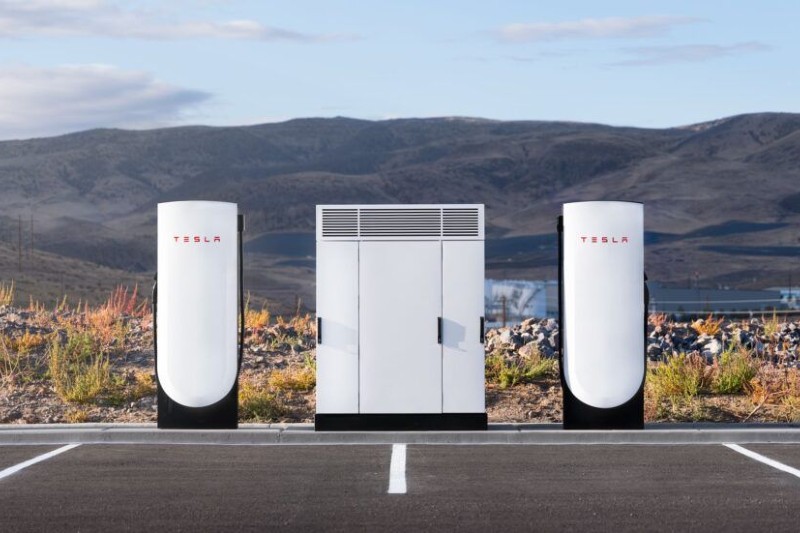
US media have picked up on the updated map after a LinkedIn post by Jason Gies. Gies, who previously held roles at ABB E-Mobility and Windrose, now works in the business development team for the Tesla Semi.He shared a link to the map and wrote: “You can see Megachargers and coming soon sites forming a backbone across the country. Chicago is becoming a real anchor. The Southeast is filling in. Corridors are starting to connect, not just scatter pins.”In addition to the two already operational megawatt-scale sites, the map now lists a total of 66 truck charging locations from Tesla along key freight corridors stretching from the West Coast to the East Coast. Under the current plan, the network will cover 15 US states.Texas leads with 19 planned sites, followed by California with 17. Florida, Georgia, Illinois and Washington are each set to receive four sites, while New York and Nevada will have two locations apiece. Arizona, Colorado, Utah, Oregon, Indiana, Pennsylvania and Maryland are each slated for one site.The two operational Megacharger locations are situated at Gigafactory Nevada in Sparks and in Carson, California.The updated map highlights Tesla’s prioritisation of infrastructure development along Interstates 5 (I-5) and 10 (I-10), two of North America’s busiest freight corridors. Another focal point is Chicago (I-65 and I-94). Additionally, plans are in place for activity along the I-95 and I-75 on the East Coast and in the Southeast, as well as along the I-5 extending into the Northwest.It remains unclear when charging will go live at the planned locations. On the map, all 64 additional sites are currently labelled as ‘coming soon’.However, US portal Electrek offers some indications regarding the timeline. In April 2025, Dan Priestley, Head of the Tesla Semi programme, said that Tesla aims to build 46 Megacharger stations by early 2027. In addition, Tesla’s Q4 shareholder report included a map highlighting 37 sites scheduled to go into operation in 2026.The partnership announced in January between Tesla and Pilot Travel Centers to build a proprietary truck charging network also suggests a swift roll-out.Construction of Tesla Semi charging stations at selected Pilot locations in California, Georgia, Nevada, New Mexico and Texas is scheduled to begin in the first half of 2026. The first sites are expected to open as early as summer 2026. Each Pilot hub will feature four to eight charging stalls based on Tesla’s V4 technology, designed to deliver up to 1.2 megawatts per dispenser.Pilot Travel Centers is the largest operator of truck stops in North America.Notably, the agreement between Pilot Travel Centers and Tesla initially предусматриes exclusive access to the truck chargers for Tesla customers. The official statement says: “This network will initially focus on providing charging infrastructure for Tesla’s Semi trucks.”However, a future opening to third-party brands appears conceivable – similar to the way Tesla has gradually made its Supercharger network accessible to other passenger car manufacturers. According to the partners, locations are selected based on ‘where the need for heavy-duty charging is highest.’Pilot Travel Centers operates around 900 sites across 44 US states and five Canadian provinces.The hardware to be deployed is Tesla’s 1.2 MW charging system, unveiled last spring for the Tesla Semi and based on the company’s proprietary V4 technology. Tesla also leverages this platform to boost the performance of its passenger car charging infrastructure.The system follows a decentralised architecture, combining slim satellite dispensers with a separate cabinet, known as the Power Unit. In its maximum configuration, the setup can deliver up to 1.2 MW. At that output, it is expected to replenish the majority of the Semi’s 800-kilometre range within around 30 minutes.The growing infrastructure activity suggests that the Tesla Semi is finally approaching market launch, with a US debut expected this year. The programme has faced repeated delays over the past few years.Series production is set to take place in a dedicated facility next to Gigafactory Nevada. According to an earlier report by Electrek, Tesla completed the building in early 2025 and has since started installing production lines. The plant is designed for an annual capacity of 50,000 units. First unveiled in 2017 and originally scheduled for 2019, the Semi is now expected to enter regular sales in 2026.It has also been evident since at least September 2024 that the Semi is not intended solely for the US market but is planned for Europe as well. At the IAA Transportation in Hanover, the electric truck attracted considerable attention, with long queues forming around the vehicle. Company representatives stated at the time that a European launch would be delayed by at least two years – meaning not before 2026.There were also personnel developments last year pointing in that direction. Usuf Schermo announced on LinkedIn that he had taken on the role of ‘Head of Business Development EMEA’ for the Tesla Semi. EMEA refers to Europe, the Middle East and Africa.electrek.co, electricdrives.tv, cleantechnica.com, linkedin.com, tesla.com