Electric to the slopes: Audi A6 Avant e-tron on a winter trip with the whole family
Please note: this is not a conventional test report – you can find those on the Audi A6 Avant e-tron quattro and on the Sportback saloon variant elsewhere. This is a travelogue. A real-world trial without weeks of familiarisation – we simply set off. Experience with electric cars? We have plenty. The real challenge? The ultimate family proving ground: a skiing holiday in the Alps.For the winter sports enthusiast from the flat expanses of northern Brandenburg– who also took on the role of test driver – the trip to the Alps called for a car that combined two key qualities: generous luggage space and solid winter range, given the roughly 780 kilometres each way. An SUV or even a van felt oversized for the task, which narrowed the shortlist. Four people, ski equipment, a small snowboard, and plenty of luggage all had to fit. An estate car seemed the logical choice—and the decision fell on the Audi A6 Avant e-tron Performance.The journey begins on a Sunday: luggage loaded, the ski bag slid neatly through the folding centre armrest (a genuine blessing), the car left overnight at a public AC charging station despite the looming blocking fee. And we set off at 8 a.m. with the battery fully charged and the cabin preconditioned. The German ADAC previously tested the car in the cold, achieving a winter range of 441 kilometres, compared to a WLTP-rated range of 719 km. In reality, however, that number quickly proves optimistic. Brandenburg greets us with Siberian conditions: minus 10 degrees at departure. The heating demands of three teenagers—who, naturally, insist on travelling in just their socks– and a driver who prefers to stick to at least the recommended cruising speed rather than crawl along in the slow lane, put noticeable strain on the 192 prismatic cells of the 800-volt battery. Sure enough, the A6 e-tron, perhaps already anticipating the long haul ahead, shows a projected range of just 300 kilometres right from the outset.The Arctic temperatures make their mark: consumption on the first leg climbs to around 28 kWh per 100 kilometres. After roughly 280 kilometres, we reach Hermsdorf Junction with 18 per cent state of charge – time for the first charging stop. The location, however, is less than inspiring. The chosen provider cooperates with hardware store Bauhaus, so we pull into a deserted car park. On a Sunday, naturally, everything is shut in Germany. Three increasingly irritable teenagers stay in the car, while only the driver ventures out to stretch his legs at minus 5 degrees. The stop lasts a full 25 minutes. The only available 300 kW charger has to be shared with another EV, capping peak output at 220 kW instead of the 270 kW the battery can theoretically accept. Once again, real-world conditions override the brochure figures – and it will not be the last time on this journey.At least we leave the biting cold of eastern Germany behind us. As we continue through Bavaria, temperatures hover around freezing. The immediate effect: consumption drops and the projected range climbs. The next charging stop follows at around 1 p.m. – this time at a McDonald’s in Greding. Hungry teenagers dictate the schedule, so both the battery and the passengers recharge within just over half an hour, despite the lunchtime rush. Precise charging data? Impossible to verify afterwards. We vacate the bay immediately, as impatient EV drivers are already queuing behind us. There is no time to photograph the charging curve. It has been a long time since we experienced this level of stress at a charging point.On to the final leg towards Lofer in Austria. After seven and a half hours at the wheel and 780 kilometres covered, the on-board computer shows an average consumption of 25.7 kWh per 100 kilometres – at an average speed of 105 km/h. That figure moves closer to the 23.2 kWh/100 km measured by the ADAC at 0 degrees on its test bench. Yet the gap between theory and practice remains noticeable. So do the test car’s substantial 21-inch wheels – complete with red-painted brake callipers at an additional €350 – which make their presence felt not only visually but also in terms of efficiency.
Image: Peter Schwierz
Image: Peter Schwierz
Image: Peter Schwierz
Image: Peter Schwierz
Image: Peter Schwierz
Image: Peter Schwierz
Image: Peter Schwierz
Image: Peter Schwierz
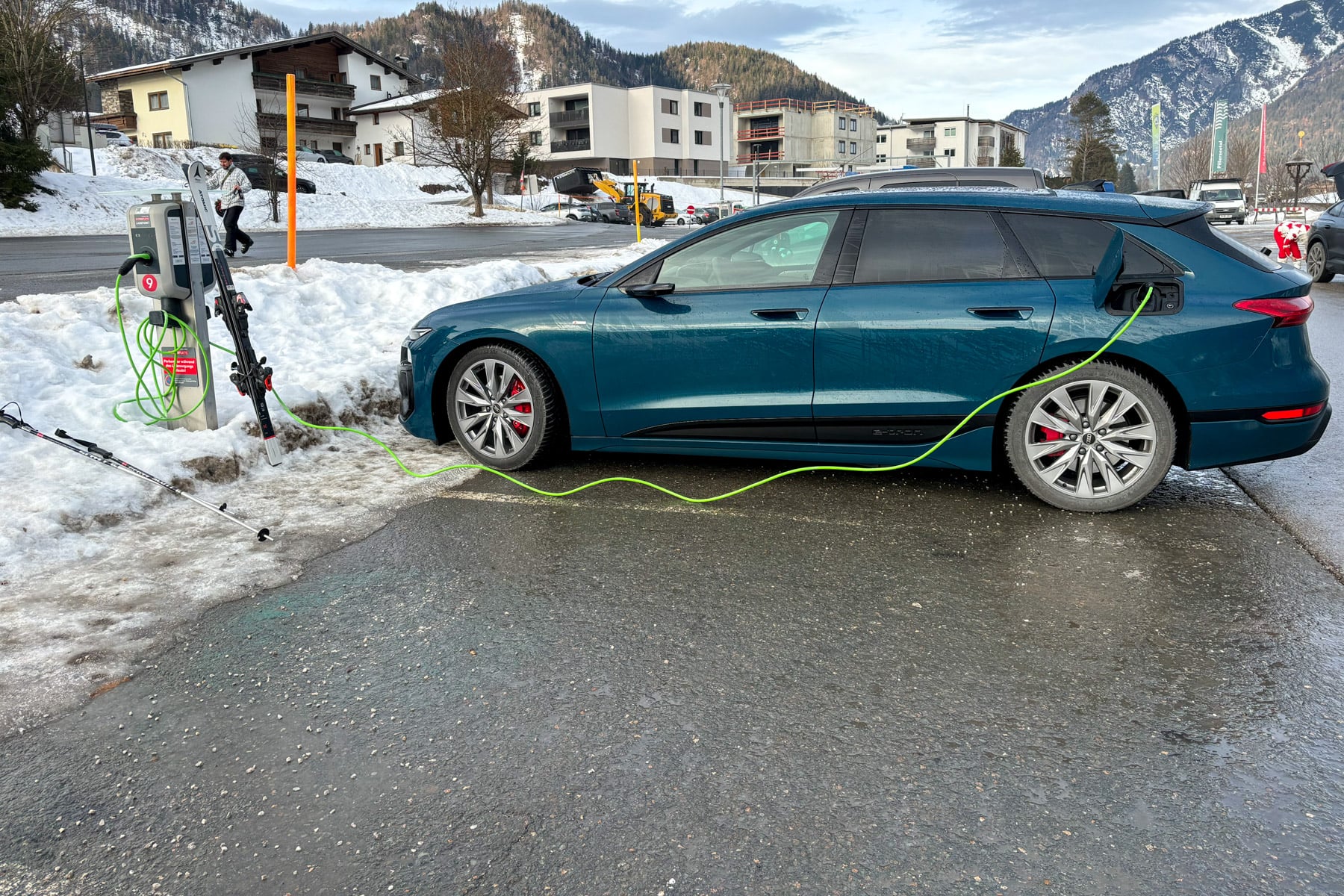
Image: Peter SchwierzNext stop: the ski hire shop to collect the remaining equipment – there is still space on the teenagers’ laps – followed by a quick visit to the local Spar, which conveniently opens on Sundays. In its car park, a 150 kW charger feeds 53.5 kilowatt-hours into the battery of the Audi A6 Avant e-tron Performance in just 23 minutes. That secures the daily runs during the ski week from Lofer to the valley station of the Steinplatte-Winklmoosalm cable cars in Waidring. No time lost charging. Teenagers and driver: satisfied. We head to the holiday apartment, unpack, cook and sleep.The following days revolve around the short shuttle between the apartment and the car park. The A6 Avant e-tron performs as expected. The electric estate even remembers that warm hands are preferred and automatically activates the heated steering wheel when we get in – a welcome touch. The dedicated climate functions, such as ‘warm feet’ or ‘fresh air’ impress in daily use. Anyone keen to avoid navigating three levels of the still somewhat convoluted MMI can simply tell the Audi via voice command, “My feet are cold,” and the system responds with instant warmth. Say that your feet are now pleasantly warm, however, and the system counters with a blast of cold air.The charging session at the supermarket, as convenient as it was, could have been avoided had we known about the superb charging experience offered by the Steinplatte-Winklmoosalm cable cars directly at the valley station in Waidring. While you’re on the slopes, the battery charges below—and at a fair price of €0.44/kWh without blocking or minute fees, via direct payment to the operator da emobil right at the cable car’s valley station. That is how it should be! And we’re not the only ones who appreciate it; many other e-mobility users from the Berlin-Brandenburg metropolitan region do too, as evidenced by the number plates. Of course, it’s winter holidays back home.We make use of the convenient infrastructure on the final day of skiing, charge the battery to 100 per cent and set off on the return journey the next morning. That leg, however, turns into a test of patience. Berlin and Brandenburg appear to be heading home at the same time, while Saxony seems to have conquered the Alps. Bavaria becomes a transit corridor for ski tourists. Repeated traffic jams prompt the Audi A6 Avant e-tron Performance to divert us from the motorway onto country roads – ‘for efficiency reasons in charging planning,’ or words to that effect, as the navigation system explains. At the same time, temperatures are far milder than on the outward trip, hovering in the single-digit plus range. The result: the Audi shows a projected range of 400 kilometres – and reaches it with ease.Yet the journey feels long. Nine hours of driving plus two charging stops – triggered less by necessity than by hunger and other teenage requirements – add up to a total travel time of ten hours. Even so, the driver arrives relaxed. Travelling in the malpelo-blue electric estate with the four rings proves more comfortable than in any other electric car he has driven to date. The sports seats (S line interior, €2,230 extra) with their fabric/artificial leather combination are a revelation and feel almost cosy in winter. In “balanced” mode, the air suspension strikes an ideal compromise. No back pain, no stiff muscles after the long haul. At a German premium manufacturer, however, comfort comes at a price. A few ticks on the options list push the already substantial base price of €77,250 to €103,475 for the test vehicle. That amount would buy a VW ID. Polo – or two Dacia Springs – in optional extras alone. Hardly surprising, yet still worth reflecting on. At least the elegant malpelo-blue metallic paint does not cost extra.And consumption? It drops markedly on the return leg to 20.7 kWh per 100 kilometres, at an average speed of 88 km/h. However, the entire A9 motorway is so congested that even maintaining the recommended cruising speed proves difficult. Only between Leipzig and Berlin do we manage to travel noticeably faster.What do we take away? In winter, the thermometer still determines how wide the gap between theory and practice opens up in an electric car. Two degrees above zero or eight degrees below make a tangible difference – even for the Audi A6 Avant e-tron Performance. You also have to familiarise yourself with Audi’s software logic. The system does not offer true state-of-charge-based range navigation. More than once, the teenager in the passenger seat steps in to fine-tune the filters in the charging planner. Anyone who prefers specific providers must actively tell the system so – and then switch the navigation display to the cockpit screen behind the steering wheel. That – and only that – shows the predicted SoC on arrival at the next stop. And that is information you definitely want to have.