Noam Chomsky’s reputation will never recover from the Epstein files
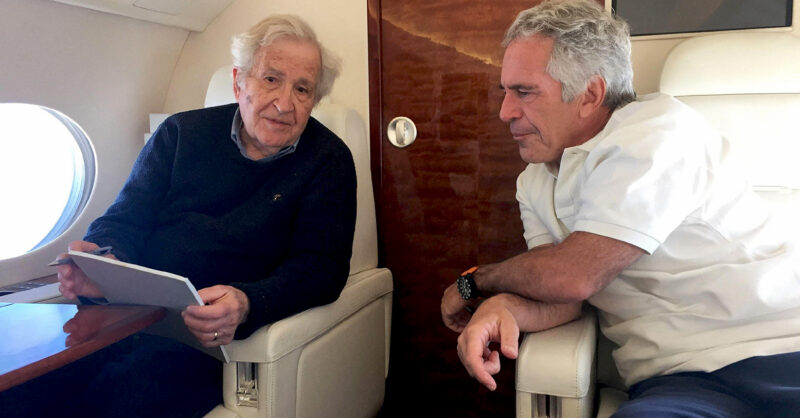
Noam Chomsky has a long-standing reputation for being the conscience of the American left. As Norman Finkelstein once put it, he is its (for some of us, our) “philosopher king”. Or perhaps it should be he “had” that reputation. Though there is no suggestion that Chomsky was involved in anything criminal or sordid with regards to Jeffrey Epstein, the latest stunning and intimate revelations about his relationship with the paedophile-financier betray a grave moral miscalculation. The taint on Chomsky’s reputation may never disappear.
The email from Chomsky to Epstein that stood out in the most recent cache of released documents was from February 2019. Chomsky was giving Epstein advice on how to contain the bad press (Epstein then forwarded this email to a lawyer and publicist named Matthew Hiltzik, who said “I think that is wise”). From Chomsky’s point of view, he probably thought he was writing a private note of support and solidarity to a friend. But even this “best-case scenario” does not stand up to what, by 2019, was a staggering preponderance of evidence against Epstein. In 2018, the Miami Herald published the exposé that permanently soiled Epstein’s public standing: it detailed how lenient his 2008 conviction and sentence for soliciting prostitution from a minor were given the number and nature of allegations against him. This fallout is what Chomsky is referring to as the “horrible way” Epstein was being treated by the “vultures”.
The news has understandably shocked many on the left. Chomsky’s sage authority came from a perceived moral integrity: a privileged intellectual who chose to champion oppressed peoples around the world, and speak the truth about the barbarity of US imperialism. His work in solidarity with the East Timorese who suffered ethnocide under a Washington-backed dictatorship is above reproach. But Chomsky’s status as a “dissident” intellectual is in contradiction with his friendship with Epstein, someone who embodies the elite in its most degenerate form. It doesn’t make any sense. How could he not see Epstein for what he was: a patrician pimp?
In a 2003 philippic against Christopher Hitchens, Finkelstein observed that “bashing Noam Chomsky” was a rite of passage for apostates because he “mirrors their idealistic past as well as sordid present, an obstinate reminder that they once had principles but no longer do, that they sold out but he didn’t”. Finkelstein was turning Chomsky into a messiah figure. The latter was adamantine in his political consistency, in contrast with “apostates” like Hitchens, a former Chomsky enthusiast who had turned to the dark side when convenient.
New year, new read. Save 40% off an annual subscription this January.
Given Chomsky, aged 97, is unwell and rarely makes public statements, it would be easy to use the Chomsky revelations to ostracise him (as much of the left ostracised Hitchens for his support of the Iraq War in the early 2000s). Indeed, Chomsky’s silence has created a vacuum for the speculation of his critics. Many on the right have straightforwardly pounced on his associations with Epstein to discredit his wider politics. But on the left, too, those who always saw Chomsky as the establishment’s favourite pseudo-dissident have taken this episode as evidence that Chomsky was a wimpish liberal all along. (Of course, the anti-Semitic groypers have added Chomsky to the globalist Jewish cabal that rule the world.) But character assassination is rarely a good method of intellectual surgery. And for those more baffled or wounded by these Chomsky revelations, there is a more tempered conclusion: Chomsky was never a beacon or a sage, and was susceptible to these lapses of judgement long before he met Epstein.
Chomsky’s perverse loyalty to him is not a novelty of character. One need only consult the philosopher’s statements on the Cambodian genocide, the Bosnian genocide and the Syrian civil war to see the similar pattern of naive gullibility. In the case of Cambodia, he expressed scepticism at the initial reporting of the atrocities of the Pol Pot regime and accused Western reporters of producing atrocity propaganda. When it became clear that what was happening was even worse than first thought, he refused to acknowledge that he was wrong. Chomsky then wrote a foreword for his long collaborator Ed Herman’s The Politics of Genocide (2010); the book claimed the Serbs were “demonised” by the West and that the reported existence of rape camps and concentration camps was “fabricated”. When confronted on this by George Monbiot, Chomsky refused to acknowledge that these specific factual claims from Herman were wrong because it would be “sheer cowardice”.
Chomsky later gave credence to claims that chemical weapons attacks in Syria were staged and that there was a “cover up”. Again, he hasn’t conceded that he was wrong (as the journalist Seymour Hersh recently conceded on this very question, and investigations concluding that the overwhelming majority of Syrian chemical weapons attacks came from the Assad regime). In all three of these cases, you can see Chomsky’s Manichaeanism. He had no problem with saying that the 2001 US bombing campaign in Afghanistan was a “silent genocide”, but claims that to call what happened in Srebrenica a genocide was “to constitute virtual Holocaust denial”. In other words, it is only genocide when its suits my narrative, and not when it doesn’t. This isn’t morally or politically consistent; it is tendentious.
Chomsky has named George Orwell as one of his inspirations. But he consistently failed to heed a crucial lesson from Orwell that any intellectual must aspire to: the power of facing unpleasant facts and being able to assimilate them, even if it destabilises ideological narratives you’re comfortable in. It’s no surprise that Chomsky chose to pretend that the unpleasant facts that would be awkward for him didn’t exist. This is a common vice for activists and intellectuals of all political persuasions. But when you feel like you are part of a vanguard against global power it can be especially hard to face those close to you because you fear it will undermine your cause and give credibility to the establishment.
In of itself, Chomsky’s friendship with Epstein doesn’t impeach his criticisms of American imperialism, Israel, Marxism or anything else. Only his image as a moral exemplar has been destroyed. But Chomsky’s penchant for morally compromised judgements existed long before the Epstein files were released. And perhaps many of his betrayed fans didn’t want to see it for the same reason: they wanted to maintain their alliance with Chomsky and his legacy, avoiding unpleasant facts about him until it was too late.
[Further reading: How has Donald Trump escaped the Epstein files?]
Content from our partners
Related