Kristen Stewart’s The Chronology of Water is startlingly good
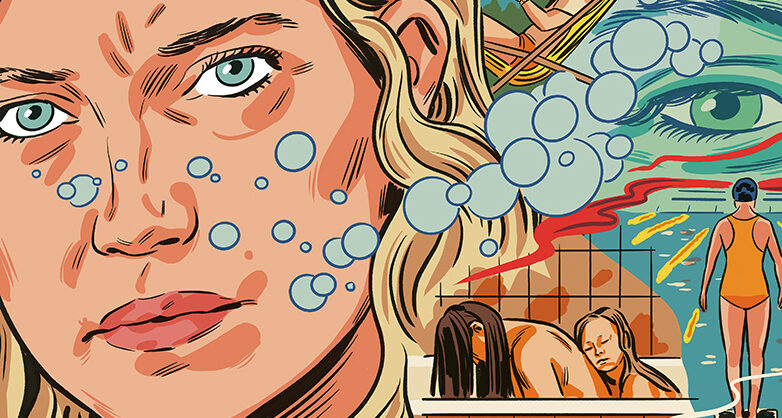
Lidia Yuknavitch’s 2011 memoir, The Chronology of Water, is a tough read. She traces her life, from an abusive childhood, through teenage success as a swimmer, then a riot of drink, sex and drugs as a student, multiple abortions, a stillborn baby, and tumultuous relationships with both men and women, to her emergence as an acclaimed writer, even achieving family happiness and motherhood. All this in a fractured, declamatory style.
Yuknavitch is a distant descendant of the Beat writers, letting it all out, using short sentences, street language, repetition and immediate grammar. She sometimes abandons punctuation altogether, in page-length sex rhapsodies, for example. Few other memoirists have kept the reader so informed about what’s happening in their pants.
The book is powerful nonetheless, much more artfully constructed than the pounding prose first suggests. Life itself, Yuknavitch tells us, is “a series of fragments and repetitions and pattern formations” and that’s what she aims to capture in her writing.
Hardly a doddle to adapt, then. Kristen Stewart, former star of Twilight, now an indie presence, was entranced as soon as she read “this jagged, non-linear journey through trauma and memory”. Quite the proclaimer herself, Stewart adds: “I love Lidia and, in a way, she is holy to me. It became a sacred text for me overnight.” That’s probably not the easiest attitude with which to convert a book into a film. Stewart claims to have written some 500 versions of the script over the last eight years. But here it is: her first feature film as writer and director, previously only having made shorts, such as the arty Come Swim in 2017.
New year, new read. Save 40% off an annual subscription this January.
And it’s startlingly good; not only honouring its source but outdoing it. The film offers a series of intense moments, with no clear exposition, no establishing shots or scene-setting, no timelines or follow-throughs, always in a vivid present tense, even when suddenly turning back to the past, for the memories here are lived just as fiercely.
Her approach, in proceeding through a series of images rather than an explicit narrative, resembles Terrence Malick’s style in The Tree of Life (2011), minus the mysticism. I found the screen version coherent – but maybe the fact that I had read the book disqualifies me from judging how easy it would be to grasp the themes for someone new to the material.
Stewart chose to shoot the film on 16mm. “When you sit next to a digital camera, you’re recording, you’re not taking pictures,” she said in an interview last year, which sounds like run-of-the-mill analogue piety, but the result vindicates her choice. The pictures here have a fantastic texture, grainy and Kodachrome-coloured, like memories, internal, never detached. Most of the shots are in extreme close-up, often partial views, flaring at the edges, bringing you right into the experience, making it matter whenever different perspectives open up.
The Chronology of Water is far from the average actor-turned-director’s movie, loyally foregrounding stagecraft. For all that, the film does depend entirely on the astonishing performance of Imogen Poots as Lidia. There’s complete complicity between her and Stewart about showing every part of the female experience that’s usually wincingly elided, and she gives it her all without restraint, irresistibly watchable all the way through. She’s so alive in every moment, changing remarkably from boorish boozer to madonna, from hurt to rage to tenderness. Her face alters so much, transforming her own distinctive looks, that droopsnoot and large mouth. She is fascinating from first to last.
Thora Birch is touching as Lidia’s older sister; Michael Epp, nasty as her authoritarian father (abuse is never directly shown); Jim Belushi, splendidly wrecked as her alcoholic mentor, the writer Ken Kesey; Charlie Carrick, ideally still and sensitive as her eventual pretty-much-perfect husband. But were Imogen Poots any less involved than she is, were almost anyone else in this role, the film would be nothing like as good.
There are over-earnest moments, when the book is too directly turned to dialogue or voiceover, but it’s not the least of the film’s accomplishments that it makes the more or less unfilmable act of writing so central and convincing. For in the end, the tale is familiar, if not classic: a writer discovering herself, a woman finding a way to emerge from the trap of the past. Kristen Stewart has made that story anew. It will be exciting to see what she writes and directs next.
“The Chronology of Water” is in cinemas now
[Further reading: The cultural power of balladry]
Content from our partners
Related