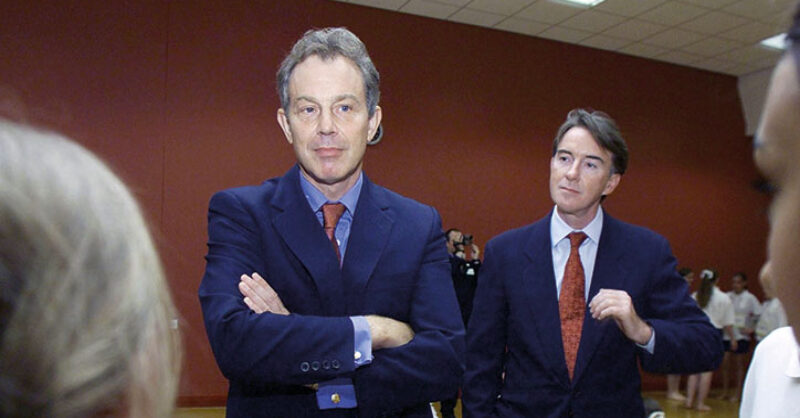
Mandelson’s adoration of wealth and power reaches its inevitable conclusion
Peter Mandelson is at the heart of one of the biggest British political scandals of modern times. He is alleged to have forwarded highly sensitive government information to Jeffrey Epstein from within an administration that was under huge pressure during the 2008 crash. How did he get to this point?
There are echoes of other scandals. The nearest is the Profumo affair in 1963, when Harold Macmillan’s secretary of state for war was forced to resign. Security risks, a glamorous model and a Soviet naval attaché combined to create an explosive brew during the final phase of a long Conservative rule. But the Mandelson saga is much more significant. He was a figure of greater prominence than Profumo, an emblem of the New Labour era, and, in some respects, of the Keir Starmer leadership as well.
Mandelson came to personify a version of New Labour, the project that propelled a vote-losing party to three election victories. From July 1994, when Tony Blair became leader, he was rarely out of the headlines. After the election he was close to the heart of Blair’s governing operation in the Cabinet Office, before becoming a cabinet minister who was sacked twice. Blair never gave up on him, making him a European commissioner. When, as prime minister, Gordon Brown was threatened by various insurrections from his Blairite wing, he turned to Mandelson to protect him. Mandelson was a hero to many seeking to remove the PM. Sure enough, with Mandelson as his protective shield, Brown was safe.
The juxtaposition of such powerful ubiquity and the Epstein emails triggers many questions about the modern Labour Party. Above all, why was a figure capable of reckless misjudgements repeatedly given such prominence in the New Labour era, and again during Starmer’s leadership? Such conduct is never an aberration. Mandelson was sacked from the cabinet the first time after he got caught up in a row over a loan from the wealthy Labour MP and later Treasury minister, Geoffrey Robinson. He needed the cash as he looked to buy a grander house in Notting Hill. The next removal, in 2001, was connected to his dealings with the wealthy Hinduja brothers. The dismissals were harsh, but the pattern was in place. He was too easily intoxicated by the glamour of wealth, wanting to be a part of that world as well as being entranced by it.
New year, new read. Save 40% off an annual subscription this January.
Far from being embarrassed by such connections, Mandelson saw them as a form of political vindication. Old Labour was mistrusted or despised by the wealthy. New Labour would be far from ashamed in hailing the very rich. For Blair and Mandelson, there was no longer a “right” or “left” in politics, only a determined ideological rootlessness that legitimised almost any form of engagement. If they found themselves in virtual agreement with figures like George Osborne or David Cameron, it was simply modern politics, where the primary divide for them was “open vs closed” – a distinction that has long existed in British politics without eclipsing the fierce debates between left and right.
Blair would never have done what the emails suggest Mandelson got up to. Indeed, Blair sacked his friend twice for lesser offences than allegedly leaking sensitive financial information. In many respects, the scandal is about Mandelson alone. But Blair’s style of leadership gave space for both of them to pursue their fascination for the wealthy and the powerful.
They were not soulmates by chance: they shared much in common. Both were shaped by Labour’s election defeats in the 1980s and the chaotic minority governments of the 1970s. Driven more by a hunger to win than by ideology, they dismissed the past as “old Labour”. By rejecting a party disconnected from voters and the media, they embraced a new admiration for wealth and power. Old Labour had struggled with the business elite; New Labour would cultivate them. Old Labour toiled in opposition; New Labour would move among the powerful. Old Labour had been mauled by the press; New Labour would woo Rupert Murdoch.
Out of such assumptions, born of defensive caution, risky alliances were formed. One example among many: Blair admired Silvio Berlusconi, the Italian prime minister later convicted of tax fraud. “I liked Silvio,” Blair wrote in his biography, making no mention of Berlusconi’s politics or dubious financial dealings. Blair “liked” many figures supposedly far removed from Labour’s values, from Berlusconi to President Bush – another Republican leader willing to invade a country without regard for international law. Now, Blair is ready to serve on Trump’s darkly comical “Board of Peace”, having formed close relationships with key figures in the White House. Perhaps he is convinced that this is the only means available to help revive Gaza, and he will seek to play a constructive role. If that is “what works”, so be it. Since returning from Washington, Mandelson has written articles and given interviews making a similarly expedient case in favour of Trump.
“What works” was a key part of their political philosophy. Blair often told his party that its great error had been to get worked up about the means rather than focus solely on what works. But this misses a fundamental purpose of democratic politics: there is a never-ending debate over how policy outcomes are best achieved. Margaret Thatcher was not in favour of “what doesn’t work”. She argued that her means worked. In the 1980s, there was an ideological battle over ideas and the policies they produced. Labour lost those battles. Out of those electoral failures emerged a revisionism that, at its most extreme, was sweeping, value-free, technocratic and simplistic.
The New Labour era was layered. Indeed, Mandelson’s role was more limited than mythology suggests. Famously, Brown and his entourage barely spoke to him from the mid-1990s until his dramatic return to government in 2008. As a result, Mandelson had little or no input in economic policy until the financial crash, when, ironically, his role was highly valued by colleagues. Blair was surrounded by figures more rooted in social democratic politics than Mandelson chose to be: Brown, Ed Balls, Alastair Campbell and David Miliband helped shape the era with subtle, thoughtful strategy. Even Mandelson acknowledged his lesser role in his memoir, The Third Man, as Blair and Brown navigated the challenges of the mid-1990s and beyond.
Political projects are products of their times. They cannot be transplanted to a different era. Yet Keir Starmer, a Labour leader with comparatively light ideological baggage, turned to some of New Labour’s stars after losing confidence following the Hartlepool by-election in 2021. Mandelson, in particular, enjoyed increased access.
The end result was a clumsy imitation, as Labour approached the 2025 election in a political and economic context unrecognisable from 1997. New Labour had ruled out income tax rises. In 2025, Starmer and Rachel Reeves pledged not to increase income tax, National Insurance or VAT. Blair and Mandelson remained of the view that taxes and spending were too high and that vaguely defined “reforms” of public services were the solution. That became Starmer’s pitch as well, even though figures like Paul Johnson of the Institute for Fiscal Studies warned that substantial tax increases were unavoidable. Meanwhile, Starmer’s frontbench team had very different ideas about the nature of “reform” that were never resolved. Merely mentioning the word seemed to do the trick. There were other, more fertile routes to victory available for Labour in the 2024 election.
Partly on the advice of Mandelson, Starmer also recruited advisers from the Blairite era. This is an approach that Blair did not follow when he was a new leader. In the mid-1990s he did not turn to Harold Wilson’s advisers, nor did Thatcher look to Edward Heath’s entourage as she pursued her election-winning project. They were looking to move on.
Starmer is a different political species to Mandelson: a former director of public prosecutions, a lawyer who, in certain cases, represented causes and individuals for no fee, shaped politically by the iniquities endured by his family as he grew up. But without reflecting deeply he not only sought out figures from the past but also relished the symbolism of their involvement: “We are working with the winners. We are on the centre ground. We are not Jeremy Corbyn.” It cannot have seemed too big a leap for Starmer to make Mandelson the Washington ambassador, whatever wise reservations he too easily overcame.
Mandelson’s career sheds much light on the fragility of Labour as a modern force. I always thought it strange that when Mandelson arrived as a communications director in the mid-1980s, he generated such excitement. In those dark times for Labour, he was utterly committed, witty, ruthless and smart, but he had only been a producer on the Sunday lunchtime TV programme, Weekend World. A party seeking to win elections had so little awareness of the modern media that a single producer from the mysterious world of television became almost legendary from the beginning. Forty years later, a Labour leadership fearing it might lose to the Conservative Party of Johnson, Truss and Sunak turned to the guru once more. It will not do so again. Perhaps for Starmer, this will be a form of catharsis, as he struggles to escape the traps of his own election manifesto and the nervy outdated assumptions that lay behind it.
The fall of Mandelson is a tragedy in many dimensions. Only a few months ago, he was Washington ambassador: a glittering, powerful figure in his dream role, sought after by many who will now turn away. But it is also the story of a political party lacking ideological confidence, perpetually fearful of losing the next election. From the mid-1980s until very recently, Mandelson seemed part of the solution for a party that struggled to win. Suddenly, the recent past feels more distant and complex. Labour will need to find new ways to secure victory in the future.
[Further reading: The Epstein files expose the rot of Mandelson’s Britain]
Content from our partners
Related