Parallel Vs. Sequential Twin Turbo: What's The Difference?
The turbocharger has brought significant improvements to automotive engines' output. In those engines, exhaust gas that leaves the cylinders after each combustion cycle is routed to the turbine, making the turbine wheel spin. That movement activates the compressor wheel, which sends air at high pressure to the cylinders. Receiving more air makes the air/fuel mixture richer, which means the cylinders can burn more fuel than usual in each combustion cycle. As a result, the engine produces more power with the same displacement.
While that change is desirable, it also brought new issues to address compared to naturally aspirated engines. One of the most impactful is lag, that time between the driver stepping on the gas pedal and actually feeling the boost. During those seconds, the engine is running on its own until enough exhaust gas is produced to activate the turbo. Automakers can reduce but never eliminate turbo lag. Another is that, since the flow of exhaust gas varies with the steps of the combustion cycle and the engine's rpm, the turbo boost goes up and down and affects the power produced.
A common solution is adding a second turbocharger, which can be done in different ways. When the turbochargers are equal and work independently, each taking care of half the engine's cylinders, the setup is called "parallel twin turbo." The other common setup has a small turbocharger operating at lower rpm, then a larger one activated instead at higher rpm, configuring a "sequential twin turbo." The parallel setup produces turbo boost with fewer variations or interruptions while the sequential one enables higher maximum power delivery.
How does each twin turbo setup work?
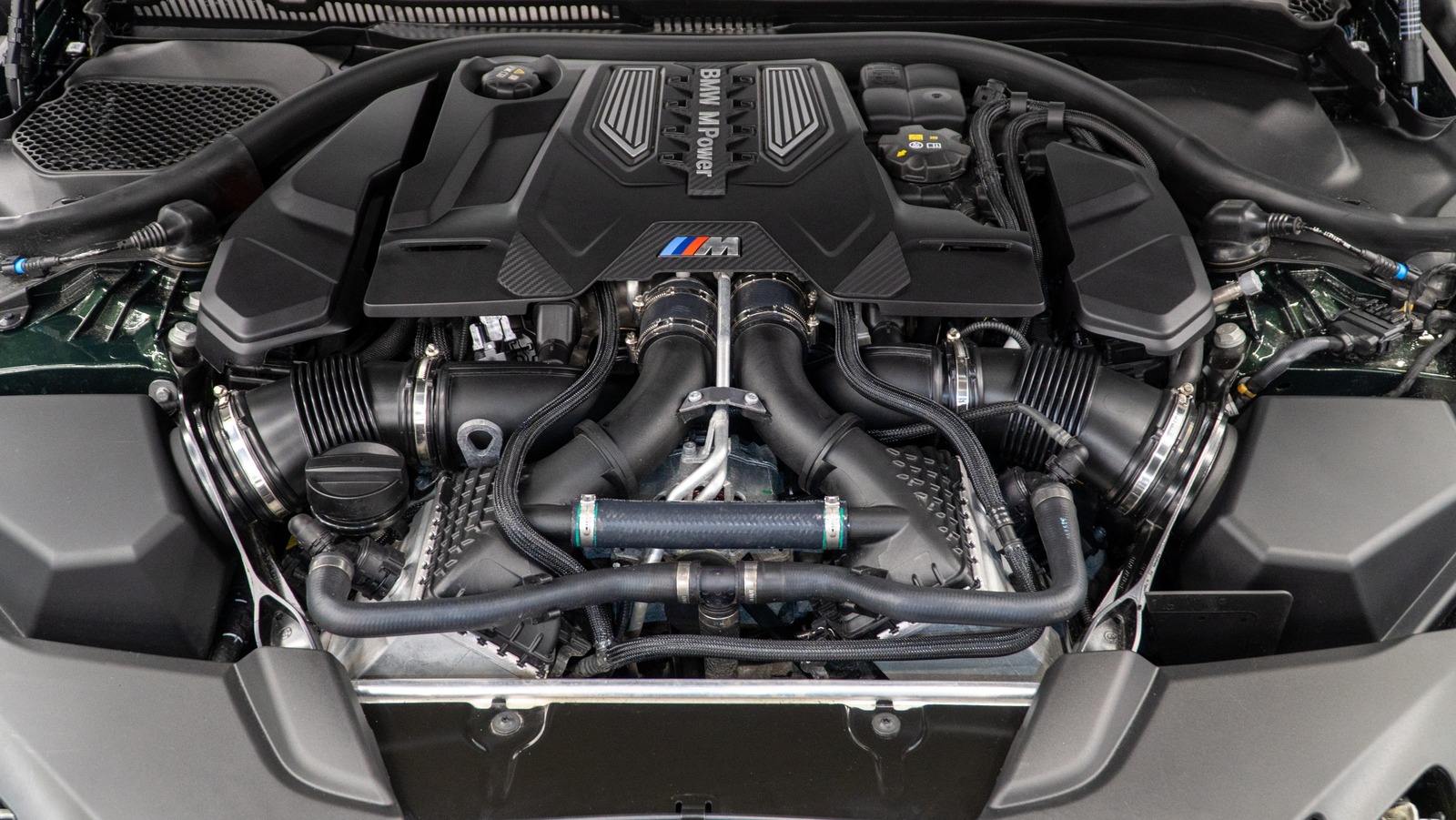
The parallel twin turbo is typically used in V6 and V8 engines. Those layouts have separate banks of cylinders and exhaust piping, so it's possible to use identical turbochargers, one on each bank. Power delivery becomes highly consistent when the systems on both banks are synchronized, but it's common to add an equalization pipe to balance boost pressure between them. Another advantage is being able to use smaller turbochargers than the one that would be needed to boost the engine alone. A smaller turbo needs less gas to be activated, which means it starts working sooner and causes a lower lag.
In the sequential twin turbo, the small turbocharger starts working at low rpm, boosting all cylinders on its own. Then a compression valve redirects the increasing gas flow to the larger turbocharger, which takes over at high rpm. This setup manages to minimize lag with the small turbo, just like what happens in the parallel system, while still producing high maximum power thanks to the larger turbocharger.
The parallel twin turbo was first used in the 1981 Maserati Biturbo, which provoked sharply mixed opinions. That car paired the twin turbo with a carbureted 2.5-liter V6 in most countries; the exception was Italy, where the engine was a carbureted 2.0-liter V6 to avoid heavier taxes. The first car to use the sequential twin turbo was the still-impressive 1986 Porsche 959, which made it work with a 2.8-liter flat-6 engine.
What are the trade-offs of each system?
Adding components affects the engine's reliability because it implies having more parts that can eventually break. When it comes to turbo setups, the twin turbo makes that issue worse because there are twice as many turbochargers and auxiliary parts such as intercoolers and exhaust manifolds. If the car wasn't originally designed to receive a twin turbo system, it may be difficult to fit all those extra components in the engine bay. But there are other important disadvantages to mention, specific to each system.
The turbochargers used in a parallel twin turbo are small, which means that the maximum combined power they produce is still low compared to large turbos'. Another issue is that, if the turbochargers are not synchronized, the engine might get uneven boost between one cylinder bank and the other.
In the sequential setup, the engine requires more precise control, which is done with a complex piping system that uses additional electronic sensors and valves. That translates into both lower reliability and higher costs. Besides, the fact that the engine works with one turbo at a time brings back the issue with power consistency: after producing the initial boost, the engine usually gets a new lag before the second turbo is activated.