How The Digital Age Of Scrutineering Is Keeping Drivers Safer On Track
"Scrutineering" — that's a word most of us don't hear very often. It sounds like something your in-laws do to your medicine cabinet when you have them over for dinner. While that would technically apply to the dictionary definition of the word, its most common use today is in the world of auto racing. It refers to the stringent, thorough series of inspections racing associations perform on vehicles and drivers before, during, and sometimes after a race.
Scrutineering has been an essential part of racing for some time. It's a major way to reduce wrecks and injuries at races. It also helps to ensure that no one cheats by illegally modifying their vehicle. Inspections can be very thorough. At Le Mans, it takes two days to get through all of the cars, which is understandable, since a 24-hour race can be grueling on cars. Seat belts, fire extinguishers, and other safety gear are inspected. Tire pressure is checked, along with torque. The chassis is looked at for cracks and breaks.
But technology has kicked scrutineering up to a whole new level in recent years. The World Endurance Championship (WEC) uses onboard sensors and geofence tracking to monitor the cars live. Formula 1 scrutineers use lasers to measure car dimensions. NASCAR uses lasers, cameras, and optical imaging. These fancy doodads are mostly used to keep the cars in spec, but the onboard sensors go beyond that to keep the driver safe. Officials can now tell when certain systems are likely to fail and cause an accident. In some ways, scrutineers are the unsung heroes of racing.
The history of scrutineering
Scrutineering has been around a long time, ever since the first 24 Hours of Le Mans in 1923. After all, if you're about to have large machines race around at an ungodly 57 mph (the fastest average speed at the 1923 race), you want to make sure every vehicle is safe. And due to racing's competitive nature, you want to make sure everyone is playing fair. At Le Mans, the cars were lined up near the Place de la République, the public square in the town's center, and thoroughly inspected in the days leading up to race time. That process of inspection became an important part of the 24 Hours of Le Mans festivities, and today is held in the Place de la République.
NASCAR and F1 adopted their own forms of scrutineering. Of course, they were much more manual processes than they are today. In the very early days, scrutineering was limited to basic checks, making sure that every car had all of the standard equipment. Eventually the racing teams better understood how aerodynamics affect cars' performances, and some got sneaky about it, making subtle body changes to give their cars an advantage. But the racing associations wanted to ensure fair play, and these little enhancements didn't fit their definitions of "fair."
So in the 1960s and '70s, NASCAR introduced large metal cutouts, called "claws," that would fit over the cars. If the cars didn't fit like they were supposed to, illegal modifications had apparently been made. F1 started using cutouts, as well. This worked relatively well for the era, but it wasn't quite sufficient. Some teams figured out ways to mod their cars without being detected.
How technology has changed scrutineering
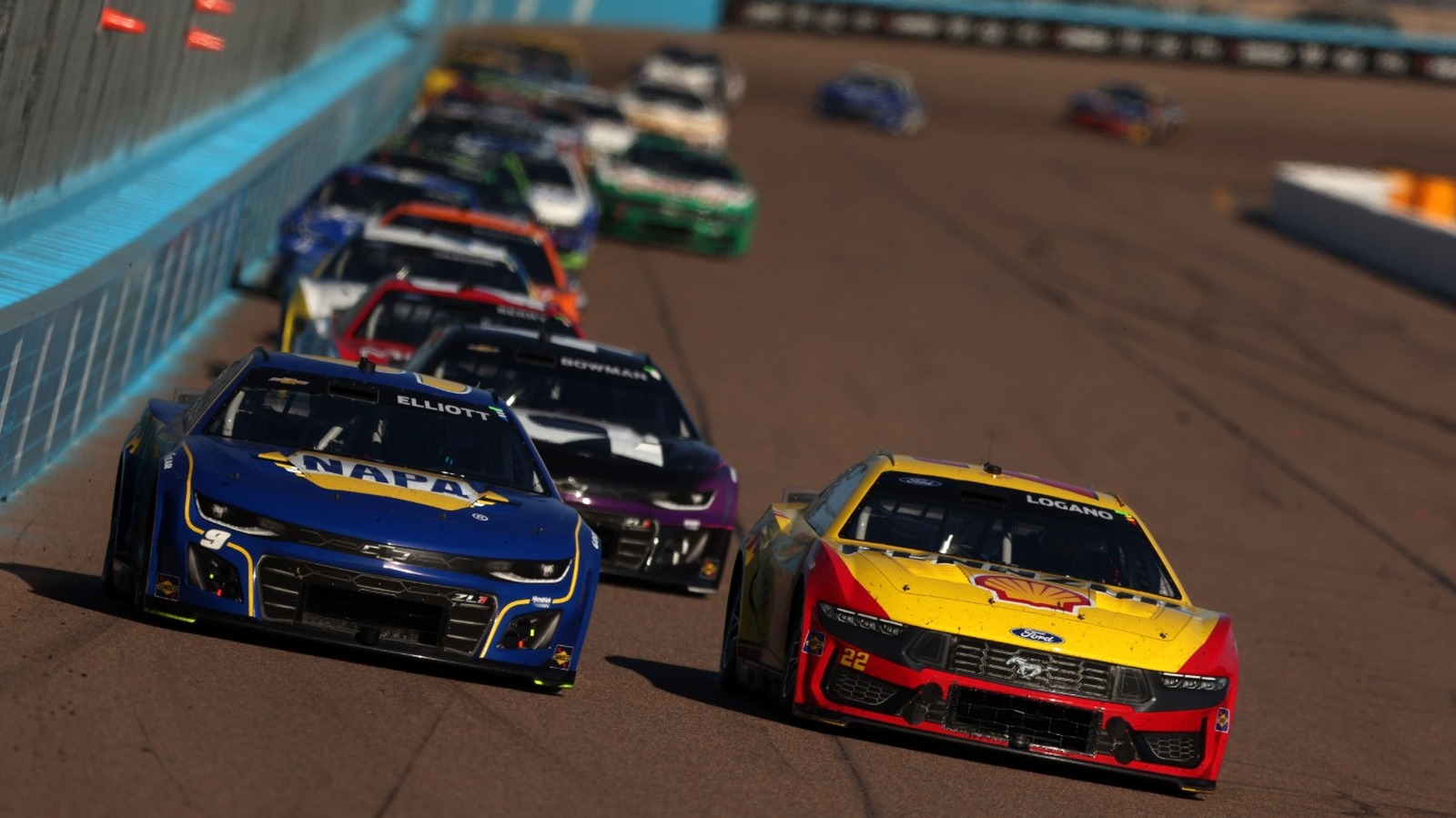
Something had to be done to better catch race teams that had illegally modified their cars to make them more aerodynamic. The metal cutouts that had been used just weren't precise enough. So in 2013, NASCAR started inspecting the cars with lasers. Then, in 2018, it brought in optical scanning stations, nicknamed "Hawk-Eye." Each car is surrounded by 16 cameras and eight projectors, and is scanned by 157,000 laser beams in 30 seconds. A heat map of each car is produced, and if any metal part of a car is just a 150,000 of an inch off of specs (a 200,000th of an inch for glass), it's sent back to the garage for the team to bring it into compliance. F1 uses lasers, too, to make sure cars meet all the correct measurements.
Racing organizations like the WEC and the International Motor Sports Association are no slackers when it comes to technology. Sensors are placed on each car so that officials can monitor them live. Scrutineers can check any car's tire pressure while the race is happening to make sure a low tire doesn't cause a blowout. Torque is monitored, too, ensuring that no cars is running at higher power than allowed.
At Le Mans, geofence tracking is used to enforce limits as drivers navigate the tricky Dunlop Chicane. And F1 officials use AI to monitor cars going outside the white lines. At the 2023 Austrian Grand Prix, before AI was adopted, officials had to review 1,200 potential violations, delaying finalization of race results by five hours. AI now is used to filter reviews to a fraction of that. F1 also placed Radio Frequency Identification tags in tire sidewalls and other parts to ensure that teams don't swap those parts out for something illegal.
Scrutineering is a huge deal in Le Mans
Scrutineering isn't just a formal procedure in Le Mans, it's an important part of the annual festivities. Race week is a big deal there, and the party officially begins when the cars are brought into the city center to be inspected. Thousands of people show up to watch scrutineers do their thing, and many of them get a very close look as the inspectors perform their duties.
Drivers work the crowd before and after their cars are inspected, shaking hands with fans, taking selfies, and signing autographs. Admission is free, and they even throw a parade when the scrutineering is done. Imagine your mechanic being eagerly watched by thousands while swapping out your car's water pump, with the whole thing ending in a parade. The price would probably go up.
But it's not just the Le Mans officials who open their inspections to be watched. NASCAR has decided to be very transparent in how it does inspections. Race team members are allowed to watch the inspection of any other team's vehicle . Not only does this show that every team is treated the same, it also helps keep the playing field level. If your team has figured out a sneaky way to mod your cars while still passing inspection, you won't be able to keep it a secret once all the other teams get a close look at your vehicles.
They even weigh the drivers
Did you know that F1 drivers have weigh-ins like professional boxers? It's not exactly the same — there aren't different weight classes the drivers must qualify for. But according to the rules, drivers should weigh at least 80 kilograms, or just over 176 pounds, including helmet, seat, and other gear. If a driver weighs less, are they disqualified? No. Officials want to ensure that each car meets the minimum weight, including the weight of the driver. So if the driver weighs less than 176 pounds, ballast needs to be added to the cabin.
Oddly enough, drivers also have to weigh in right after the race, and they aren't allowed to drink any water until they do. Apparently, driving an F1 race is even more effective than Ozempic at losing weight (and we're guessing a lot more fun). It's not uncommon for a driver to sweat away four to six pounds during a grand prix or endurance race. Weighing after the race ensures the car wasn't an illegal weight as it crossed the finish line. Running underweight is considered a serious infraction at Le Mans, where Penske Racing had qualifying times thrown out for this reason in 2025, and NASCAR rules define a minimum combined car and driver weight.
But it's also done for the sake of the driver's health. If the driver has lost an excessive amount of weight, medical professionals will know how best to treat them. It also put an end to the practice by some racing teams of making their drivers starve themselves before a race to make the car lighter. Like many of the other rules enforced by scrutineering, this ensures fair play, because teams with small drivers don't have an unfair advantage over other teams.
How scrutineering keeps drivers safe
Except for the party at Le Mans, scrutineering might sound as fun as a dental check-up, though we have to admit that watching the lasers do their thing would be cool. But the real priority of scrutineering is safety of the drivers. Andy Dee-Crowne, CEO of the Historic Sports Car Club in the U.K., told Autosport that scrutineers have found "discharged fire extinguishers, the wrong or out of date helmets and seat belts not properly fitted. We will come across clear cracks in chassis that maybe haven't been seen by the owner." That makes it hard to argue against the benefits of scrutineering.
Scrutineers check a ton of safety items. These include the roll cage, seat harnesses, seat mounting, and, of course, whether the fire extinguishers are expired and secured properly. It also includes the driver's personal gear, including helmets, fire-resistant suits, and gloves and boots, which are also supposed to be fire-resistant. There are even safety rules about the kind of jewelry and underwear the driver can wear and, yes, these are enforced by the scrutineers. At the 2022 Singapore Grand Prix, the Mercedes team was fined for filing an inaccurate scrutineering form because the form did not disclose that driver Lewis Hamilton would be wearing a nose stud.
Technology also plays a role in keeping the drivers safe. F1 has even disqualified drivers over worn floor planks. Sensors are installed to monitor things like tire pressure in real time, helping to prevent dangerous blowouts. And torque monitoring helps ensure cars operate within safe limits. The massive importance of scrutineering to race safety means it will be an integral part of racing for years to come.