
Remember me





 by Johnnie BehiriYesterday
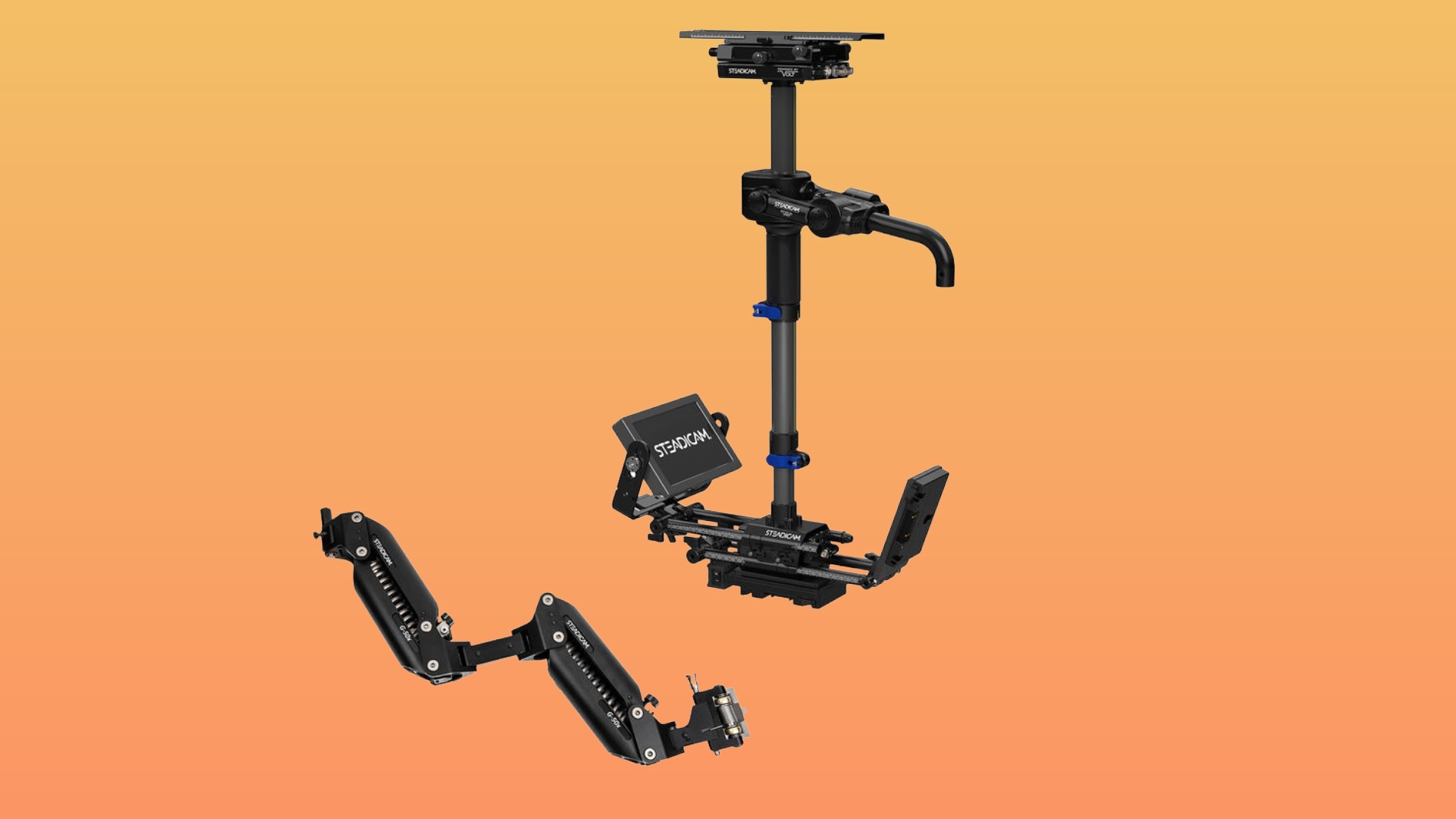
Tiffen has introduced the Steadicam Elite, a lightweight sled built around a 30 lb (14 kg) camera payload, a rigid unibody top stage, and a 3-Axis Volt gimbal with pan control fitted as standard rather than as an upgrade. It is offered as a sled only for $9,995 in V-Mount or Gold Mount form, or as a turnkey kit with the G-50x arm, a new Elite Series vest, and a 7-inch SDI monitor for $19,995.
The Elite is aimed squarely at operators who have outgrown the entry-level end of the range but do not want to carry, ship, or pay for a full-size rig. Tiffen positions it for what it calls hybrid cinema and live-production work, which in practice means the operator who flies a compact cinema body one day and a shoulder-mount broadcast build with a box lens and a wireless package the next. That is a familiar problem for anyone who has stripped a camera back to its bare bones just to get it under a sled’s payload ceiling, and the Elite’s headline numbers are a direct response to it.
 Steadicam Elite sled. Credit: B&HWhere the Elite fits in the Steadicam range
Steadicam’s recent product logic has been to spread electronic assistance across more price points. The Steadicam Axis, introduced two years ago, brought Volt technology on the roll, tilt, and pan axes to a system supporting up to 20 lb (9 kg) with its supplied arm and vest, at a price under $9,000. Above that sit the M-Series systems, where Volt has been part of the picture since the Steadicam M-2 core kits arrived as a more accessible route into that ecosystem.
The Elite slots into the gap: roughly 50 percent more payload than the Axis system, with the Volt hardware built into the stage rather than added to it. Tiffen’s own framing is that this is a medium-payload sled with broadcast-ready infrastructure, which is a reasonable description given the power and monitoring provisions we will come to shortly. It is worth noting that the Volt system itself was honored with a Scientific and Technical Award by the Academy of Motion Picture Arts and Sciences in 2025, so the technology arriving here as standard equipment is not an experimental bolt-on.
 Steadicam Elite. Credit: TiffenThe top stage and post
The structural headline is a rigid unibody top stage. Tiffen’s argument is that greater torsional rigidity reduces vibration transfer through the sled, which in turn allows the higher payload rating and a wider spread of workable builds. Operators will recognize the underlying issue: a stage that flexes under a heavy, long-lens build does not just soften the image; it makes balance a moving target as the rig accelerates and decelerates.
Stage adjustment has been moved to the side of the unit. Tiffen calls these fine-adjust stage controls, and the reasoning is ergonomic rather than mechanical: side access means the operator can reach them quickly while the rig is docked, without working around the camera body or a matte box. Underneath, the sled uses a two-stage carbon fiber post, and the gimbal handle post is a 1/2-inch fitting, consistent with the rest of the Steadicam ecosystem.
 Credit: TiffenVolt 3 and the pan axis
The most interesting part of the Elite is what the Volt integration is being asked to do. Earlier Volt implementations concentrated on horizon assistance, using gyro sensors and brushless motors to keep the camera level against the operator’s body movement. The version fitted here is the 3-Axis Volt with pan control, the same generation we looked at in prototype form at Cine Gear, where the design brief was described as an operator’s assistant rather than an autopilot.
According to Tiffen, the pan axis is where the practical gain lies. The company says the system lets the operator manage rotational inertia rather than simply resisting it, which it links to steadier tracking shots, more controlled whip pans, and better behavior on long lenses. That last case is the one worth watching. Long-lens work on a sled has always punished small pan errors, and a system that adds a tunable degree of damping to the pan axis without taking framing authority away from the operator would be a meaningful change to how those shots are approached. Whether the implementation holds up under real production conditions is something we will only know once units are in operators’ hands.
 Credit: TiffenPower distribution built for bigger builds
The Elite carries selectable 12V and 24V power distribution rated at 8A, with hot swap on the 12V side, and no external adapters required. This is the specification that most clearly signals the broadcast intent. A modern build rarely draws power from one place: the camera, a wireless video transmitter, a monitor, motors, and in live work a comms or return-video package all need feeding, and mixed 12V and 24V requirements have traditionally meant hanging converters off the sled and adding both weight and failure points.
Handling that natively at 8A means the operator can configure the rig around the job instead of around the power budget. Hot swap on the 12V rail matters just as much on long live days, where changing a battery without powering down the camera is the difference between a smooth handover and a missed cue.
Batteries, monitors, and vertical framingBattery placement is handled by dual sliding and pivoting mounts, with a new pivoting lower battery mount sitting under the post. The point here is dynamic balance: being able to slide and angle the batteries rather than shim the rig gives the operator a finer tool for tuning the sled’s inertia and drop time, which is exactly the adjustment that gets fiddly when payload increases.
Monitoring uses a universal yoke-style mount that accepts a range of monitor sizes, and Tiffen has explicitly built in support for 9:16 viewing. Vertical framing on a body-mounted stabilizer is no longer a niche request; for social and campaign work it is often the deliverable, and a monitor mount that rotates into portrait orientation without an improvised bracket is a small but genuinely useful provision. The sled is finished off with what Tiffen describes as an ultra-secure docking bracket, for parking the rig between takes.
 Steadicam Elite kit. Credit: B&HWhat the turnkey kit adds
The sled-only configuration ships without a monitor and is aimed at operators folding the Elite into an existing Steadicam setup, where an arm and vest are already in the case. The kit version is the ready-to-deploy option, adding the new Elite Series lightweight vest, a Steadicam G-50x arm with a 1/2-inch post, and a 7-inch high-brightness SDI monitor.
The G-50x is a known quantity. It weighs 8.6 lb (3.9 kg), offers a 28.7-inch (72.9 cm) boom range, and includes ride control for adjusting the arm’s iso-elastic response, so operators can tune how much the arm floats against how much it holds. Pairing it with a new, lighter vest is a sensible choice for a sled pitched on manageable weight, though we have not yet seen detailed specifications for the Elite vest itself. Both configurations come with a three-year limited manufacturer warranty.
Price and availabilityThe Steadicam Elite sled, in either V-Mount or Gold Mount form, is listed at $9,995 at B&H, with the Gold Mount version carrying the same price. In the UK and Europe, CVP lists the sled at €9,060.21 excluding VAT, which works out to €9,060.21 including VAT.
The full kit costs $19,995 at B&H in the V-Mount version, with the Gold Mount kit priced identically. CVP’s regular kit price is €18,123.92 excluding VAT, currently reduced to €16,310.95 excluding VAT (€18,123.92 including VAT) under a 10 percent pre-order saving that runs until August 15, 2026. Both retailers are taking pre-orders, with CVP requiring a deposit, and stock has not yet started shipping.
At just under $20,000 for a complete system, the Elite is not an impulse purchase, but it is priced well below full-size territory for a sled that arrives with three-axis electronic assistance, a 30 lb/13.6 kg payload, and dual-voltage distribution as standard rather than as line items on a quote.
Does an assisted pan axis change how you would approach long-lens or whip-pan work on a sled? Don’t hesitate to let us know in the comments below!