
Remember me



 by Nino LeitnerToday
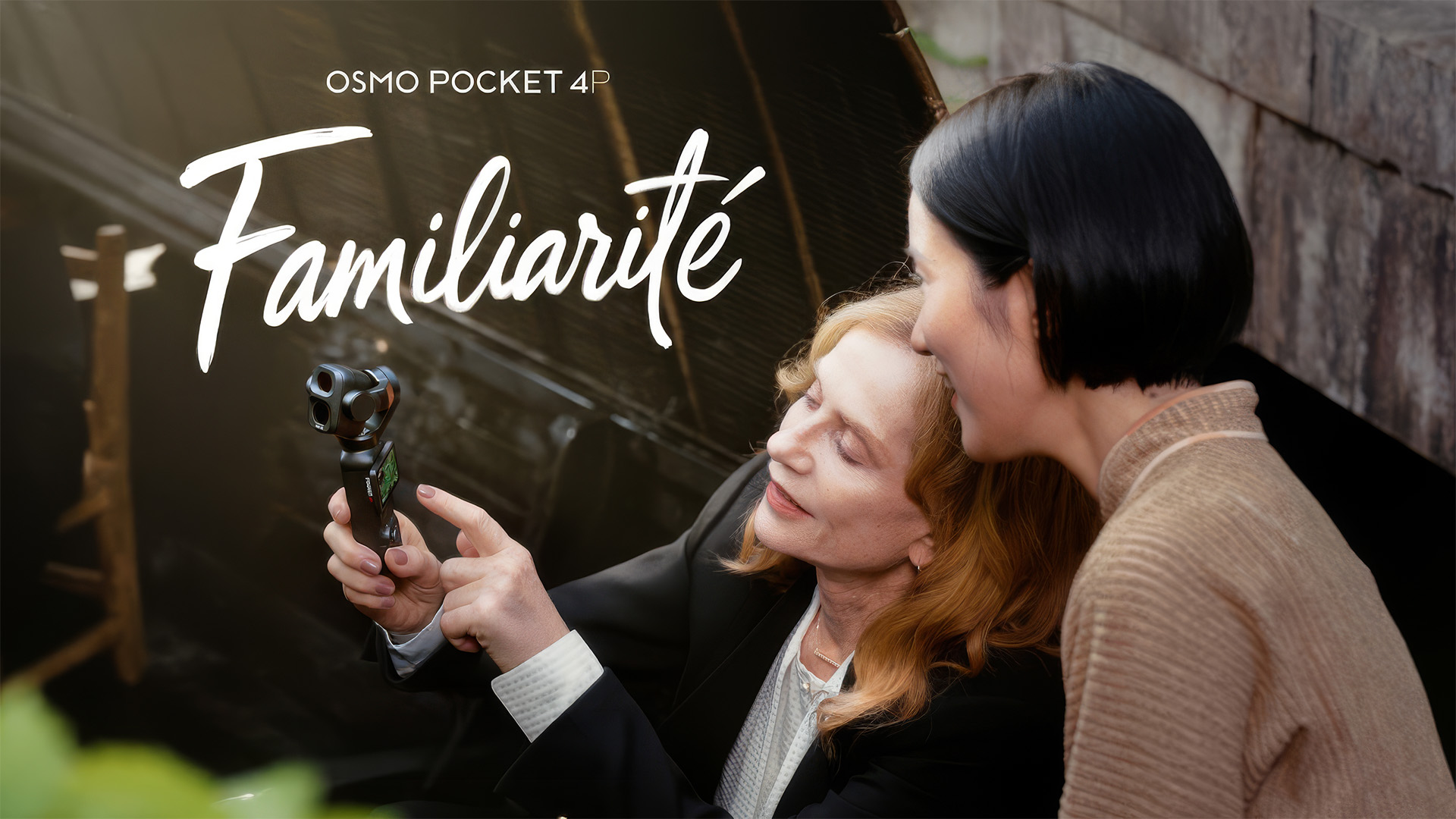
DJI has released FAMILIARITÉ, an original short film starring and creatively directed by French actress Isabelle Huppert and shot in its entirety on the Osmo Pocket 4P, the company’s first dual-lens pocket gimbal camera. The production used the camera’s 60mm med-tele lens, its three-axis mechanical stabilization, and the new D-Log 2 profile to work handheld inside a traditional Chinese garden, including an intimate two-hander staged in a drifting rowboat.
“Shot on” showcases are a well-worn marketing format, but this one is worth a closer look for two reasons. The first is the talent involved: Huppert has more than 120 films behind her, multiple Best Actress honors at Cannes and Venice, a Golden Globe and an Academy Award nomination, and she is not an obvious fit for a camera that fits in a jacket pocket. The second is the camera itself. The Osmo Pocket 4P has already turned in the single most surprising result of our recent testing cycle, so a narrative piece built around it is a genuinely interesting test case rather than another travel montage.
Poetry instead of plotFAMILIARITÉ has no conventional story. It is structured as a conversation across time between two women who never met, both of whom turned a life into written language. George Sand (1804 to 1876) claimed her voice in 19th-century France by publishing under a man’s name, a decision Huppert echoes in the film by wearing a man’s tailored suit. Centuries earlier, the Song-dynasty poet Li Qingzhao (1084 to around 1155) answered the upheavals of her age through her verse.
Sand’s poem “À Aurore” runs through the film as a connecting thread, and the piece resolves in a single wordless exchange between Huppert and a young Chinese girl. It was shot amid shifting sunlight, tree shadows, and water surfaces in a traditional Chinese garden, a location that supplies both the atmosphere and, as we will see, most of the technical challenges.
 Isabelle Huppert shooting on the Osmo Pocket 4P. Still from the behind-the-scenes video. Image credit: DJIWhy the camera choice mattered on set
Huppert did not only perform; according to DJI, she shaped the visual language of the piece and selected the Osmo Pocket 4P as the tool to realize it. The stated reasoning is one that documentary shooters will recognize immediately: a camera small enough to disappear changes what a performer does in front of it. DJI says the camera all but vanished on set, letting Huppert work in a more relaxed, unguarded state than a larger rig tends to allow.
Huppert’s own comment in the press material is characteristically dry. “It’s the first time I’ve discovered such a tiny camera,” she recalls, going on to describe it as almost invisible while still resolving an image of considerable sharpness and precision, and crediting it above all with conveying the emotion of a face and what passed between her and her scene partner. She also notes that it never felt like an intimidating machine and did not alter her craft.
That is a marketing quote, and we should read it as one. Still, the underlying observation holds up outside a press release: the psychological footprint of a camera on a performance is real, and it is one of the few things a 230g gimbal camera can genuinely do better than an ALEXA.
The rowboat, and other places a rig will not fitThe most concrete production detail concerns one of the film’s most intimate exchanges, staged between Huppert and her co-star aboard a small rowboat drifting across the garden pond. DJI’s account is that fitting a traditional cinema camera and its crew into a space that confined and that unsteady would have meant breaking the moment. The Osmo Pocket 4P sat inside the boat instead, keeping both performers in frame and letting the movement of the water carry the shot.
Much of the rest of the film lives in continuous moving takes that drift past figures, tree shadows, bookshelves, and door frames, so that transitions become gestures rather than cuts. A large share of those were captured handheld by the DP. With the camera’s three-axis mechanical stabilization doing the heavy lifting, the operator could reset between setups in seconds, which DJI credits with lifting the overall pace of the shoot. Anyone who has waited for a gimbal to be rebalanced between takes will understand why that matters more than it sounds.
High-contrast light and the dynamic range questionThe garden setting is exactly the kind of environment that punishes small sensors: hard highlights sitting next to deep, layered shadow, on foliage and on faces alike. The production shot in D-Log 2, DJI’s new 10-bit profile, which the company pairs with a claimed 17 stops of dynamic range from the LOFIC-equipped 1-inch sensor behind the wide lens. According to DJI, that combination preserved the full gradation of the light and gave the colorist room to work.
 Osmo Pocket 4P performs really well in high-contrast scenarios. Still image from “Familiarité” with Isabelle Huppert. Image credit: DJI
Manufacturer dynamic range claims usually deserve a raised eyebrow, and we raised one when the camera was announced at Cannes. Then we put it through our lab. In our Osmo Pocket 4P Lab Test, the wide camera delivered the highest dynamic range figure we have measured in more than 70 camera tests, beating the ARRI ALEXA 35 on that specific metric. Gunther and Nino unpacked the results and their limits in Focus Check episode 127, which is worth your time before anyone declares the cinema camera obsolete. Dynamic range is one number among many, and rolling shutter, codec headroom, lens control, and audio all still separate this class of camera from a production body.
A 60mm lens doing portrait workThe second lens is where FAMILIARITÉ gets closest to conventional cinematography. To carry Huppert’s most restrained expressions, the production leaned on the 60mm equivalent med-tele camera, an f/1.8 optic that DJI positions as a natural portrait focal length. The reasoning given is the familiar one: no wide-angle distortion on faces, compressed space behind the subject, and enough separation that a small shift in expression reads clearly.
Wider framings at 15mm and 20mm were used to place each character inside her space, so that a movement across the garden also registers as a movement in time. Cutting between a 20mm and a 60mm perspective on a single body, without swapping optics or breaking the shooting rhythm, is precisely the argument for the dual-lens design that DJI introduced at Cannes earlier this year, and this is the first high-profile piece of work built around it.
 From our Osmo Pocket 4P Lab Test, which revealed remarkable performance for both dynamic range and exposure latitude results. Image credit: CineDWhat this does and does not prove
It is worth being clear about what we are looking at. This is a brand film, made with manufacturer support, a director of photography, a colorist, and presumably a lighting and production crew that a spec sheet does not mention. It does not demonstrate that a pocket gimbal camera replaces a cinema package, and DJI’s own framing about placing imaging power in every storyteller’s hands is corporate language, not a test result.
What it does demonstrate is narrower and more useful: that this camera can be the A-camera on a controlled, performance-driven shoot with a very demanding lead, and that its real advantage is access rather than resolution. Boats, tight interiors, tracking moves through doorways, close proximity to a performer who is more comfortable without a crew in her eyeline; those are the situations where the form factor buys something no full-size rig can. We reached a similar conclusion when we tested the Osmo Pocket 3 in a professional documentary workflow, and the 4P widens that window considerably.
FAMILIARITÉ has been released across DJI’s official channels alongside behind-the-scenes material, and you can watch the film on YouTube or embedded above.
The Osmo Pocket 4P Standard Combo is priced at €599 / £529, while the Vlog Combo comes in at €689 / £605, with European and UK prices including VAT. The camera is available in Europe, the UK, Canada, and Australia, but DJI is still not selling it in the US, which remains the most frustrating part of this story for our American readers. Full specifications are in our release article, and the camera’s predecessor is covered in our Osmo Pocket 4 announcement.
Would a camera this small change what you attempt on a narrative set, or is the real story here the performer rather than the sensor? Don’t hesitate to let us know in the comments below!