
Remember me

 Jay Biggerstaff-Imagn Images
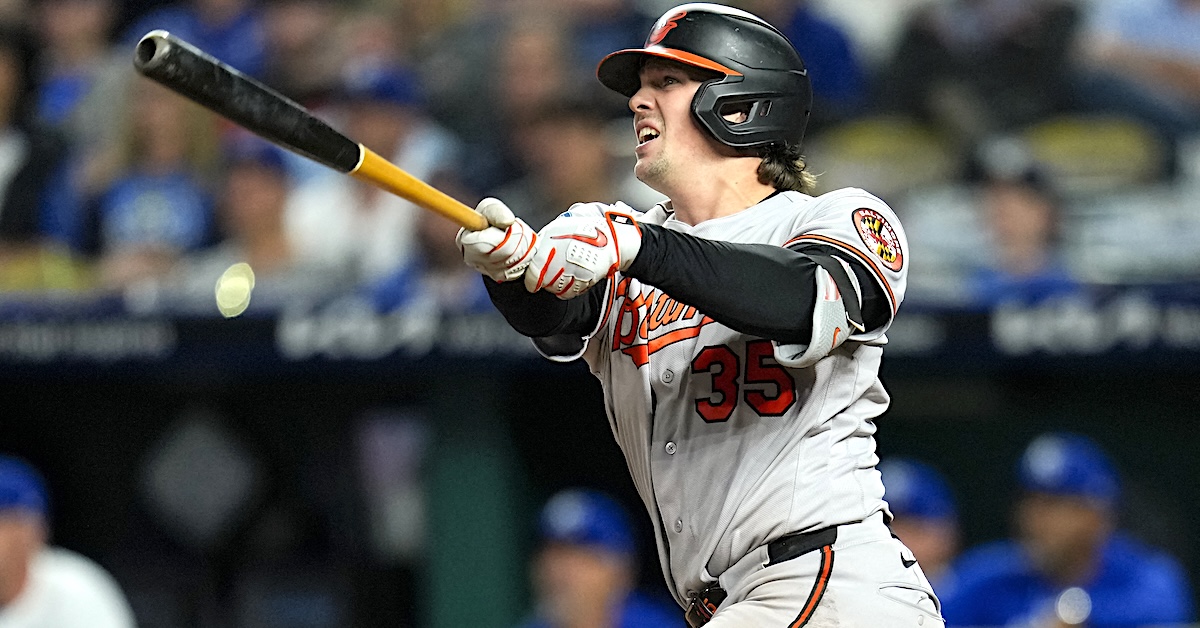
The Baltimore Orioles have traded Adley Rutschman to the Boston Red Sox, along with Jake Rogers, for catcher Carlos Narváez and four prospects: right-handed pitchers Anthony Eyanson and Kyson Witherspoon, and teenage center fielders Enddy Azocar and Harold Rivas.
Wow.
The first reaction to this deal can only be one of astonishment, on multiple levels. The trade itself is audacious, from both teams’ perspective. Even with his trade value and reputation at a low ebb, Rutschman’s talents are gigantic, and the return reflects that.
But this trade’s on-field impact pales in comparison to What It All Means. Rutschman, the no. 1 overall pick in the 2019 draft, was the Orioles’ franchise player as they emerged from nearly a decade in the wilderness to become (if only briefly) a power player in the AL East. Seeing Rutschman in any other team’s colors will be weird enough to inspire the heebie-jeebies.
Let’s deal with the tangible parts of this trade first. Rutschman, who has been limited to just 157 games over the past two seasons, is back on the IL with wrist inflammation, but he’s expected to return soon.
With the Red Sox somewhat unexpectedly back in contention, it is difficult to overstate how big an upgrade Rutschman is at catcher. It’s hard to find a good backstop these days; a few teams have basically punted the position, willing to eat three or four outs a game if it means they can pay a good receiver and blocker the minimum salary.
You Aren't a FanGraphs Member
It looks like you aren't yet a FanGraphs Member (or aren't logged in). We aren't mad, just disappointed.
We get it. You want to read this article. But before we let you get back to it, we'd like to point out a few of the good reasons why you should become a Member.
1. Ad Free viewing! We won't bug you with this ad, or any other.
2. Unlimited articles! Non-Members only get to read 10 free articles a month. Members never get cut off.
3. Dark mode and Classic mode!
4. Custom player page dashboards! Choose the player cards you want, in the order you want them.
5. One-click data exports! Export our projections and leaderboards for your personal projects.
6. Remove the photos on the home page! (Honestly, this doesn't sound so great to us, but some people wanted it, and we like to give our Members what they want.)
7. Even more Steamer projections! We have handedness, percentile, and context neutral projections available for Members only.
8. Get FanGraphs Walk-Off, a customized year end review! Find out exactly how you used FanGraphs this year, and how that compares to other Members. Don't be a victim of FOMO.
9. A weekly mailbag column, exclusively for Members.
10. Help support FanGraphs and our entire staff! Our Members provide us with critical resources to improve the site and deliver new features!
We hope you'll consider a Membership today, for yourself or as a gift! And we realize this has been an awfully long sales pitch, so we've also removed all the other ads in this article. We didn't want to overdo it.
But absent those clubs, and a couple others that are dealing with injuries, Boston’s catching situation is as dire as it gets. The Red Sox, in the form of Narváez, Connor Wong, and the odd Mickey Gasper game, are 26th in catcher WAR, 26th in wRC+, and 23rd in defense. The other Oriole backstop in this deal, Jake Rogers, is in sniffing distance of replacement level over the past two seasons. But even he would’ve been a useful addition to Boston’s stable of catchers.
When Rutschman is healthy, he is an elite defender. He’s literally leading the league in caught stealing above average, to go with 93rd-percentile framing and 73rd-percentile blocking. After an injury-plagued run starting in the second half of 2024, Rutschman has rediscovered his stroke: .251/.331/.433 (115 wRC+), with just a 14.1% strikeout rate in 284 plate appearances this season.
Nothing about Rutschman’s offensive game is elite, but he’s at least pretty good at everything. As a legit switch-hitter, from a position where offense is impossible to come by, that’s a huge deal. I’ll go so far as to say this: No other trade at this deadline is going to improve a team this much at a single position. Not Tarik Skubal to the Dodgers, not Kevin Gausman to the Cubs, not Luke Weaver to the Pirates.
And Rutschman is under team control through next season. He’ll be due a raise from his $7.25 million salary this year, which might’ve been odious to Baltimore, but will be more manageable for Boston.
As you’d expect, it took a massive haul for the Red Sox to shake Rutschman loose from a division rival. Brendan Gawlowski will have a detailed breakdown of all four prospects, but I’ll give you some highlights here.
Eyanson is the star piece here, the no. 27 global prospect with a 55-FV grade. He was an intriguing arm out of LSU, the Saturday starter behind Kade Anderson on last year’s national championship team.
The Red Sox went big on college arms in last year’s draft, popping Eyanson in the third round, no. 87 overall, for an over-slot bonus of $1.75 million. Since then, he has been the breakout prospect of his entire draft class. By this spring, he was throwing between three and five miles per hour harder than he was at LSU. Eyanson’s high arm slot and developing splitter inspired Brendan to drop a dollar in the Trey Yesavage Swear Jar in his writeup of the Red Sox top prospects list from May, but Eyanson’s two breaking balls are his most dangerous secondaries.
Eyanson was the third college pitcher the Red Sox drafted last year; Witherspoon was the first, selected 15th overall out of the University of Oklahoma. Witherspoon sits in the mid-90s and will touch 99, but he’s struggled to get much out of it, even in the minors. Hitters aren’t whiffing on the heater at all, and his command, which came and went during his college career, is currently only in the office part-time.
Azocar, 19, broke out after signing for just $40,000 as an amateur in 2024. He’s now a tooled-up center fielder with enough speed and defensive savvy to stay at the position long-term, and his bat speed is only climbing with age. Brendan cautioned that there’s big hit-tool risk here, but he likes Azocar’s underlying tools enough to raise his FV grade from 45+ in May to an even 50. Rivas, who turned 18 in May and just finished his first season in stateside complex ball, is a similar prospect minus a year of development.
On top of this star-for-prospects deal is a swap of backup catchers: Rogers for Narváez.
Rogers is one of those zero-offense/all-defense catchers I was talking about earlier. A longtime starter for Detroit, he was about a 2.5-WAR player when his defense graded out as elite — especially in 2023, when he somehow ran into enough slop to hit 21 home runs. Since then, Rogers is hitting .188/.263/.337 and was rendered surplus to requirements by Dillon Dingler. The Orioles only traded for him last week when — oh dear, this wasn’t supposed to happen — Rutschman and Samuel Basallo got injured at the same time.
Narváez looked like Boston’s catcher of the future last year, when he posted a 97 wRC+ with 15 home runs and plus defense in 118 games. In 62 games this year, though, he is hitting .187/.260/.275. His strikeout rate has climbed from 24.9% to 33.5%, and basically everything about his offensive game — bat speed, contact rate, barrel rate, maximum exit velo — has gone backwards.
All that said, I’d much rather have Narváez. Not only has he flashed offensive competence much more recently than Rogers, he’s three and a half years younger and under team control through 2030. Rogers is set to hit free agency this winter, not that you’d go out of your way to bring him back.
When the Red Sox traded Connelly Early for Curtis Mead a week ago, I noted that a 1-for-1 challenge trade left Boston’s head of baseball ops, Craig Breslow, with plenty of ammo if he wanted to go out and make another big move. (Lucky for him, since Mead got hurt in his first game for the Red Sox.)
Clearly, Breslow agrees; in addition to trading a global top-30 prospect and three other meaningful youngsters for a year and a half of Rutschman, he shipped Marcelo Mayer to San Francisco for Erik Miller while I had this WordPress window open. The Red Sox have a new lease on life after their 15-game winning streak, and Breslow seems dead-set on getting his money’s worth.
The Orioles’ direction of travel is a little murkier. To be clear: Much as I love Rutschman’s game, I think the Red Sox overpaid here. And even though the Orioles have been sellers at this deadline — sayonara, Taylor Ward, Tyler Wells, and Dean Kremer — they’re well-positioned to reset for 2027. Eyanson, with his proximity to the majors, will only aid in that effort.
But 2027 wasn’t supposed to be Year 1 of Phase 2 of Baltimore’s contention window after two years out of the playoffs. It was supposed to be Year 5 of a perennial contender’s prime. And Rutschman’s career could not be a better microcosm for the fortunes of the team that drafted him.
In Rutschman’s rookie season, 2022, he hit .245/.362/.445 in 113 games with plus defense behind the plate. That was good enough for 5.6 WAR, 12th in the MVP voting and second to Julio Rodríguez in the Rookie of the Year balloting. Thanks in no small part to Rutschman, the Orioles improved by 31 games from the previous season and enjoyed their first winning campaign since 2016.
In 2023, another 5-WAR season, the Orioles won 101 games and the AL East. But he busted up his hand in June 2024, and ever since then, things have started to slide. The Orioles bowed out of the 2024 Wild Card series with a whimper, then missed the playoffs altogether in 2025 as injuries limited Rutschman to 90 games. Again in 2026, he’s been in and out of the lineup — albeit, with much better production while healthy — as the Orioles find themselves on the wrong side of the bubble again.
Adley Rutschman, Before and After the Watershed
Period G AVG OBP SLG wOBA xwOBA wRC+ Through June 30, 2024 346 .274 .365 .447 .353 .357 130 Since July 1, 2024 226 .222 .305 .362 .295 .321 90 Through June 30, 2024 94.0% .601 21 87 22.6 15.4 6.2 Since July 1, 2024 64.2% .474 10 42 -6.8 7.1 1.5Gunnar Henderson replaced Rutschman as the face of the Orioles. Cal Raleigh replaced Rutschman as the American League’s leading switch-hitting catcher. (Admittedly, Raleigh’s going through it himself at the moment.) And most jarring of all, Basallo was anointed as the Orioles’ franchise backstop with his eight-year, $67 million contract extension.
That left Rutschman, well, in the lurch. The incredible part of this story is not that, having been displaced, Rutschman ended up on the trade block. It’s that he ever got displaced at all.
That prompts two questions about Rutschman’s legacy as an Oriole. The first is easy: Were the Orioles wrong to pick him first overall in 2019, ahead of Bobby Witt Jr.?
With the benefit of hindsight, this is obviously the case. But in 2019, Rutschman was the safest, most obvious no. 1 pick since Bryce Harper. There has not been a better prospect available at 1-1 in any draft since — including Paul Skenes, who was a mild surprise when the Pirates picked him first.
I got asked this question for the first time in the press box at the 2024 Wild Card series, when Witt’s Royals swept Rutschman’s Orioles. I said then that while the exemplary draft screwup in sports history was the Portland Trail Blazers picking Sam Bowie over Michael Jordan in 1984, nobody ever criticizes the Rockets for taking Hakeem Olajuwon with the first pick in that draft, even though the ultimate gap between Jordan’s career and Olajuwon’s is massive.
The point I was making is that if you draft the consensus no. 1 prospect in the class, and he turns out to be a star, it’s hard to be too upset if a later pick hits his 99th-percentile outcome and becomes an even bigger star later on.
The Rutschman-as-Olajuwon comparison doesn’t feel so secure anymore, but calling Rutschman a bust requires reasoning so motivated it blurs into the realm of the disingenuous. He is still only 28, and in four and a half big league seasons he’s made the All-Star team three times and produced 17.3 WAR — already, that comfortably places Rutschman in the top half of outcomes for the no. 1 pick. And he’s still got close to another decade to go.
The better question is what this says about Rutschman’s Orioles — or, to put it more pointedly, Mike Elias’ Orioles.
From a process perspective, Elias did well to get so much talent in exchange for a star player in the midst of an injury-plagued two-year slump. Basallo’s emergence, which made Rutschman expendable in the first place, is another unalloyed plus for the franchise.
But the Orioles, with three straight no. 1 global prospects and numerous other homegrown hitters in the lineup, were unable to win a playoff game with all that talent. Their offense went dark against the Royals in their last playoff appearance; it’s hard not to wonder if things would’ve been different had they gotten more out of Jackson Holliday or Heston Kjerstad.
And with Eyanson and Witherspoon representing so much of the value in this trade, the focus returns to Baltimore’s inability to develop pitching internally. What else could Rutschman have done for this team had the Orioles been able to develop (or sign) enough pitching to obviate the need for an Eyanson?
The Orioles are probably going to be better off in the long run for their decision to pivot away from their original franchise player. But that change in course should come with a measure of regret that Elias and the O’s couldn’t make Plan A work in the first place.