Mayo's All-Ireland homecoming: How Sam Maguire united a county on an unforgettable journey home
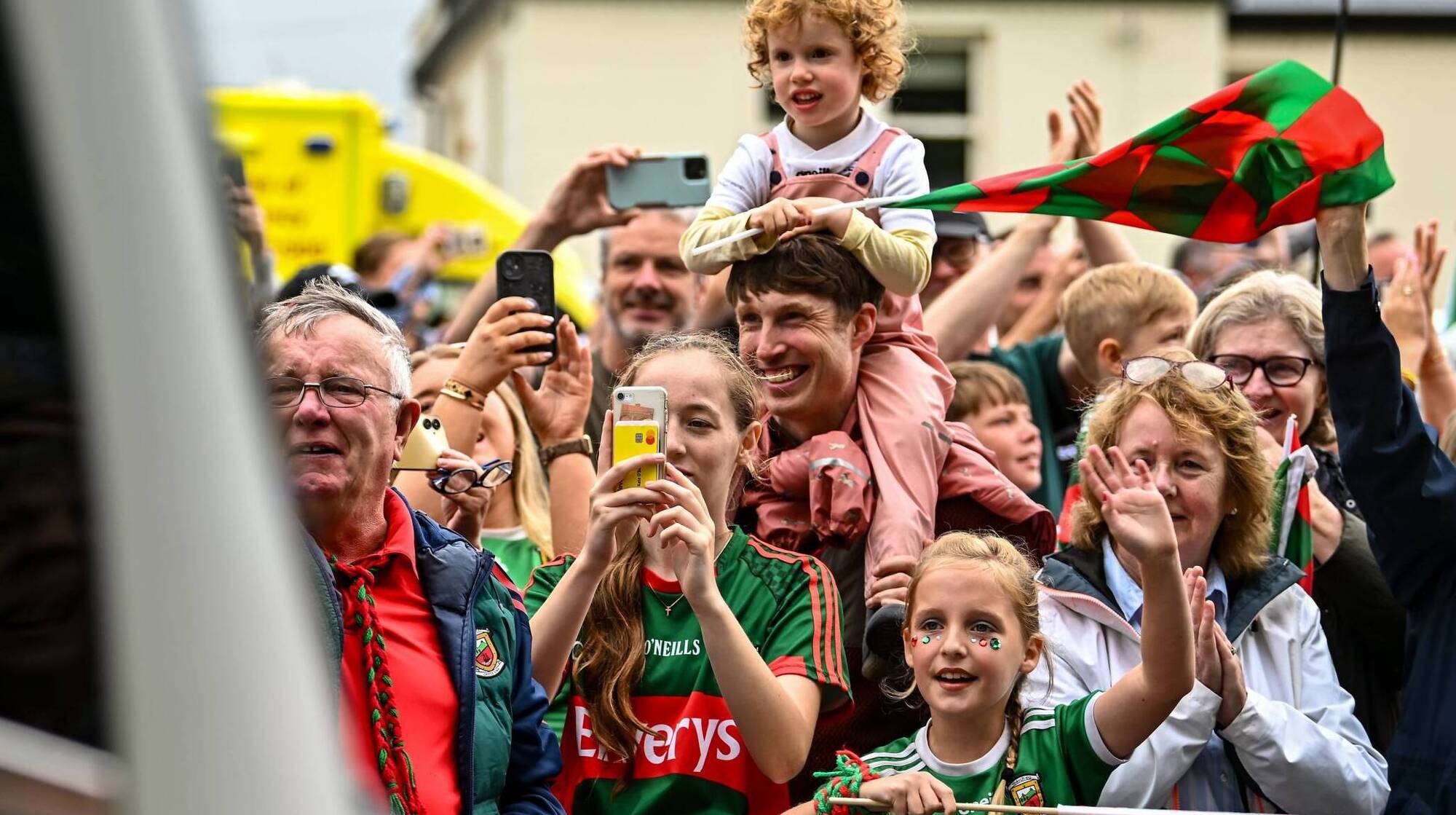
On Monday morning, those Mayo people lucky enough not to be leaving through airports or ferry terminals drove west, towards home. Every service station along the M4 was overrun with green and red. Mayo flags fluttered from car windows. Children, exhausted by the emotional labour of Sunday, slept across back seats beneath jerseys that had never seen a better day. Parents who had scarcely slept queued for coffee, exchanging knowing smiles and fist pumps with old friends and complete strangers. Nobody had organised any of this. Nobody had to.Toll plazas are among the least romantic places on earth. They exist to keep traffic moving, to monetise movement, to reduce journeys to transactions. Concrete. Steel. Fluorescent lights. Barrier arms rising and falling with mechanical indifference. Yet on Monday, this most ordinary of places briefly became extraordinary. Cars slowed as windows were rolled down. Horns sounded. Drivers leaned across passenger seats to wave at people they half-recognised. Fists punched the air. Wet eyes caught wetter eyes. Laughter travelled from one lane to the next. Nobody lingered for more than a few seconds, yet something unmistakable passed between us all. The homecoming had already begun.A little further west, the Shannon appeared. There are rivers that divide counties. The Shannon has always divided imaginations. For centuries, Connacht existed less as a province than a place of punishment. The phrase "To Hell or to Connacht" reduced an entire landscape to exile, hardship, and distance. The river was more than geography — it was a frontier. Mayo's Ryan O'Donoghue, Jack Coyne, and Darren McHale celebrate at the homecoming. Picture: Tom Maher/InphoOn Monday, Sam Maguire crossed it once again. It is a surprisingly rare journey. In almost a century and a half of Gaelic football, the cup had only crossed into Connacht 14 times. Statistics tell us that, but the faces on the bridge told us something else: Every crossing gathers the weight of all the crossings that came before it. And the 15th may have been the most profound of all.By Monday evening, MacHale Park in Castlebar had ceased to resemble a stadium, but a colosseum of collective catharsis. Fatigue, mist, capacity — nothing could dampen or discourage the people who came in their tens of thousands. Nobody had planned for this, yet everybody miraculously arrived. Grandparents who had waited their entire lives stood misty-eyed in the July drizzle, watching children who had never known defeat dance beneath a stage erected on sacred turf. This was neither a wedding nor a funeral, but a reunion of competing realities.The following morning the county began breaking itself back into parishes. Mayo captain Jack Coyne held the cup aloft in Ballyhaunis. It was only Tuesday, yet it felt like a decade had passed since Tommy Conroy had fisted the final point of an unforgettable afternoon. Time, for so long Mayo’s enemy, had suddenly become its closest friend. “No rush,” fate seemed to whisper, softly, which made a pleasant change. For decades the clock had mocked Mayo, both in its passing and its pace.By Wednesday, the convoy turned north-west again, and crossed another totem of its one-time torture — the bridge over the river Moy. A body of water that separates Moy Davitts on the Foxford side, and Knockmore. A player from each club, Cian McHale and Darren McHale, disembarked and carried the cup over the pass. In doing so they put to bed a curse most of us argued never existed. A curse that haunted, nonetheless. Nobody declared it broken. Nobody needed to. Sometimes history is at its most eloquent when nothing at all is said.The Big Apple If this week's journey west cleansed a people of its legacy trauma, another leg of that Camino deserves mention, if only to correct the record. In 2019, Mayo were drawn to play New York in the opening round of the Connacht championship. On paper, it was barely a contest. New York had never beaten Mayo and likely never will. And yet something extraordinary happened. More than 10,000 Mayo people crossed the Atlantic. The match was the excuse, but it was never the reason. Aidan O'Shea challenged by fellow Mayo man Matthew Queenan (Lahardane Machales/Mayo Accolades) during the 2019 Connacht quarter-final between Mayo and New York in Gaelic Park, The Bronx. Picture: Andy Marlin/Inpho At the time, if I'm honest, I never felt entirely comfortable with it. There was something about the spectacle that left me uneasy. Times Square awash with green and red. Gaelic Park overflowing. The inevitable viral moments of packed Irish bars on McClean Avenue. It all felt as though it invited ridicule. Here we were again, I thought, the county that could turn even its own longing into a punchline. We had won nothing, so what were we celebrating?Only now do I realise how wrong I was. The people who travelled weren't really going to watch football. Football was simply the bridge that carried them.For one weekend, siblings, separated by circumstance, embraced again. Parents met children who had built lives across an ocean. Grandparents met grandkids they’d never held. Friends who had left Mayo decades earlier broke bread with neighbours who had never left at all. Green cards, mortgages, work visas, distance, time zones, immigration — all the ordinary obstacles that quietly fracture families — were suspended for a few precious days because a football match gave everyone permission to gather. I thought they had travelled to New York as a branding exercise. Looking back now, I think they were travelling to another version of home.Journeys and a reason to come back That is what I failed to understand then, and what this week has finally taught me. Mayo people have always been making journeys. Across the county. Across the Shannon. Across the Atlantic. They have always been leaving, and just as importantly, they have always been finding reasons to come back. The trip to New York was never an act of delusion by a county that hadn't yet won an All-Ireland. It was simply another chapter in a much older odyssey. Long before Sam Maguire came home, the people had already shown us what home meant.Beyond Crossmolina, the country begins to empty itself. Not in the melancholy sense. Not as though something has been lost. Rather, the landscape starts stripping away everything that seems unnecessary. The trees retreat. The roads narrow. The bog opens. The wind — whistling through the musical bridge at Bellacorick — acquires a voice of its own. The Erris Peninsula is not for the faint of heart. The Atlantic begins announcing itself long before you can see it. It is a landscape that seems to ask, gently but persistently, whether you really intend to keep going.On Wednesday, everybody kept going.It seemed only right that this is the place the metaphorical journey finally ended, because Belmullet should not exist. Certainly not as a thriving town. Yet, somehow, improbably, defiantly, it does. On Wednesday evening it heaved with humanity. Youngsters atop the roofs of moving cars. Parents lifted babies born into a county that had never known an All-Ireland champion. Padraig Conroy, publican and chief parade marshal, urged punters to obey the local constabulary. For the first time in history, Sam Maguire had come to Erris. Not even in the innocent hysteria of 1951 had the cup travelled this far west.There was something fitting about that. Odysseus did not simply win a war. He came home. To Ithaca. That was the real victory. And home, for Mayo, is never merely a place. It is an idea.A curious place Erris has always occupied a curious place within Mayo’s imagination. It is simultaneously one of our most spectacular landscapes and one of our most forgotten. The Atlantic does not merely border it; it defines it. Stand at Dún na mBó and there is almost nothing between you and Newfoundland but weather. It was weather, of course, that made Blacksod briefly the most important place on earth. On the eve of D-Day, it was observations taken from this remote lighthouse that persuaded Allied commanders to postpone the Normandy landings by 24 hours. It was weather, too, that claimed the lives of Captain Dara Fitzpatrick and her three helicopter crewmates at Blackrock Island.History has an odd habit of passing through forgotten places, but the place and its people remember.They remember the Big House at Binghamstown and the brutal legacy of landlords. They remember famine, and eviction. They remember the slow violence of emigration that emptied cottages and islands more effectively than any army ever could.This is a landscape and a people shaped not simply by geography but by endurance.Mayo's Ryan O'Donoghue celebrates their victory over Kerry at Croke Park last Sunday. Picture: James Crombie/InphoMayo’s talisman Ryan O'Donoghue understands that instinctively. His father is from Glencastle. His mother came west from Co Down, swapping Newcastle for one of Ireland's most isolated corners. From his home to Blacksod is almost 50km. In much of Europe that distance would carry you across cities, suburbs, and industrial estates. In Mayo it is a single parish. Perhaps a thousand houses. Perhaps fewer.It is difficult to explain to outsiders just how empty parts of Mayo remain. Emptiness, though, should never be mistaken for absence. These are places crowded with memory.The roads may be quiet. The stories never are.O'Donoghue has become the face of modern Mayo football not because he sought celebrity but because he embodies something elemental about the county itself. So, so talented. And oh, so tough. His journey to Sam Maguire began in a place many Irish people have never visited. His homecoming ended there too.When the bus carrying the team finally arrived, Belmullet shook. At the front was the Glencastle man, not so much holding the trophy, but offering it to the people as evidence that what they witnessed in Croke Park was real. After three days straight of crying, grown men cried some more. In a few weeks, the man who they carried shoulder high through his hometown, will quietly revert to being a schoolteacher, educating the very kids that carried him. That, right there, is the poetry.The miracle of the GAA Mayo supporters celebrate as the Sam Maguire Cup is held aloft during the homecoming celebrations at MacHale Park on Monday. Picture: Piaras Ó Mídheach/SportsfileIt is also the one thing the GAA must never relinquish. Professional sport has become detached from place. Players become assets. Supporters become consumers. Success belongs increasingly to balance sheets. As Mayo's story spread around the world, people naturally searched for comparisons. The Boston Red Sox ending 86 years of hurt was one. Liverpool finally winning the Premier League after 30 years was another. But imagine if every member of that 2004 Red Sox roster had been born and raised in Massachusetts. Imagine if David Ortiz taught history in your local secondary school. Imagine if Manny Ramírez spent his winters tiling bathrooms in Dorchester. Imagine if the hero who ended generations of waiting also coached your daughter's Little League team on a wet Tuesday evening.That sounds absurd almost everywhere else.In Ireland, and in Mayo, it is normal. That is the miracle of the GAA.As the players took to the streets and mingled among fans and family, they became less immortal, and wonderfully human. Diarmuid O’Connor, utterly immense on Sunday, leaned in to indulge a question asked of him. He smiled, opened his mouth to answer, and nothing emerged. His voice had gone. Simply gone. There are obvious explanations for that. Three days of speeches, celebrations, and songs. Every interview requiring another small piece of yourself.Standing there, though, I found myself wondering if that was really where his voice had disappeared.The teeming MacHale Park welcoming back the All-Ireland champions on Monday. Picture: Piaras Ó Mídheach/SportsfileFive years earlier, against Dublin in another season that ultimately ended in a final defeat, the same man stretched an impossible leg towards a ball that was all but dead. It was one of those interventions that history has a habit of overlooking. Yet without it, perhaps everything that followed unfolds differently.Hope has always survived in Mayo because somebody chased the ball that everyone else assumed had gone.Looking at him now, I wondered whether he had lost his voice this week, or simply exhausted it over a lifetime of trying.At 10.45pm on Wednesday, as the rest of Ireland had already surrendered to darkness, in Belmullet, daylight lingered. It felt as though the sun itself was reluctant to set. Behind us lay Blacksod, the deserted islands of Inishkea, Inishglora, and Duvillaun, the weather station that helped shape history, a coastline that had given so much, and taken in equal measure. Somewhere in the gathering darkness the roads that had carried generations of Mayo people away, and the roads that, for one remarkable week, carried them all home again. It struck me then that perhaps everybody else had misunderstood the story all along. The triumph was never the destination. It was simply the point at which the rest of the world finally caught up with the journey.And so, we too reached that place at last.The visitors came for the ending. In Mayo, we have been living the story all along.