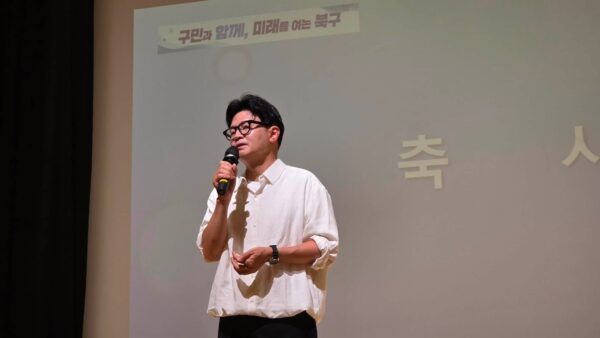
Rhyu Si-min, a former minister of health and welfare, has spent the past few decades building a reputation as one of South Korea’s most influential liberal commentators. Over the past several weeks, however, he shockingly has aimed that influence at President Lee Jae-myung – the leader his commentary once helped elect.
In a series of YouTube appearances since late June, Rhyu has argued that Lee is not merely tolerating the ruling Democratic Party’s drift toward the center but directing it. He compared the shift to the “reconstruction” of a building that displaced longtime residents without their consent and predicted that Lee would come out damaged and the party would descend into disarray.
Rhyu pressed further on July 21, saying that the informal bloc of Lee loyalists known as “New Lee Jae-myung” answers not to junior lawmakers but to the president himself. He argued that the disorder inside the party over the past year most likely traces back to a plan Lee set in motion from his first days in office. Rhyu also compared the presidential Blue House to a fish market that would start to smell of rot without outside scrutiny.
While accusing Lee of betraying his loyal supporters in the DP, Rhyu’s most detailed accusation concerns prosecutorial reform. He has argued that a stalled bill to fully separate police investigative power from prosecutorial indictment power remains unfinished because Lee himself wants prosecutors to keep some investigative authority, and that Lee has let allies absorb the criticism rather than explain the shift in his own voice. The presidential Blue House pushed back immediately, saying its commitment to full separation of investigation and indictment powers has never wavered.
The remarks have unsettled South Korea’s ruling party, which is already bracing for a leadership election on August 17. A group of pro-Lee lawmakers dismissed Rhyu as a false prophet. Two of the three contenders for the DP chair election – Kim Min-seok, Song Young-gil, and Jung Cheong-rae – have weighed in as well. Kim, a former prime minister for Lee and fourth-time lawmaker, pushed back by saying that Rhyu’s account of the president’s motives was not accurate. Song, a veteran lawmaker and former mayor of Incheon, also said Rhyu’s language crossed into curses and invective. However, Jung, the former leader of the DP, did not make any comments on Rhyu’s controversial remarks, showing his stance on this recent series of events.
To no one’s surprise, Rhyu has not backed down.
Rhyu, 66, first entered politics as a student activist at Seoul National University in the 1980s as part of the democratic movements against the military dictatorship. He later served two terms in the National Assembly and led the Ministry of Health and Welfare under President Roh Moo-hyun from 2006 to 2007.
After losing a series of races in the years that followed, he declared his retirement from electoral politics in 2013 and returned to writing, his first job. He is currently one of the best-selling authors in the country. Rhyu has also built a large following as a television debate panelist and one of the country’s most-watched YouTube commentators. He went on to chair the Roh Moo-hyun Foundation, a role that cemented his standing as a leading voice on Roh in the liberal bloc.
Using his role as a liberal thought leader, Rhyu was an active figure in the rise of Lee Jae-myung. Rhyu was a fixture on debate programs and YouTube broadcasts that helped consolidate liberal support behind Lee’s candidacy – and Rhyu has said so himself.
Why he has now turned that platform against the man he helped install? His own remarks – and the reactions they have provoked inside the liberal bloc – provide clues.
Rhyu has repeatedly framed his criticism as an insider’s disappointment rather than an outsider’s attack. He has said he still considers himself a Lee supporter and wants the president to succeed even as he insists Lee’s course will fail. That framing reflects a belief that his own advocacy carried real weight in Lee’s election and that he therefore has standing to correct a course he sees as reckless. When Lee’s approval ratings fell faster than the DP’s own, Rhyu pointed to that gap as evidence the president, not the party, bears responsibility.
Also, Rhyu has cast the conflict as a struggle between the party’s traditional base, rooted in the democracy movement of the 1980s and the Roh Moo-hyun–Moon Jae-in political lineage, and a newer bloc of centrist supporters who joined behind Lee. He argued that this newer group has spent months attacking the party’s core cells online, likening the discord as a kind of autoimmune disease. Rhyu pointed to personnel decisions as evidence of the rightward drift, arguing that officials who mock or distance themselves from former South Korean President Moon have been rewarded, starting with Lee’s pick to lead the personnel authority of the government. According to Rhyu, conservative figures have been brought into government in ways that leave it unclear whether the outreach is genuine or aimed at remaking the identity of the DP.
As a longtime figure in the Roh-Moon camp, Rhyu appears uneasy watching that lineage lose influence inside a party now led by Lee loyalists. It’s a bit ironic, then, that Rhyu is reportedly not a member of the DP, but an independent.
With that in mind, Rhyu’s commentary about Cho Kuk, the former justice minister for Moon and founder of the Rebuilding Korea Party, is noteworthy. Cho finished third in a June 3 by-election in Pyeongtaek, a race widely seen as winnable for the broader liberal bloc. Instead, the conservative candidate won, as the DP and Rebuilding Korea Party split the liberal vote. Cho stepped down as leader of his party over the loss. The defeat came after Jung failed to garner support within his party for a merger with Cho’s party.
Rhyu has treated that sequence as a warning sign for the DP’s future rather than a verdict on Cho’s own campaign. His sympathy for Cho, whom he has grouped with Moon, Jung and broadcaster Kim Ou-joon as targets of the same online attacks, suggests he sees rebuilding a path back to power for Cho as part of what is at stake in the current infighting.
Meanwhile, Rhyu’s most pointed remarks have landed just as the party’s leadership race has begun. Several of Rhyu’s own critics inside the party have suggested, without offering proof, that his commentary is meant to boost Jung’s standing at the expense of Lee-aligned rivals like Kim and Song. Rhyu has not confirmed that motive and he has said that he does not expect to win the argument so much as to put an uncomfortable truth on the record. Still, the proximity of his broadsides to the chair election has done little to quiet suspicion.
Whether any of these explanations is sufficient on its own is unclear. Rhyu himself has offered a simpler account: he believes Lee’s strategy will fail and he says so because no one else with his standing will. The DP’s leadership vote on August 17 is now about more than electing its next chair; the outcome will help demonstrate how much weight Rhyu’s warnings still carry with the base he helped build. If Jung becomes the next leader of the DP, it will be a clear message that even the president himself is not the core of the party – it’s those in the Roh-Moon lineage.