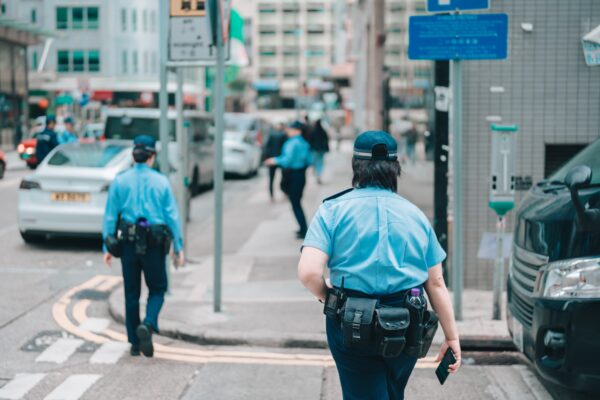
On July 15, the Hong Kong national security police raided two bookstores in Mong Kok: Have a Nice Stay (founded by former journalists) and Greenfield Bookstore. The police arrested five people on suspicion of selling seditious publications.
This falls into a larger pattern of national security operations against bookstores, with Book Punch and Hunter Bookstore being targeted in March and June, respectively. Book Punch and Hunter are well-known and established bookstores within Hong Kong, and the government cracking down on them sends a signal to all independently operated bookstores and civic spaces.
These raids represent a qualitative shift in the approach of the national security police, which had hitherto tolerated the existence of independent bookstores. The businesses in question were more than just bookstores; they functioned as semi-civic spaces, hosting typical events such as discussions and book talks but also yoga classes. Their function was to build and sustain a community, which became more difficult in Hong Kong amid the rapid breakdown of civil society following the 2020 National Security Law and the subsequent installation of a national security complex. The July 15 arrests were made under the 2024 Safeguarding National Security Ordinance, which broadly outlined internal and external threats.
Independent bookstores in Hong Kong have a long history of being political. Hong Kong stores and publishers often served as a gateway to sell sensitive books that were censored in the mainland. Memoirs of political figures, for example, could be bought in street stalls easily visible to tourists from Mainland China.
Not all independent bookstores have a political function, of course, but especially those founded in the wake of 2019 protests had a particular identity in mind. Many of them purposefully sought to foster an alternative civil society that became increasingly difficult to maintain. As I found in my research, they navigated Hong Kong’s national security clampdown starting in 2020 through delicate balancing acts such as the careful curation of books, community building, and calculated ambiguity.
The recent prosecutions, however, show that the boundary of acceptable behavior has shifted once again. The book store Have a Nice Stay had already announced its closure before the raid took place, citing “uncertain red lines.” When it becomes arguably impossible to adapt, a decade-old model of cultural resistance begins to fade away, with consequences for what remains of Hong Kong civil society.
For the authorities, there are benefits to maintaining what one could term strategic ambiguity. However, one might argue that even the national security police themselves do not know what or where the “red lines” are. Communities, civic spaces, and speech in Hong Kong will come under increasing examination as the government uses and ever-finer comb to find supposed threats. With the obvious targets out of the way, the range of what will be allowed seems set to shrink still further. Meanwhile, the police, whose budget has ballooned in the past years, need to justify their existence even as there is less and less to scrutinize.
The attention being paid to bookstores therefore shows a new development in the approach of the national security police toward perceived threats. Traditional loci of activism such as labor and student unions have already been dealt with in recent years, and now the gaze has shifted to spaces that are able to foster a sense of Hong Kong identity and society different from the one mandated by the government.
Independent bookstores are particularly suspect because of the wares that they sell. Books hold powerful ideas, including alternatives to the status quo, which authoritarian governments are wary of. As Hong Kong society draws closer to that of Mainland China, it must also align with the idea that society’s direction and future is solely in the hands of the government. Hong Kong’s independent bookstores, especially those that explicitly identified themselves with the pro-democratic ethos of the 2019 protest movement, are remnants of an old Hong Kong society where discussion about the direction of society was still possible in public.
These arrests must therefore be read as part of the larger integration of Hong Kong within the People’s Republic of China. Hong Kong was handed over to Beijing’s control in 1997, but full integration is scheduled to occur only by 2047, 50 years later. As Beijing prepares for that long-term goal, Hong Kong society and culture are currently being reconstructed.
This includes major projects such as the “patriots governing Hong Kong” election reforms as well as the patriotic education reforms. But it also includes more banal examples, such as mandating that the Chinese national anthem must be played before news broadcasts, or the fact that October 1, China’s national day, has been a public holiday since 1997. Other, more visible changes include the complete renovation of the Hong Kong Museum of History to include a national security component.
These laws, in combination with the encroaching national security complex, demarcate the path along which the government wishes to develop Hong Kong society – that is, its further integration with Mainland China. While economic concerns previously served as a brake on such reforms, the 2019 protests and subsequent reaction have shown that ideology and stability by whatever means take precedence over economic development and global alignment.
Hong Kong has come a long way from being the “goose that lays the golden eggs” that the Chinese Communist Party was careful not to touch. The current rhetoric is more one of a wayward child that has lost its way and needs a heavy hand and strict discipline to remember where it comes from. From the government’s perspective, the past decade has seen major unrest in the Umbrella movement and the 2019 protests, which the authorities described as a failed color revolution. No surprise, then, that they are acting to safeguard stability and national security – something that, as the government often emphasizes, many other countries do as well.
In the book “China’s Hong Kong,” Jiang Shigong, a well known legal scholar who worked for the Hong Kong Liaison office, the representative office of the PRC in Hong Kong, wrote that the British colonial period had altered the “deep consciousness and the psychological structure of the Hong Kong people, leading to their extreme fear of ‘the leftist,’ ‘the Communist Party,’ ‘the Mainland’ and ‘socialism.’” He argued that it is the task of the post-handover government to rectify these mistakes and make the Hong Kong people remember their “Chinese hearts and souls.”
The censure of independent bookstores – together with the assemblage of other measures taken to advance one sense of Hong Kong society, identity, history, and culture – are part of a larger campaign to re-align Hong Kong’s “hearts and souls.” The governments of Hong Kong and China appear determined to give only one option to Hong Kongers: to remember their “Chinese heart” and fall in line in a new society under the auspices of national security, where the only way forward is the one offered by the government.