Since the start of 2026, few capitals have seen more diplomatic traffic than Beijing. A non-stop stream of world leaders has arrived seeking to deepen or recalibrate relations with China. Beyond the most headline-grabbing visits by U.S. President Donald Trump and Russian President Vladimir Putin, leaders from Canada, the United Kingdom, Spain, Uruguay, Ireland, South Korea, Vietnam, Serbia, and the United Arab Emirates, among others, have all made their way to China with distinct objectives in mind.
This burst of diplomatic engagement has take place against a backdrop of mounting global uncertainty caused by trade disputes, geopolitical tensions, and supply chain disruptions. As one of the world’s largest trading nations, home to some of the most complete industrial and manufacturing ecosystems, and a key node in global supply chains, the appeal of China is clear.
Yet this global trend has received far less attention for its implications for Africa, even as African leaders and senior officials – including Mozambique’s President Daniel Chapo, Liberia’s Foreign Minister Sara Beysolow Nyanti, Seychelles’ Foreign Minister Barry Faure, and South Africa’s Deputy President Paulus Mashatile – have also traveled to China this year.
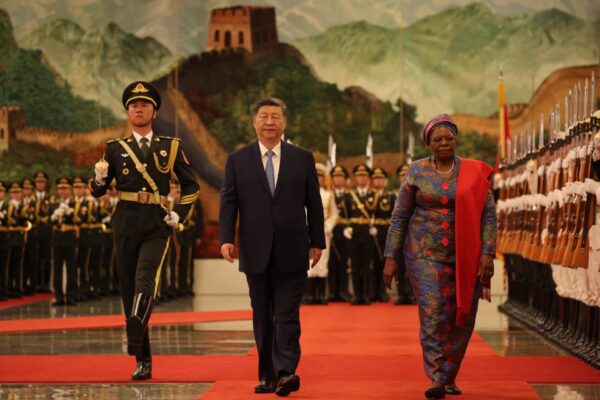
African governments cannot assume that the diplomatic status quo will remain unchanged. The most recent visit by President Netumbo Nandi-Ndaitwah from Namibia – a country of about 3.1 million people in the western corner of southern Africa – provides a useful lens through which to examine how African countries can strengthen their development objectives in this increasingly competitive diplomatic environment.
Nandi-Ndaitwah made China one of her first major international destinations after taking office, helping to maintain momentum from previous administrations, strengthen relationships with Chinese counterparts, and reassure investors that long-term cooperation remains a priority.
More importantly, Nandi-Ndaitwah brought with her a clear agenda.
The first notable feature of her visit was the structure of the itinerary itself. The Namibian delegation began their week-long journey in Guangdong and Sichuan provinces before concluding in the capital. This approach was significant because the selected destinations were closely connected to China’s regional strengths and Namibia’s own development priorities. Guangdong, China’s leading province by economic output and a pioneer of the “reform and opening up” policy, provided exposure to one of the country’s most dynamic manufacturing, technology, and business ecosystems.
In Sichuan, the delegation’s visit to local agricultural research facilities reflected Namibia’s interest in practical solutions to food security challenges, including drought-resistant crop varieties, agricultural technology, and modern farming equipment. The province has already been involved in advancing cooperation with Namibia in areas such as lithium resource development, biomass power projects, and green ammonia initiatives.
Second, local processing and value addition emerged as recurring themes throughout the visit. A notable example was Nandi-Ndaitwah’s delegation’s tour of the Daya Bay Nuclear Power Base in Shenzhen, which is managed by China General Nuclear Power Corporation, the operator of Namibia’s Husab Uranium Mine – one of China’s largest single industrial investments in Africa.
Importantly, Namibia’s interest extends beyond attracting investment in resource extraction. The delegation used the visit to explore opportunities for greater domestic value addition, including seeking Chinese support to develop local uranium processing and enrichment capabilities. This reflects a broader shift in African countries’ expectations of China, from supplying it with raw materials to participating more deeply in global value chains through industrial upgrading and technology cooperation.
Namibia has positioned green hydrogen as a strategic pillar of its green industrialization agenda, seeking to leverage renewable energy resources for domestic value addition and industrial transformation. While Europe has become a key partner, progress in aligning European investment with Namibia’s broader industrialization ambitions has been slower than anticipated. To date, most large commercial initiatives have remained primarily export-oriented, with comparatively limited investment in downstream manufacturing and domestic value chains relative to Namibia’s stated objectives.
Hence, Namibia ensured this priority was elevated during Nandi-Ndaitwah’s meeting with President Xi Jinping n Beijing, and green hydrogen featured as a new strategic area for future bilateral cooperation. During the visit, Nandi-Ndaitwah also held discussions with representatives from China National Chemical Engineering Corporation in Sichuan, building upon existing cooperation with Namibia’s Hyphen Hydrogen Energy. The discussions further sought to accelerate the implementation of a 2025 signed Front-End Engineering Design (FEED) and an Engineering, Procurement, and Construction (EPC) contract for a green ammonia facility with an annual production capacity of 2.4 million tonnes.
For context, it should be noted that the FEED and EPC contract are on par with the comprehensive cooperation agreement between Mozambique and China. In that relationship, Mozambique’s Rovuma Basin and its 5 trillion cubic meters of natural gas, along with significant deposits of critical minerals, drives cooperation in security, local processing capacity, and value chain boosting.
In these two special ways – ensuring a “beyond Beijing,” implementation-focused agenda and the intentionality behind the visit – Namibia demonstrated that it was not engaging with China from a position of weakness. The structure of the agreements, the sectors prioritized, and the language of mutual modernization and local value addition collectively indicate an awareness that Namibia’s leverage lies not only in attracting Chinese capital but in helping China achieve objectives it already has – whether securing critical mineral supply chains or advancing green technologies. Namibia increasingly frames the relationship as one of mutual strategic utility rather than one-way economic assistance.
The 2024 FOCAC Summit elevated China’s relations with all African countries maintaining diplomatic ties with Beijing to the level of “strategic relations,” providing an important institutional foundation for future cooperation. However, institutional ties alone do not guarantee outcomes. The challenge is how African governments can ensure that engagement translates into tangible development gains.
One of the strongest messages African governments can bring to Beijing is that Africa is not merely seeking investment or aid; it can also help China advance its own strategic objectives. As China seeks to diversify its economic relationships and reduce overdependence on any single supplier, market, or region, Africa’s resource endowments, growing markets, and industrial potential create opportunities for deeper cooperation. Moreover, many African countries retain greater policy autonomy than regions where relations with China are increasingly shaped by geopolitical competition. This flexibility is a distinctive advantage, enabling African countries to pursue cooperation with China on terms aligned with their own development priorities.
With preparations for the next phase of China–Africa cooperation already underway, with the Republic of the Congo in the helm as FOCAC co-chair for 2027, opportunities to shape future agenda are emerging. Countries that approach China with clear priorities, concrete projects, and sector-specific proposals will be better positioned to shape the direction of cooperation.