
Remember me

The South Korean high speed network faces significant constraints both in terms of available seats and track capacity. Benjámin Zelki examines the steps the country is taking to ensure growth can be delivered in the future.
The South Korean high speed rail network is struggling to meet huge demand, with the busiest section between Pyeongtaek and Osong carrying more than 180 000 passengers a day.
The clearest sign of the capacity challenge is that train tickets for the busiest periods regularly sell out, sometimes up to two weeks ahead. This is most common on the route linking the Suseo terminus in southeast Seoul with the second-largest city, Busan, where trains are currently run by part-privatised operator Supreme Railways.
To tackle the challenge in the short-term, the Ministry of Land, Infrastructure & Transport announced its Dual High Speed Railway Integration Roadmap in December 2025, with the intention of merging SR into incumbent national operator Korail by the end of this year.
The ministry claims that the merger will increase seat capacity by about 6% on high speed services across the country. It would allow Korail to introduce more off-peak services, and to run longer 20-car trains to and from Suseo at peak times. The merger is also intended to facilitate the creation of an integrated payment and ticketing platform.
Until February, Korail’s KTX and SR’s SRT services served different termini at the Seoul end of the main north-south high speed rail axis; Korail trains ran to and from Seoul station, while Supreme Railways used Suseo.
Coupling upMay 15 brought one of the first tangible signs of progress with the amalgamation. The two operators started running revenue services formed of two trainsets in multiple, with each operator providing one half of the formation.
A KTX-Sancheon trainset was coupled to an SRT rake to work a Suseo – Gwangju-Songjeong service, while on the same day the diagram for a KTX train on the Seoul – Busan route was modified from a pair of Korail trainsets to a mixed pair. These operations are intended to test interoperability between the two fleets, as well as communications, braking and emergency control systems.
 Korail and SR started running revenue services formed of two trainsets in multiple, with each operator providing one half of the formation.
The first steps towards the merger started with a timetable recast on February 25, when one pair of trains per day from each operator started using the alternative station in the capital: an SR train from Busan started to run to and from Seoul station, while a KTX service started running between Busan and Suseo.
Second double-trackHowever, the ministry’s measures to manage the capacity crunch are not limited to operations.
A more fundamental step is the decision to duplicate a section of the main north-south high speed line between Pyeongtaek and Osong, where trains to and from Seoul station share tracks with those serving Suseo, and the line is now saturated.

The 46.9 km line will provide a second pair of tracks between the two key junctions. Work started in June 2023, and opening is scheduled for 2028. Being built close to the existing line, the new alignment includes a 34 km tunnel and 6·3 km of bridges. It will have a design speed of 400 km/h, whereas the existing line is operated at up to 300 km/h.
Budgeted at 3·18tr won, the project is expected to increase the capacity of this section from 190 to 380 trains per day in each direction.
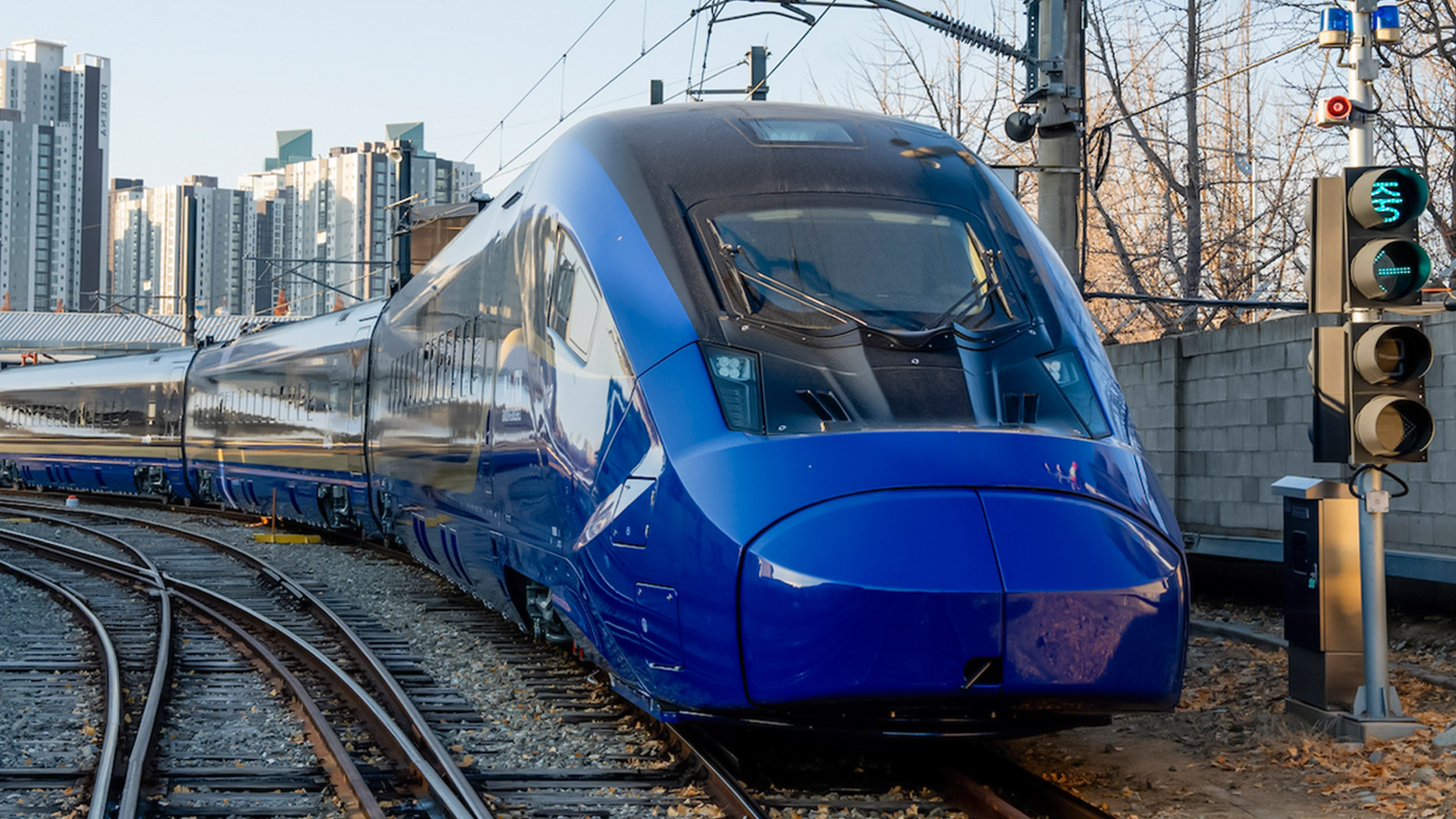
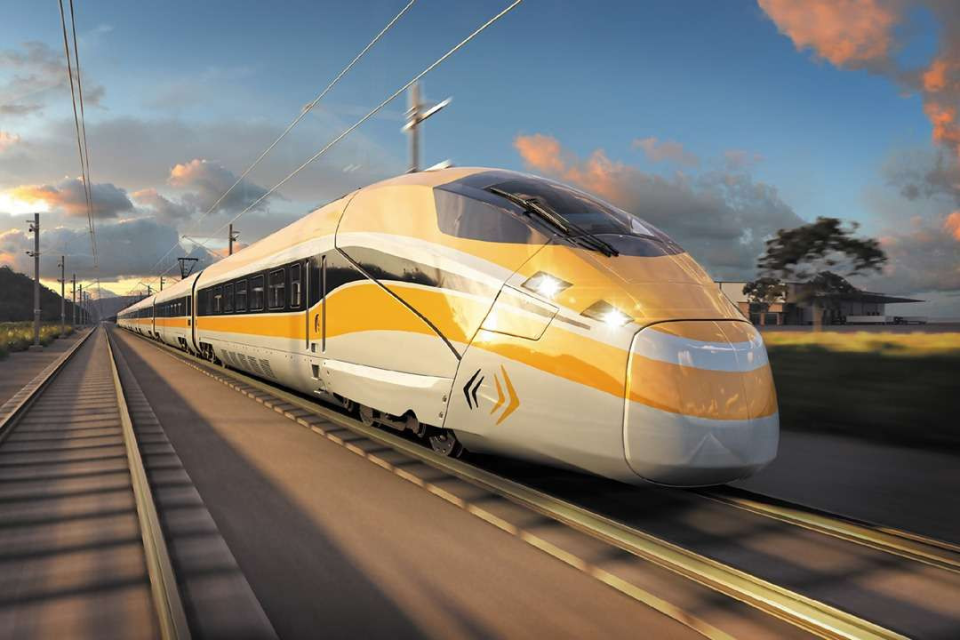
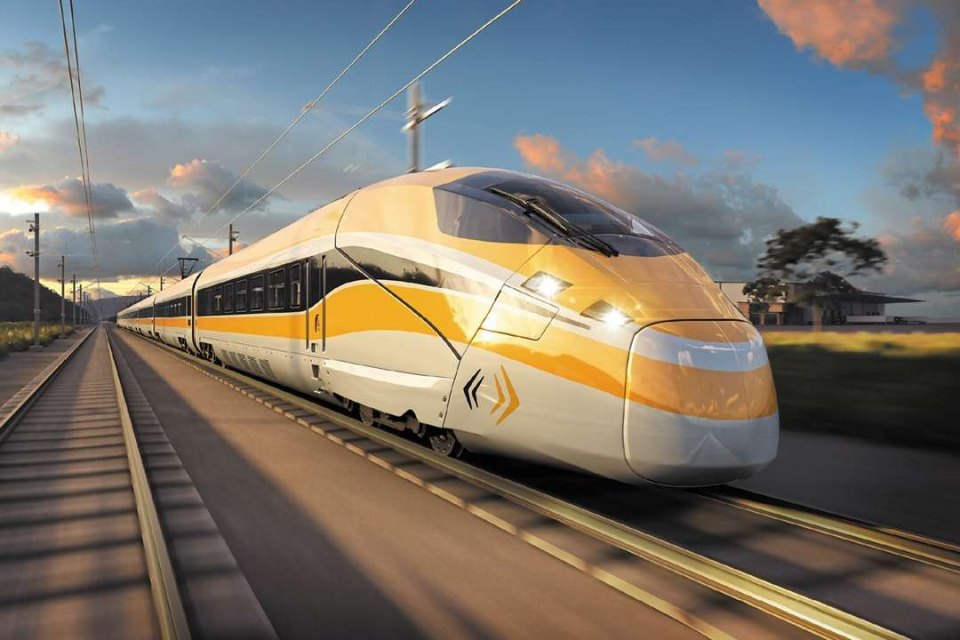
New rolling stock next yearAnother element of the capacity constraint is the number of high speed trains available to the two operators. To tackle this, Hyundai Rotem has been awarded contracts to supply 31 eight-car EMU-320 high speed trainsets for both companies.
 Designated as KTX-CheongRyong for Korail, two pre-production EMU-320s entered service in May 2024.
Two pre-production EMU-320 units ordered by Korail in 2016 entered service in May 2024, designated as as KTX-CheongRyong. A first batch of 17 series-built trains was ordered by Korail under a 710bn won contract placed in March 2023, while SR ordered 14 similar sets the following month, for 1·09tr won including 15 years of maintenance.
Derived from the HEMU-430X prototype developed by Hyundai Rotem and Korea Railroad Research Institute in 2012, the EMU-320 is designed for a maximum speed of 320 km/h.
Hyundai Rotem unveiled the first of the production build of EMU-320s at its Changwon facility in October 2025. That train was destined for SR, while the manufacturer delivered the first of the series-built fleet for Korail in January.
The second-generation vehicles are now undertaking test runs, and are scheduled to enter service from next year. The two operators confirmed on June 9 that the combined fleet of 31 trains would be operated jointly.
Korail announced a further planned procurement of 49 EMU-320 high speed trainsets in July at an estimated cost of 5tr won.
 Hyundai Rotem unveiled the first of the production build of EMU-320s in October 2025 for SR.
The procurement is intended to allow replacement of the operator’s 46 first-generation KTX-I trainsets. Derived from French TGV designs, these were built by Alstom and Rotem between 1997 and 2003 and will begin reaching the end of their planned service life from 2033.
Island linkMeanwhile, South Korea is making progress on the extension of its high speed network beyond the existing footprint.
The expansion programme is led by the 174·6 km new line linking Gimcheon at the intersection of the Seoul – Busan high speed line and the Central Inland Line with the island city of Geoje. Construction of this line started on February 3, with the project cost estimated at 7·097tr won.
Designed for 250 km/h running, the single-track Southern Inland Line will plug Geoje into the national rail network, and will feature South Korea’s first undersea rail tunnel. The 2·1 km fixed link would run to the island from Tongyeong on the mainland.
The line will also offer a more direct route for trains from Seoul to Masan and Jinju, significantly shorter than the current route via Samnangjin. It is expected to cut journey times from the current 3 h 30 min to 2 h 20 min.
Mokpo link delayedThe other major construction project now underway is the second section of the Honam high speed line between Gwangju-Songjeong and Mokpo in the southwest corner of the country.
 Korail and SR started running revenue services formed of two trainsets in multiple, with each operator providing one half of the formation.
As the first stage of the project, the 26·4 km conventional line between Gwangju-Songjeong and Gomakwon was upgraded for 230 km/h running by the end of 2019. For the second phase, 44 km of new alignment is now being built from Gomakwon to Imseong-ri on the outskirts of Mokpo. Rather than following the historic route via Naju, this will serve Muan International Airport.
Work began in August 2021 and was scheduled to be completed in December 2025, but by that point reports suggested that only 50% of the civil works had been completed.
370 km/h trainsetMeanwhile, the country’s rail sector remains determined to deliver higher speeds and shorter journey times. A research project to develop the technologies required for the next generation of rolling stock able to run at a commercial speed of 370 km/h was completed in December 2025.
 In July, Korail announced that it is to take delivery of an initial EMU-370 trainset in 2032.
The project to develop the EMU-370 started in April 2022 as part of a 22·5bn won national research and development programme led by Korea Railroad Research Institute. A further six state-owned and private companies participated including Hyundai Rotem, train vehicle control system specialist Intercon Systems, and Korail. Funding worth 18bn won was provided by the national government, and 4·5bn won by the private sector.
The EMU-370 is designed to reach a maximum speed of 407 km/h, but the project partners have indicated that the train would be limited to 370 km/h in revenue service.
In July, Korail announced that it is to take delivery of an initial EMU-370 trainset in 2032.

This article first appeared in the July 2026 issue of Railway Gazette International
See also


Already have a subscription? Log in.
Choose your subscription Most popular! Digital Onlyi Prices are displayed as monthly rates (exc. VAT), but billed annually. Please refer to our subscription terms for more details.
€18,17 per month per user *
£15.75 per month per user *
$19.17 per month per user *
Unlimited access to all Railway Gazette content Monthly digital Railway Gazette International Magazine 2000+ Operator Profiles Newsletters & Breaking News Updates Subscribe with 1, 3, or 5 user logins Digital + Printi Prices are displayed as monthly rates (exc. VAT), but billed annually. Please refer to our subscription terms for more details.
€25,67 per month per user *
£22.33 per month per user *
$26.67 per month per user *
Monthly print Railway Gazette International Magazine Unlimited access to all Railway Gazette content Monthly digital Railway Gazette International Magazine 2000+ Operator Profiles Newsletters & Breaking News Updates Subscribe now ›Considering a corporate subscription? Contact us to find out more.